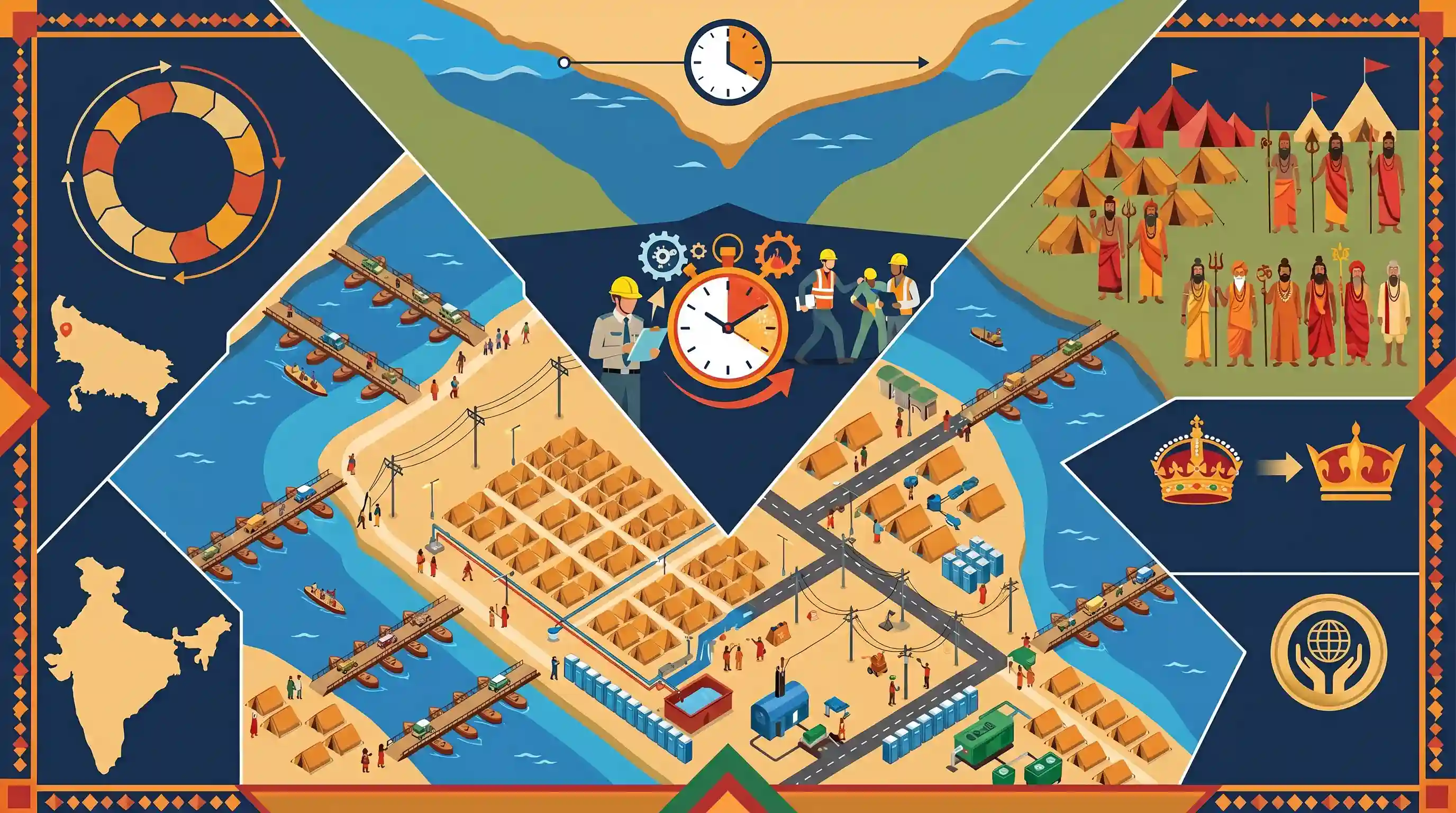
Prayagraj tent city preparations for Maha Kumbh in Uttar Pradesh
Source:indianexpress ↗
Why It Matters
The Maha Kumbh Mela represents the world's largest peaceful human gathering and is a critical cultural and administrative event for Uttar Pradesh. UPPSC frequently tests the cultural history of India, regional river geography (such as confluences and tributaries of the Ganga-Yamuna system), and specific Kumbh details (like the recent 2025 UPPSC Prelims question on the Pushkar Kumbh in Uttarakhand).
Summary
The article highlights the massive administrative and logistical preparations in Prayagraj for the Maha Kumbh 2025. Facing delayed receding of floodwaters in the Ganga and Yamuna, the Prayagraj Mela Authority raced against time to construct a temporary 4,000-hectare tent city. Key infrastructural works included over 30 pontoon bridges, roads, electricity, and sanitation facilities. The event is culturally significant for its 12-year cycle, the role of Akharas, and recent updates such as renaming 'Shahi Snan' to 'Rajasi Snan' and UNESCO's recognition of Kumbh as Intangible Cultural Heritage.
Key Points
- The Maha Kumbh 2025 in Prayagraj involved setting up a massive temporary tent city across 4,000 hectares, divided into 25 administrative sectors to accommodate over 40 crore expected pilgrims.
- A delayed receding of water levels in the Ganga and Yamuna due to late-season monsoons in late 2024 left the banks submerged, compressing the preparation window and creating a logistical 'race against time' for laying roads, pontoon bridges, and setting up tents.
- Over 30 temporary pontoon bridges, thousands of kilometers of pipelines, temporary power grids, and more than 1.5 lakh eco-toilets were installed to manage the world's largest gathering under the 'Clean Kumbh, Safe Kumbh' initiative.
- The Uttar Pradesh government and the Akhil Bharatiya Akhara Parishad (ABAP) officially agreed to rename the traditional 'Shahi Snan' (Royal Bath) to 'Rajasi Snan' or 'Sanskriti Snan' to distance the tradition from Mughal-era terminology.
- The Kumbh Mela is celebrated on a 12-year cycle at four sacred locations in India: Prayagraj (confluence of Ganga, Yamuna, and mythical Saraswati), Haridwar (Ganga), Ujjain (Shipra), and Nashik (Godavari). It was inscribed on UNESCO's Intangible Cultural Heritage list in 2017.
Important Terms
UNESCO Representative List of the Intangible Cultural Heritage of Humanity

A global registry established under UNESCO's 2003 Convention to safeguard and raise awareness about living traditions, performing arts, oral expressions, and cultural practices worldwide, such as India's Kumbh Mela.
UPSC context
GS Paper I (Art & Culture); tests knowledge of international conservation mechanisms and globally recognized living traditions.
Akhil Bharatiya Akhara Parishad (ABAP)
The apex governing body established in 1914 that regulates and represents the 13 traditional Hindu monastic orders (akharas) in India, coordinating their participation in major Kumbh Melas.
UPSC context
GS Paper I (Indian Society); tests awareness of traditional monastic orders, religious institutions, and socio-cultural governance.
Prayagraj Mela Authority
A statutory body established by the Government of Uttar Pradesh under a 2017 Act to plan, coordinate, and execute massive religious congregations like the Maha Kumbh, Kumbh, and Magh Melas.
UPSC context
GS Paper II (Governance) & UPPSC; tests knowledge of administrative bodies, municipal governance, and public safety in mega-events.
UNESCO
A specialized United Nations agency established in 1945 to promote global peace, security, and sustainable development through international cooperation in education, science, culture, and communication.
UPSC context
GS Paper II (International Relations); tests understanding of UN specialized bodies, international multilateral organizations, and cultural mandates.
Prelims Trap
The Pushkar Kumbh Mela 2025 was celebrated in the holy town of Pushkar in Rajasthan, famous for its Brahma temple.
The Pushkar Kumbh 2025 was actually held at Keshav Prayag in Mana village, Uttarakhand (Alaknanda-Saraswati confluence), not in Rajasthan's Pushkar.
Static Concepts Connected
What are the geographical confluences (Prayags) of the Alaknanda river system?
- Panch Prayag: Consists of Vishnuprayag (Dhauliganga), Nandaprayag (Nandakini), Karnaprayag (Pindar), Rudraprayag (Mandakini), and Devprayag (Bhagirathi, forming the Ganga).
- Keshav Prayag: Located in Mana (Uttarakhand), it is the confluence of Alaknanda and Saraswati rivers, hosting the unique Pushkar Kumbh in 2025.
What is the mandate and composition of UNESCO's Intangible Cultural Heritage list?
- Safeguarding objective: Under the 2003 Convention, it safeguards oral traditions, performing arts, social practices, rituals, festive events, and traditional craftsmanship.
- Indian representation: India has 15 elements inscribed, including Kumbh Mela (2017), Durga Puja (2021), and Garba of Gujarat (2023).
Cross-Topic Patterns
Crowd management and public health logistics
Links NDMA mass-gathering guidelines to seasonal river-flow dynamics, temporary sanitative infrastructure, and epidemiological surveillance on active floodplains.
State administration and cultural decolonization
Examines the policy shifts replacing Persianate and Mughal-era administrative/courtly vocabulary ('Shahi'/'Peshwai') with Sanskritized heritage terminology in state-sponsored events.

Maha Kumbh 2025's astronomical alignments or the distinct Pushkar Kumbh in Uttarakhand will likely feature in a tricky Art & Culture MCQ.
Linked PYQs · 2
Linked PYQs · 2
- 2025UPPSC_PRELIMSGS1
Pushkar Kumbh Mela 2025 was held in May 2025 in which of the following State(s)? 1. Rajasthan 2. Uttar Pradesh 3. Uttarakhand Select the correct answer from the code given below :
- 2023UPPSC_PRELIMSGS1
Which of the following statement is correct? (1) Ram Ganga river joins the Ganga at Kannauj. (2) River Betwa joins the Yamuna near Prayagraj. Select the correct answer using the code given below –
