Vasai Virar Faces Severe Climate Vulnerability Amid Rapid Urbanisation
Source:The Hindu ↗
Why It Matters
This article acts as an excellent case study on the conflict between rapid infrastructure development and environmental conservation in coastal urban areas. It provides concrete examples for Mains answers on urban flooding, climate justice, reclamation of wetlands, and the environmental impacts of urbanisation.
Summary
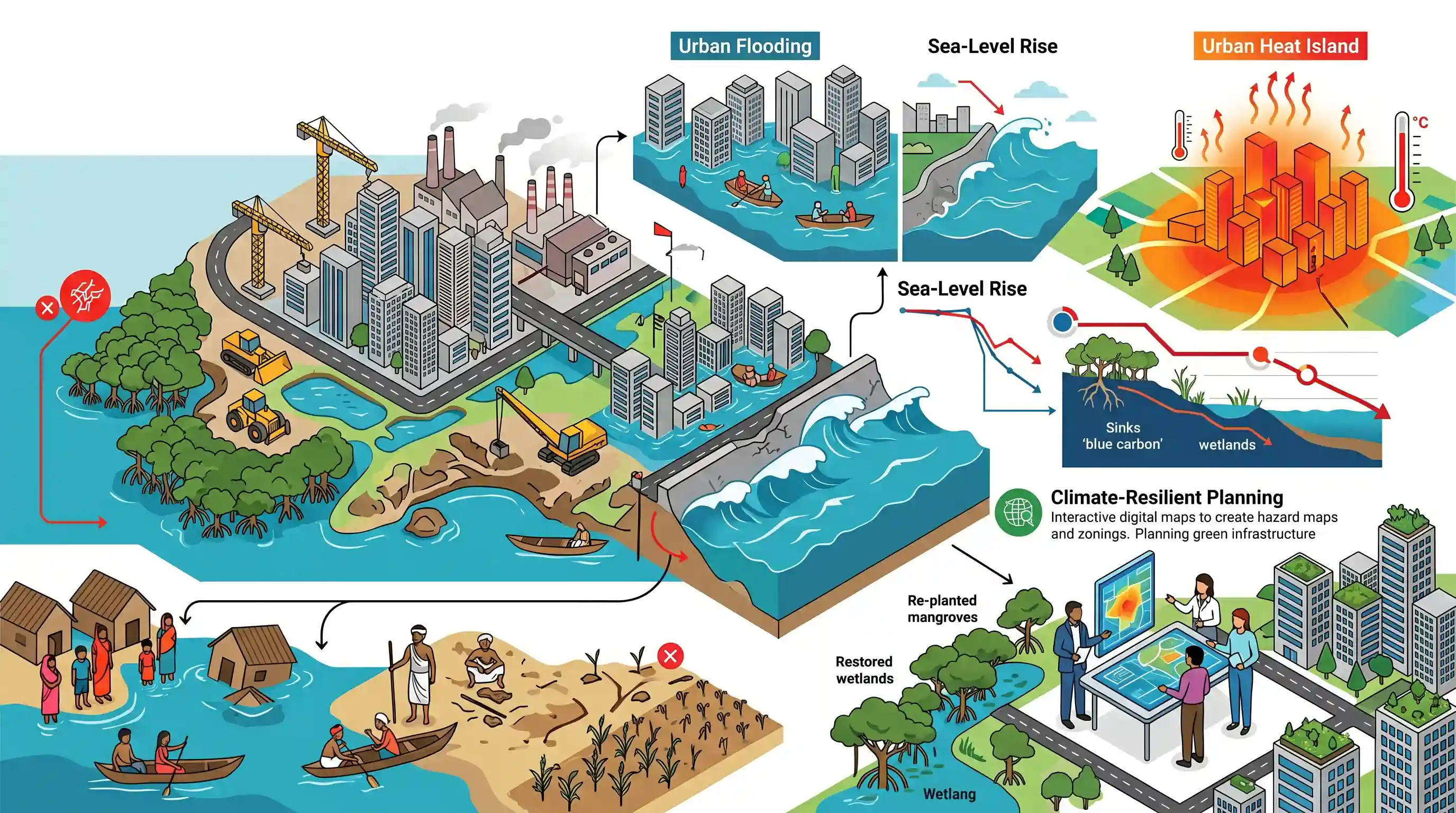
Ahead of the upcoming COP30 in Brazil, the coastal tier-2 city of Vasai-Virar in the Mumbai Metropolitan Region (MMR) is facing escalating climate risks driven by rapid, unplanned urbanisation. Large-scale infrastructure projects are encroaching upon critical natural buffers like mangroves and wetlands, exacerbating vulnerabilities to urban flooding, sea-level rise, and urban heat island effects. Local studies and the IPCC Sixth Assessment Report highlight the severe ecological degradation and loss of "blue carbon" sinks. These environmental changes are disproportionately affecting marginalized indigenous communities and local farmers, underscoring the urgent need to integrate climate-resilient planning and hazard mapping into regional development frameworks.
Key Points
- Rapid unplanned urbanisation and major infrastructure projects (like the Mumbai-Ahmedabad bullet train) in Vasai-Virar are severely destroying essential natural buffers such as mangroves, salt pans, and wetlands.
- A study by YUVA and discussions at the \'Climate Parishad 2025\' reveal rising Land Surface Temperatures (LST) and increased urban heat stress in the region due to expanding built-up areas.
- The IPCC Sixth Assessment Report warns that coastal areas in the Mumbai Metropolitan Region are becoming increasingly vulnerable to sea-level rise and flooding due to the degradation of \'blue carbon\' ecosystems.
- Environmental degradation is disproportionately impacting marginalised communities, particularly local Adivasi farmers, who are facing livelihood loss, water scarcity (disruption of traditional \'bawkhal\' systems), and food insecurity.
- Ahead of COP30 in Brazil, experts advocate for integrating climate hazard mapping into urban master plans to ensure sustainable and climate-resilient development for coastal tier-2 cities.
Important Terms
COP30

The 30th United Nations Climate Change Conference, scheduled for November 2025 in Belém, Brazil. It serves as a critical milestone for nations to submit updated 2035 Nationally Determined Contributions (NDCs).
UPSC context
GS-III (Environment). Tests international climate governance, global diplomacy, and implementation of the Paris Agreement.
IPCC (Intergovernmental Panel on Climate Change)
An intergovernmental UN body (WMO/UNEP) that assesses the science of climate change. It produces periodic Assessment Reports (AR) that form the scientific basis for global climate negotiations.
UPSC context
GS-III (Environment). Essential for scientific frameworks informing policy, mitigation, and adaptation strategies.
UNFCCC (United Nations Framework Convention on Climate Change)
The primary international treaty (1992) aimed at stabilizing greenhouse gas concentrations. It provides the framework for global climate agreements like the Kyoto Protocol and Paris Agreement.
UPSC context
GS-III (Environment). Core topic for international conventions and the principle of 'Common but Differentiated Responsibilities'.
Blue Carbon
Organic carbon captured and sequestered by coastal and marine ecosystems like mangroves, seagrasses, and salt marshes. These act as highly efficient carbon sinks compared to terrestrial forests.
UPSC context
GS-III (Environment). Tests knowledge of carbon sequestration, biodiversity, and coastal ecosystem services.
Urban Heat Island (UHI)
A localized warming phenomenon where urban areas experience higher temperatures than surrounding rural areas due to concrete density, waste heat, and reduced vegetation cover.
UPSC context
GS-I (Geography) and GS-III (Environment). Tests urbanization challenges, micro-climates, and sustainable urban planning.
Mumbai-Ahmedabad Bullet Train Project
India's first high-speed rail corridor (MAHSR). It faces environmental scrutiny in the Mumbai Metropolitan Region for encroaching upon mangroves and disrupting local indigenous and fishing communities.
UPSC context
GS-III (Infrastructure/Environment). Examines the trade-offs between developmental infrastructure and ecological conservation in sensitive zones.
Youth for Unity and Voluntary Action (YUVA)
A leading non-profit organization in India focused on urban poverty, housing rights, and youth empowerment. It works closely with marginalized communities to advocate for inclusive urban planning.
UPSC context
GS-II (Social Justice/NGOs). Represents civil society's role in advocating for the rights of marginalized urban populations.
Prelims Trap
"Bawkhal is a traditional rainwater harvesting system used by indigenous communities in the arid regions of Rajasthan."
Bawkhal is actually a coastal pond and well system unique to the Vasai-Virar region of Maharashtra, historically crucial for preventing saltwater intrusion into groundwater.
Static Concepts Connected
What constitute 'Blue Carbon' ecosystems and why are they significant?
- Definition: Carbon captured and stored by the world's coastal and marine ecosystems.
- Key Ecosystems: Mangroves, tidal/salt marshes, and seagrass meadows are the primary natural sinks.
- Significance: They sequester carbon at much faster rates than terrestrial forests and act as critical natural buffers against coastal flooding and storm surges.
What factors contribute to the Urban Heat Island (UHI) effect?
- Surface Modification: Replacement of natural vegetation with concrete and asphalt, which absorb and retain significantly more solar radiation.
- Anthropogenic Heat: Heat generated from human activities, including ACs, vehicular emissions, and industrial processes.
- Canyon Effect: Tall buildings trap heat and reduce wind speeds, creating an "urban canyon" effect that prevents natural cooling.
Cross-Topic Patterns
Coastal Infrastructure & Maladaptation
IPCC's AR6 explicitly warns that hard coastal infrastructure can be "maladaptive" by destroying natural buffers like mangroves, linking Disaster Management directly with Environmental Impact Assessments and CRZ rules.
Traditional Water Harvesting Systems
UPSC frequently tests local ecological knowledge. 'Bawkhal' (Maharashtra) joins the ranks of 'Johad' (Rajasthan), 'Khatri' (Himachal), and 'Surangam' (Kerala) as high-probability pairs for Prelims.

Expect a Mains 2026 question linking IPCC AR6 'maladaptation' warnings with coastal infrastructure projects and urban flooding.
Linked PYQs · 5
Linked PYQs · 5
- 2024MainsGS3
Flooding in urban areas is an emerging climate-induced disaster. Discuss the causes of this disaster. Mention the features of two such major floods in the last two decades in India. Describe the policies and frameworks in India that aim at tackling such floods.
- 2016MainsGS1
Major cities of India are becoming more vulnerable to flood conditions. Discuss.
- 2021MainsGS1
What are the environmental implications of the reclamation of water bodies into urban land use ? Explain with examples.
- 2025MainsGS1
How are climate change and the sea level rise affecting the very existence of many island nations? Discuss with examples.
- 2025MainsGS1
Achieving sustainable growth with emphasis on environmental protection could come into conflict with poor people's needs in a country like India – Comment.
