Moon titanium rocks decoded by IIT and PRL for lunar missions
Source:The Hindu ↗
Why It Matters
Demonstrates India's growing indigenous capabilities in planetary science and provides foundational knowledge for the upcoming Chandrayaan-4 mission, highly relevant for the Space Technology section of GS Paper 3.
Summary
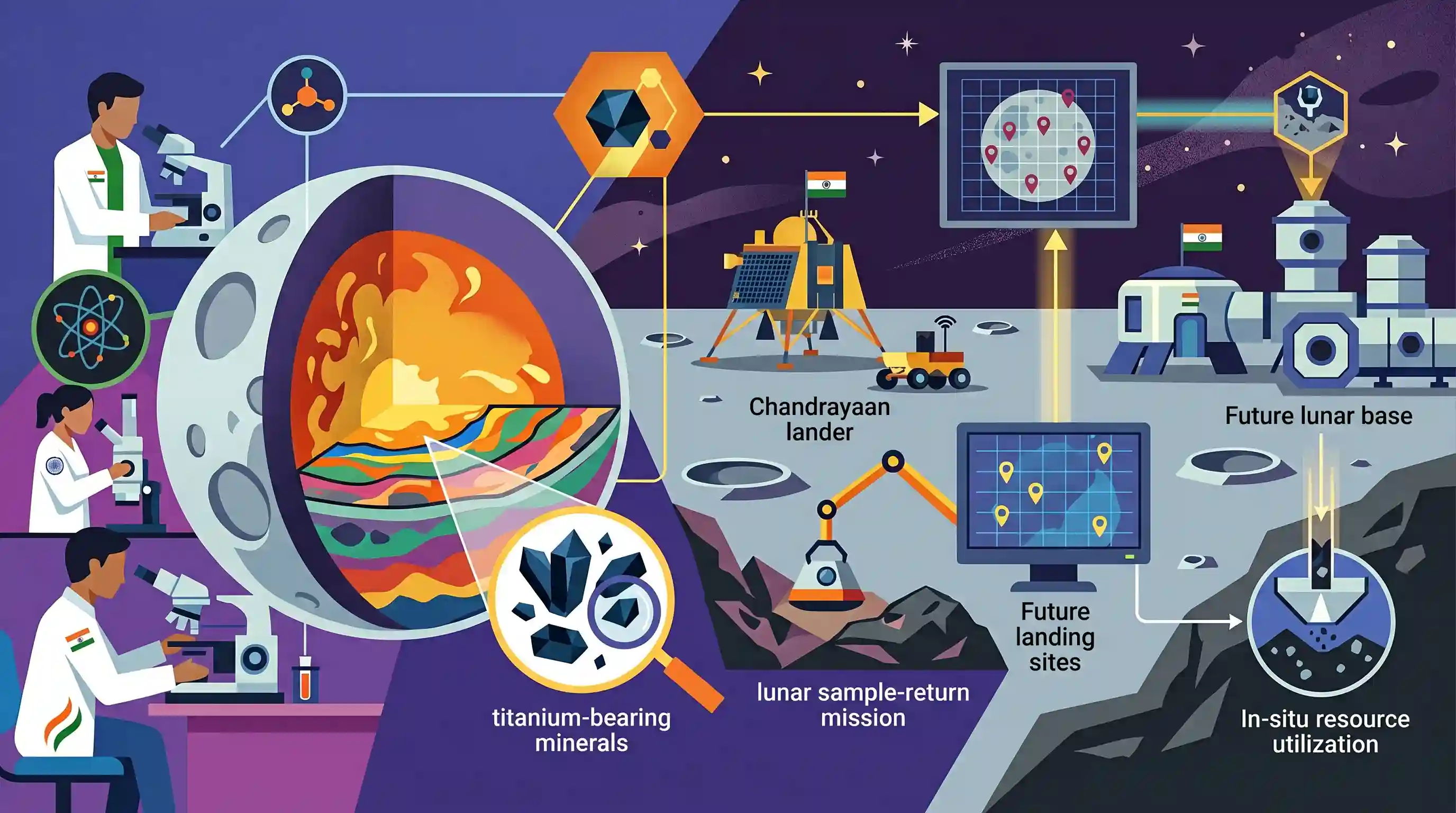
Ahead of India's ambitious Chandrayaan-4 lunar sample-return mission, researchers from an Indian Institute of Technology (IIT) and the Physical Research Laboratory (PRL) have successfully decoded the complex origin of titanium-rich rocks on the Moon. The study provides new insights into the lunar magma ocean and the formation of titanium-bearing minerals like ilmenite. By understanding the geological history and mineral distribution of the lunar surface, ISRO can better plan future landing sites and lay the groundwork for in-situ resource utilization during upcoming space exploration endeavors.
Key Points
- A joint research team from IIT and the Physical Research Laboratory (PRL) has decoded the origins of titanium-rich rocks (basalts) on the Moon.
- The study sheds light on the cooling and crystallization of the ancient lunar magma ocean and the formation of ilmenite, a titanium-iron oxide mineral.
- These findings provide crucial geological context ahead of the Chandrayaan-4 mission, which is designed as India's first lunar sample-return mission.
- Understanding lunar mineral distribution helps scientists select optimal landing sites for future missions and evaluate the Moon's in-situ resource utilization potential.
Important Terms
Chandrayaan-4

India's upcoming lunar sample-return mission (targeted ~2028). It aims to collect lunar rocks and return them to Earth, demonstrating technologies like orbital docking and atmospheric re-entry.
UPSC context
GS Paper III (Science & Tech): Key mission for India's aim to land humans on the Moon by 2040.
Ilmenite
A titanium-iron oxide mineral ($FeTiO_3$) found in lunar basalts. It is a primary source of titanium and a vital resource for producing oxygen and iron on the Moon.
UPSC context
GS Paper I (Geography) & GS III (Resources): Significant for mineral distribution and space-based resource extraction.
Lunar Magma Ocean (LMO)
A scientific theory stating the early Moon's surface was entirely molten. Cooling of this 'ocean' led to the Moon's layered structure and the formation of titanium-rich minerals.
UPSC context
GS Paper III (Science & Tech): Foundational theory for planetary geology and understanding lunar evolution.
In-situ Resource Utilization (ISRU)
The practice of harvesting and using local materials (e.g., water, minerals) on celestial bodies to support missions. It reduces launch costs and dependency on Earth-based supplies.
UPSC context
GS Paper III (Science & Tech): Essential strategy for sustainable space exploration and long-term lunar settlements.
Physical Research Laboratory (PRL)
An autonomous research institute under India’s Department of Space (Ahmedabad). It conducts fundamental research in space, planetary, and solar sciences, supporting ISRO missions.
UPSC context
GS Paper III (Science & Tech): Major Indian scientific institution involved in indigenous space research.
Sample-return mission
A type of space mission designed to collect samples (rock, dust, or gas) from an extraterrestrial body and return them safely to Earth for laboratory analysis.
UPSC context
GS Paper III (Science & Tech): Tests advanced engineering capabilities like lunar lift-off and sample containerization.
Prelims Trap
"Ilmenite is a rare extra-terrestrial mineral found exclusively on the lunar surface."
Ilmenite is not exclusive to space. It is a major titanium ore naturally abundant in Earth's crust, prominently found in India's coastal heavy mineral sands.
Static Concepts Connected
What are the key minerals found in India's coastal beach sands?
- Ilmenite & Rutile: Primary titanium ores found abundantly along the coastal stretches of Kerala, Tamil Nadu, and Odisha.
- Monazite: A crucial phosphate mineral containing rare earth elements and radioactive thorium, strictly regulated by the government.
- Zircon & Garnet: Important industrial minerals found in beach placers, widely used in refractories, ceramics, and abrasives.
What is In-Situ Resource Utilization (ISRU) in space exploration?
- Core Definition: The practice of collecting, processing, and using materials found on other celestial bodies to replace materials otherwise brought from Earth.
- Lunar Applications: Extracting oxygen from lunar ilmenite or harvesting water-ice at the lunar south pole for rocket propellant and life support.
- Strategic Significance: Drastically reduces launch payload mass and costs, serving as a critical stepping stone for sustainable deep-space human missions.
Cross-Topic Patterns
Lunar ilmenite and India's beach sands
Studying lunar titanium links space tech to India's geography, echoing UPSC's past focus on coastal heavy minerals like monazite, ilmenite, and rutile (Prelims 2022).
From lunar discovery to resource extraction
The Chandrayaan trajectory shifts from orbital water discovery (Ch-1) to soft landing (Ch-3), now moving toward resource extraction (ISRU) and sample return with Chandrayaan-4.

Expect a multi-statement question blending Chandrayaan-4's sample-return objective with the geography of India's coastal heavy minerals.
Linked PYQs · 4
Linked PYQs · 4
- 2023MainsGS3
What is the main task of India's third moon mission which could not be achieved in its earlier mission? List the countries that have achieved this task. Introduce the subsystems in the spacecraft launched and explain the role of the Virtual Launch Control Centre' at the Vikram Sarabhai Space Centre which contributed to the successful launch from Sriharikota.
- 2016PrelimsGS1
Consider the following statements: The Mangalyaan launched by ISRO 1. is also called the Mars Orbiter Mission 2. made India the second country to have a spacecraft orbit the Mars after USA 3. made India the only country to be successful in making its spacecraft orbit the Mars in its very first attempt Which of the statements given above is/are correct?
- 2010PrelimsGS1
In the context of space technology, what is “Bhuvan”, recently in the news?
- 2023PrelimsGS1
Consider the following activities: 1. Spreading finely ground basalt rock on farmlands extensively 2. Increasing the alkalinity of oceans by adding lime 3. Capturing carbon dioxide released by various industries and pumping it into abandoned subterranean mines in the form of carbonated waters How many of the above activities are often considered and discussed for carbon capture and sequestration?
