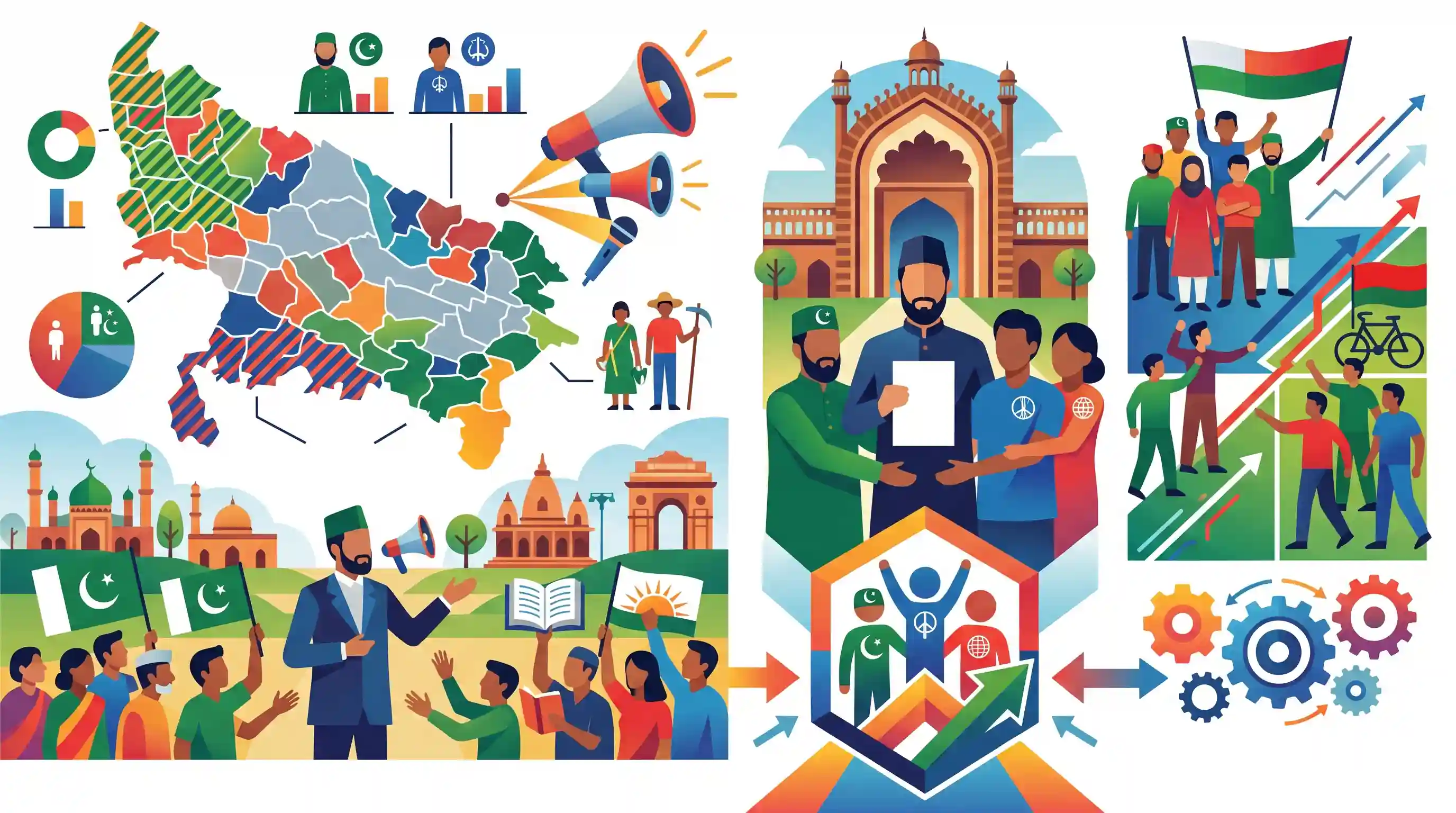
AIMIM election campaign in Muslim majority districts of UP
Source:hindustantimes ↗
Why It Matters
The article highlights electoral dynamics, social-political alliances (PDA/Dalit-Muslim coalitions), and the demographic significance of Western UP and Terai districts (like Bahraich, Saharanpur, Moradabad). This connects directly to UPPSC syllabus segments on UP geography/demography, minority representation, and electoral politics.
Summary
The article discusses the All India Majlis-e-Ittehadul Muslimeen's (AIMIM) early preparations for the 2027 Uttar Pradesh Assembly elections. AIMIM is launching localized 'Jan Chetna' campaigns in Western UP and Terai districts with high Muslim concentrations (e.g., Saharanpur, Moradabad, Bijnor, Bahraich). By promoting Dalit-Muslim-OBC alliances and declaring state chief Shaukat Ali as a candidate from Bahraich's Matera seat, AIMIM aims to establish grassroots credibility and counter SP's dominant 'PDA' (Pichhde, Dalit, Alpsankhyak) coalition.
Key Points
- AIMIM is ramping up its 'Jan Chetna' campaign across Muslim-dominated districts in Western UP and the Terai region in preparation for the 2027 assembly elections.
- UP AIMIM State President Shaukat Ali is declared as the candidate for the Matera assembly seat in Bahraich, a region with a 40-45% Muslim population alongside significant Dalit and OBC communities.
- The campaign heavily targets constituencies with dense Muslim and marginalized populations, including Najibabad (Bijnor), Saharanpur (42% Muslim population, including Deoband), and Moradabad (nearly 50% Muslim population with a large Pasmanda segment).
- AIMIM is positioning itself as a viable champion for Dalit-Muslim-OBC political alliances, attempting to counter the Samajwadi Party's (SP) popular 'PDA' (Pichhde, Dalit, Alpsankhyak) formula.
- In the 2022 UP assembly elections, AIMIM contested 100 seats but drew a blank. For 2027, the party is attempting to sheds its 'vote cutter' tag by organizing localized grassroots campaigns instead of relying solely on national leaders.
Important Terms
PDA Coalition Framework

An electoral alliance strategy formulated by the Samajwadi Party in Uttar Pradesh, focusing on the socio-political representation and mobilization of Pichhde (Backward Classes), Dalits, and Alpsankhyak (Minorities/Muslims).
UPSC context
GS Paper II: Polity and Elections; tests caste-based social coalitions, electoral arithmetic, and minority mobilization in India.
All India Majlis-e-Ittehadul Muslimeen (AIMIM)
An Indian regional political party primarily based in Hyderabad, Telangana, led by Asaduddin Owaisi, that advocates for the political representation, civil rights, and socio-economic empowerment of Muslims and other minority communities.
UPSC context
GS Paper II: Polity and Elections; tests identity politics, minority representation, and regional parties in a multi-party system.
Samajwadi Party (SP)
A major regional socialist political party in India, based primarily in Uttar Pradesh, founded by Mulayam Singh Yadav, which traditionally relies on a support base of Other Backward Classes (OBCs) and Muslims.
UPSC context
GS Paper II: Indian Polity; examines regional political parties, federalism, and social democratic representation in northern India.
Bahujan Samaj Party (BSP)
A national political party in India, founded by Kanshi Ram in 1984, representing Bahujans (Scheduled Castes, Scheduled Tribes, and Other Backward Classes) alongside religious minorities, with its primary base in Uttar Pradesh.
UPSC context
GS Paper II: Polity and Governance; tests Dalit political mobilization, social justice, and political empowerment of marginalized communities.
Terai Region
A lowland, swampy-marshy geographic belt running parallel to the Sivalik foothills of the Himalayas, characterized by fine alluvial deposits, tall grasslands, high water tables, and intensive agriculture.
UPSC context
GS Paper I: Physical Geography of India; tests features of the Indo-Gangetic plains, soil distribution, and agricultural patterns.
Prelims Trap
Arzal or Dalit Muslims are entitled to reservations under the constitutional category of Scheduled Castes (SC).
The Constitution (Scheduled Castes) Order, 1950 restricts SC status strictly to Hindus, Sikhs, and Buddhists. Arzal Muslims are classified under the OBC category, not Scheduled Castes.
Static Concepts Connected
How is Indian Muslim society sociologically stratified into status groups?
- Ashraf: Includes upper-caste Muslims claiming foreign lineage (Syeds, Sheikhs, Pathans) or high-caste Hindu converts.
- Ajlaf: Refers to backward-class Muslims, equivalent to Hindu OBCs, traditionally associated with artisan and occupational castes.
- Arzal: Represents Dalit-equivalent Muslims, encompassing communities engaged in historically stigmatized occupations, facing extreme social exclusion.
- Pasmanda: An umbrella Persian term meaning 'left behind', representing the collective marginalized Ajlaf and Arzal classes.
What are the geographical features of the Dudhwa landscape?
- Contiguous zones: It comprises Dudhwa National Park, Kishanpur Wildlife Sanctuary, and Katarniaghat Wildlife Sanctuary across Lakhimpur Kheri and Bahraich.
- River boundaries: The Ghaghara River acts as the geographical boundary separating Dudhwa National Park from the Katarniaghat Wildlife Sanctuary.
- Habitat type: Characterized by Terai-Bhabar ecosystems containing tall wet grasslands, sal forests, and clayey swamps along the Indo-Nepal border.
Cross-Topic Patterns
Socio-spatial developmental deprivation
The concentration of marginalized Pasmanda communities overlaps with geographically backward pockets, highlighted by low literacy and high developmental deficits in the Terai region.
Minority representation and delimitation
Political mobilization of clustered minorities faces spatial challenges under Article 82, driving debates on geographical boundaries and reserved constituency allocations.

Constitutional boundaries of SC status under Article 341 vis-a-vis Dalit/Arzal Muslims is likely to feature in upcoming CSE papers.
Linked PYQs · 4
Linked PYQs · 4
- 2025UPPSC_PRELIMSGS1
Which of the following districts of Uttar Pradesh shares its boundary with only one other district of Uttar Pradesh ? 1. Lalitpur 2. Saharanpur 3. Sonbhadra Select the correct answer from the code given below :
- 2017UPPSC_PRELIMSGS1
Match List-I with List-II and select the correct answer from the code given below the lists: List-I (Centre): (A) Sports goods (B) Match box (C) Brassware (D) Wood List-II (Industry): 1. Moradabad 2. Saharanpur 3. Meerut 4. Bareilly carving
- 2021UPPSC_PRELIMSGS1
How many districts of Uttar Pradesh has been covered under the Aspirational District Programme run by NITI Aayog, up to June, 2021?
- 2025UPPSC_PRELIMSGS1
Match List-I (Committee): (A) Union Constitution Committee (B) Rules of Procedure Committee (C) Drafting Committee (D) Advisory Committee on Fundamental Rights, Minorities and Tribal and Excluded Areas List-II (Chairman): 1. Dr. B.R. Ambedkar 2. Sardar Vallabhbhai Patel 3. Jawaharlal Nehru 4. Dr. Rajendra Prasad
