Uttar Pradesh Governor Highlights Drones and AI in Agriculture
Source:dailypioneer ↗
Why It Matters
The article connects agricultural modernization (AI, drones, biotech) with women's empowerment (Namo Drone Didi scheme) in the specific context of Uttar Pradesh. It is highly relevant for UPPSC Prelims questions concerning state agricultural universities, central schemes implemented in UP, and advancements in agritech (GS-3).
Summary
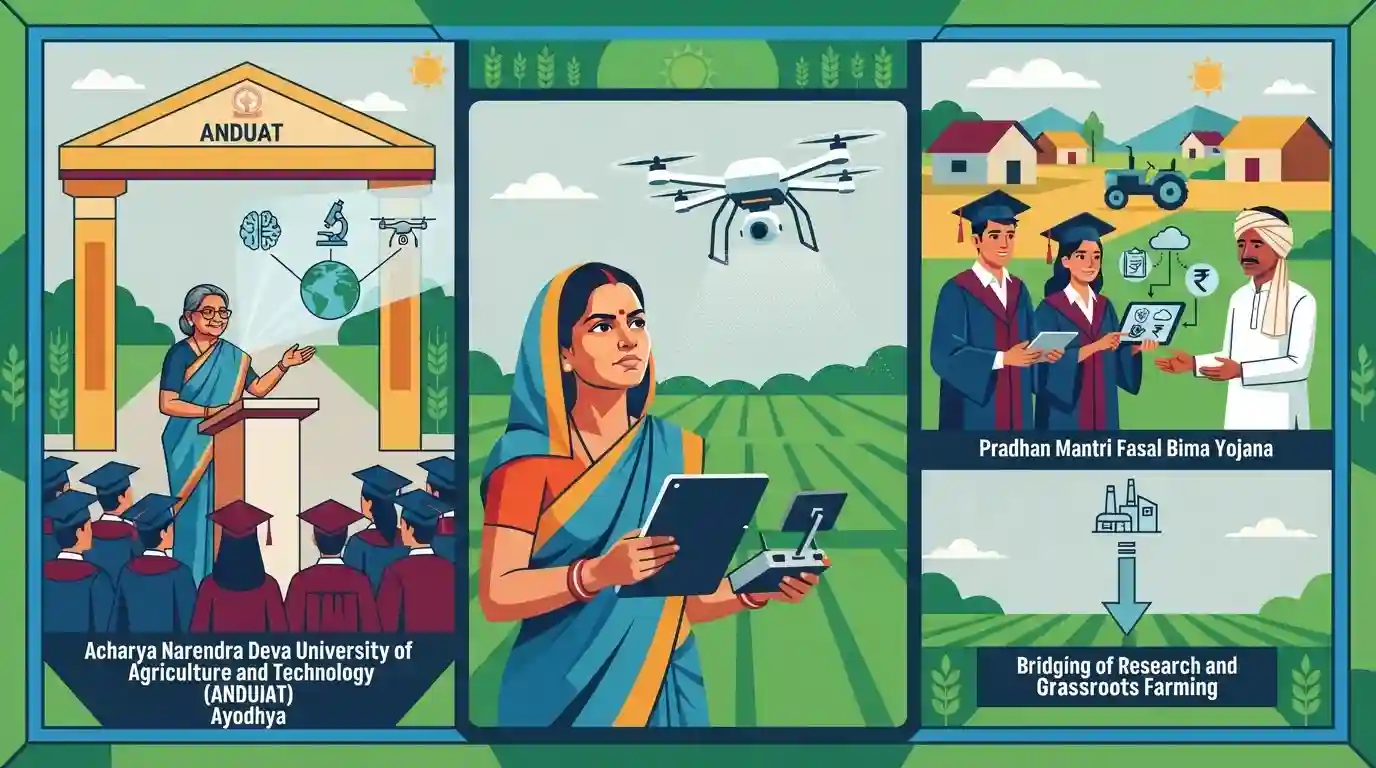
Uttar Pradesh Governor Anandiben Patel addressed the convocation at Acharya Narendra Deva University of Agriculture and Technology (ANDUAT) in Ayodhya, highlighting the transformative role of modern technology in agriculture. She emphasized that the integration of artificial intelligence, drones, and biotechnology is crucial for future farming. A key focus of her address was the 'Namo Drone Didi' scheme, which is empowering rural women by training them to operate drones for agricultural purposes. Patel also called upon agricultural graduates to assist local farmers by raising awareness about government initiatives such as the Pradhan Mantri Fasal Bima Yojana. The event underscored UP's commitment to bridging the gap between advanced agricultural research and grassroots farming.
Key Points
- UP Governor Anandiben Patel addressed the 28th convocation of Acharya Narendra Deva University of Agriculture and Technology in Ayodhya, emphasizing the role of AI, drones, and biotechnology in modernizing farming.
- The central 'Namo Drone Didi' scheme was highlighted as a major step toward women's empowerment, enabling rural women to use drones for agricultural activities like spraying fertilizers.
- The Governor urged agricultural graduates to promote awareness among farmers regarding schemes like PM Fasal Bima Yojana and soil testing.
- Top agricultural officials, including the DG of ICAR, stressed the importance of technological interventions for achieving food security and boosting agricultural output.
Important Terms
Namo Drone Didi Scheme

A Central Sector Scheme offering an 80% subsidy to women Self Help Groups (SHGs) to purchase agricultural drones. It trains rural women as drone pilots for precision farming (e.g., spraying nano-fertilizers), fostering women-led agritech entrepreneurship.
UPSC context
Relevant for GS-2 (Welfare Schemes) & GS-3 (Agriculture Technology). Tests the intersection of women's empowerment and rural agritech modernization.
Pradhan Mantri Fasal Bima Yojana (PMFBY)
India's flagship crop insurance scheme offering comprehensive financial coverage against non-preventable natural risks. It caps farmer premiums at 1.5% for rabi, 2% for kharif, and 5% for commercial/horticultural crops, shifting the subsidy burden to the government.
UPSC context
Crucial for GS-2 (Government Schemes) and GS-3 (Agriculture). Tests knowledge of premium rates, risk coverage, and farming income stability.
Acharya Narendra Deva University of Agriculture and Technology (ANDUAT)
A prominent state agricultural university established in 1975 in Ayodhya, Uttar Pradesh. Named after educator Narendra Deva, the institution focuses on localized agricultural research, extension activities, and bridging scientific advancements with grassroots farming.
UPSC context
Relevant for State PCS (UPPSC) and GS-3 (Agricultural Education). Highlights the role of regional institutions in decentralized agricultural extension.
Indian Council of Agricultural Research (ICAR)
An autonomous apex organization under the Ministry of Agriculture's DARE. Established in 1929, it coordinates agricultural research and education nationwide. ICAR spearheaded the Green Revolution and currently drives climate-smart farming and agritech innovations across India.
UPSC context
High priority for GS-3 (Science & Tech in Agriculture). Tests institutional frameworks governing India's food security and research.
Prelims Trap
"The Namo Drone Didi scheme provides agricultural drones free of cost to individual women farmers."
The scheme provides an 80% subsidy (up to ₹8 lakh) to Women Self-Help Groups (SHGs) under DAY-NRLM, not individual farmers, and requires 20% contribution.
Static Concepts Connected
How does PM Fasal Bima Yojana (PMFBY) utilize technology for claim settlements?
- Crop Cutting Experiments: Drones and GIS technology are increasingly used to conduct precise Crop Cutting Experiments (CCEs) to estimate regional crop yields reliably.
- Rapid Loss Assessment: Satellite imagery and drones help assess localized crop losses due to extreme weather, accelerating the objective settlement of insurance claims.
- Premium Structure: Farmers pay highly subsidized, uniform premiums: 2% for Kharif crops, 1.5% for Rabi crops, and 5% for annual commercial and horticultural crops.
What is Liquid Nano Urea and why is drone spraying beneficial?
- Foliar Application: Drone spraying directly targets leaf stomata, ensuring rapid absorption of nutrients compared to soil-applied conventional granular urea.
- Higher Efficiency: It significantly enhances Nitrogen Use Efficiency (NUE) to 85-90%, whereas conventional granular urea has an efficiency of only about 25%.
- Environmental Benefit: Precise application reduces soil, water, and air pollution caused by the leaching and volatilization of excess bulk fertilizers.
Cross-Topic Patterns
SHGs pivoting to Agritech services
The Namo Drone Didi scheme shifts the role of DAY-NRLM SHGs from traditional micro-finance and cottage industries to leading precision agriculture and high-tech rural service providers.
Precision Farming + Subsidy Rationalization
By using drones for the precise application of Nano Urea, the government aims to boost Nitrogen Use Efficiency, indirectly reducing India's massive granular fertilizer subsidy burden.

Expect a multi-statement Prelims question integrating Namo Drone Didi's SHG criteria, Liquid Nano Urea efficiency, and drone regulations.
Linked PYQs · 4
Linked PYQs · 4
- 2025UPPSC_PRELIMSGS1
Consider the following and arrange them in correct chronological order. 1. Jawahar Rojgar Yojana 2. Development of women and children in Rural Areas 3. Integrated Rural Development Programme 4. National Rural Employment Programme Select the correct answer from the code given below :
- 2025UPPSC_PRELIMSGS1
Consider the following and arrange them in correct chronological order. 1. Food for work programme 2. Community Development Programme 3. Training for Rural Youth for Self Employment (TRYSEM) 4. Drought Prone Area Programme Select the correct answer from the code given below :
- 2009UPPSC_PRELIMSGS1
'Nitrogen use efficiency' in crop production may be enhanced by
- 2014UPPSC_PRELIMSGS1
The International Crop Research Institute for Semi Arid Tropics (ICRISAT) is located at
