Kerala Digital Crop Survey Implementation and Farm Schemes
Source:The Hindu ↗
Why It Matters
The article highlights a real-world application of e-technology in agriculture (a direct GS3 syllabus topic). Digitising crop data prevents leakage in agricultural subsidies and ensures better targeting for flagship schemes like PMFBY and PM-KISAN. This provides concrete examples for Mains answers on digitisation in agriculture and prepares students for Prelims questions on the features of associated agricultural schemes.
Summary
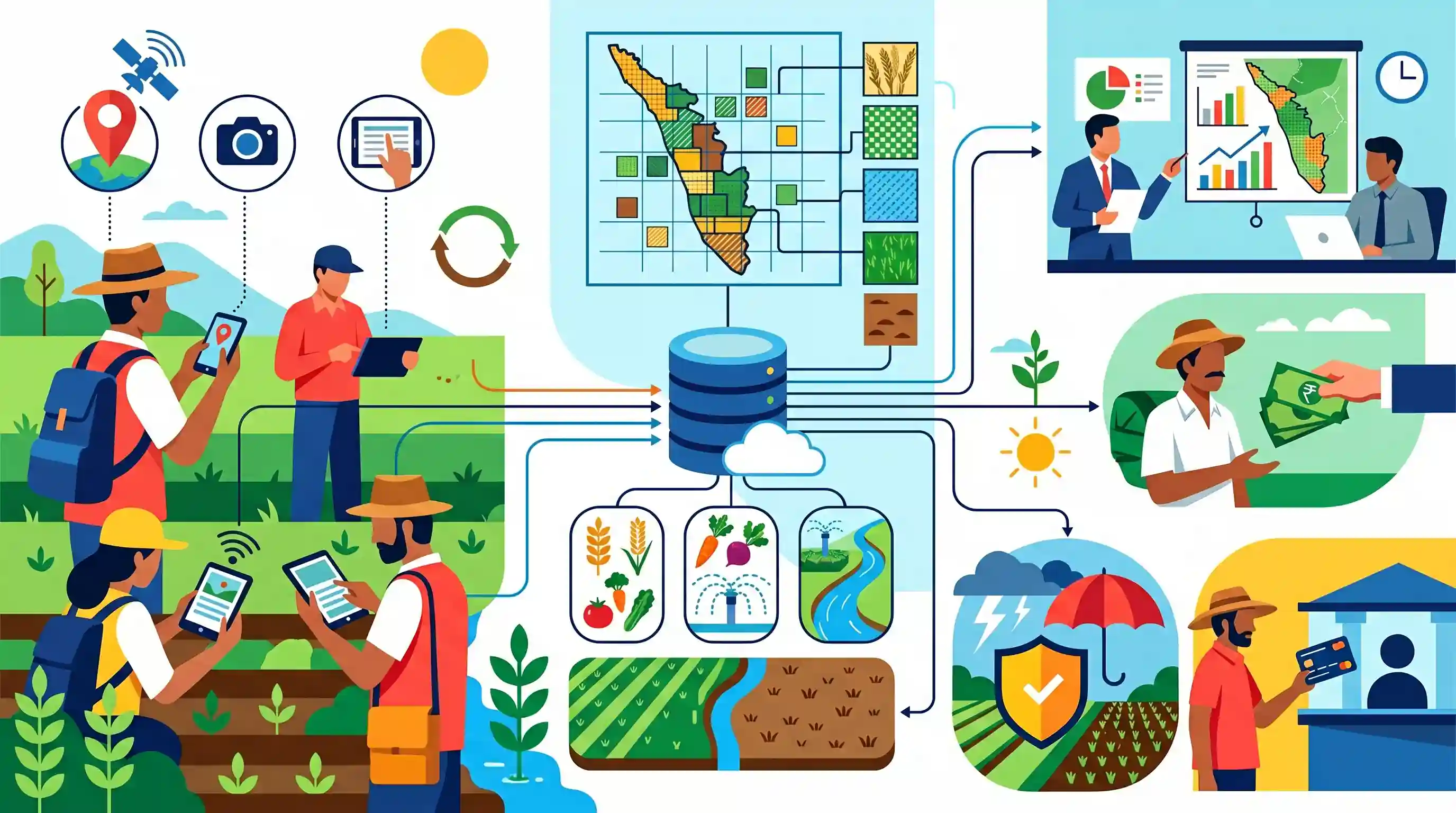
Kerala's Agriculture Department is rolling out a Statewide Digital Crop Survey as part of a nationwide Central Sector Scheme. The initiative relies on surveyors who will geo-tag, photograph, and record crop and land details via a mobile app twice a year (Kharif and Rabi). By creating an accurate database of farmlands—including crop types, irrigation methods, and land usage (cultivated vs. fallow)—the government aims to streamline agricultural planning and ensure that farmers can more easily access central welfare benefits such as the Pradhan Mantri Fasal Bima Yojana, PM-KISAN, and Kisan Credit Card.
Key Points
- The Kerala Agriculture Department is implementing a Digital Crop Survey across the State to build an up-to-date database on farmers, farmlands, and crops.
- Surveyors will visit plots to record data, geo-tag, and photograph locations, uploading the information via a mobile app twice a year during Kharif and Rabi seasons.
- The initiative is part of a nationwide Central Sector Scheme and helps verify if land is cultivated, fallow, or non-farm, along with details on irrigation and specific crops.
- The resulting digital database will improve farmers\' access to benefits from central schemes like PMFBY, PM-KISAN, and the Kisan Credit Card.
Important Terms
Digital Crop Survey (DCS)

A central initiative using GPS, geo-tagging, and satellite imagery to record accurate, plot-level crop data via mobile applications to create a "single source of truth" for agriculture.
UPSC context
GS Paper 3 (Agriculture/e-tech). Important for improving agricultural statistics, claim settlements, and precise targeting of farmer-centric policies.
Pradhan Mantri Kisan Samman Nidhi (PM-KISAN)
A Central Sector Scheme providing ₹6,000 annual income support in three equal installments to all land-holding farmer families through Direct Benefit Transfer (DBT).
UPSC context
GS Paper 3 (Subsidies). Key for analyzing direct income support vs. input subsidies and rural financial stability.
Pradhan Mantri Fasal Bima Yojana (PMFBY)
A flagship crop insurance scheme protecting farmers against non-preventable natural risks from pre-sowing to post-harvest, with capped premiums of 1.5% to 5%.
UPSC context
GS Paper 3 (Agriculture/Risk Management). Tests knowledge of social security and technology-driven disaster mitigation in the primary sector.
Kisan Credit Card (KCC)
A credit scheme launched in 1998 providing farmers with timely, formal credit for cultivation, post-harvest, and consumption needs at subsidized interest rates through a revolving card.
UPSC context
GS Paper 3 (Agriculture Credit). Fundamental for discussions on financial inclusion and institutional credit versus informal money lenders.
Central Sector Scheme
Schemes 100% funded and implemented by the Union Government, distinguishing them from Centrally Sponsored Schemes where the states share the financial burden.
UPSC context
GS Paper 2 (Governance/Fiscal Federalism). Essential for understanding the division of financial responsibility between the Centre and States.
Digital Public Infrastructure (DPI) in Agriculture
Open-source digital frameworks, such as AgriStack, that integrate farmer identities and land records to enable seamless delivery of services and credit.
UPSC context
GS Paper 3 (e-technology). A high-priority area regarding the modernization of rural governance and data-driven farming.
Prelims Trap
The Digital Crop Survey only maps actively sown croplands and excludes fallow or non-agricultural lands.
The survey explicitly records whether land is cultivated, fallow, or non-farm, establishing a comprehensive plot-level baseline of all land usage.
Static Concepts Connected
What are the three foundational registries of the proposed AgriStack?
- Farmer Registry: Links farmer details with Aadhaar to create a unique Farmer ID (Kisan Pehchan Patra).
- Crop Sown Registry: Real-time, plot-level data on crops sown, dynamically updated via the Digital Crop Survey.
- Geo-referenced Maps: Digitized cadastral records matching physical boundaries to ownership, creating a spatial baseline.
How do PM-KISAN and PMFBY differ fundamentally in their funding structure?
- PM-KISAN: It is a 100% Central Sector Scheme. The entire financial burden for income support is borne by the Union Government.
- PMFBY: It is a Centrally Sponsored Scheme. The premium subsidy burden is shared between the Centre and the respective State governments.
Cross-Topic Patterns
AgriStack as India's next DPI
Following UPI and ONDC, AgriStack represents the extension of India's Digital Public Infrastructure (DPI) model into the primary sector to plug subsidy leakages and automate credit (KCC) delivery.
Space technology in Agriculture
Combining mobile-app geo-tagging with satellite remote sensing directly links GS3 Agriculture schemes with GS3 Space Technology applications, a frequent theme in UPSC Mains.

AgriStack's three pillars and the Digital Agriculture Mission are highly likely to feature in a 2026 GS3 e-technology question.
Linked PYQs · 3
Linked PYQs · 3
- 2023MainsGS3
How does e-Technology help farmers in production and marketing of agricultural produce? Explain it.
- 2020PrelimsGS1
Under the Kisan Credit Card scheme, short-term credit support is given to farmers for which of the following purposes ? 1. Working capital for maintenance of farm assets 2. Purchase of combine harvesters, tractors and mini trucks 3. Consumption requirements of farm households 4. Post-harvest expenses 5. Construction of family house and setting up of village cold storage facility Select the correct answer using the code given below:
- 2016PrelimsGS1
With reference to 'Pradhan Mantri Fasal Bima Yojana', consider the following statements: 1. Under this scheme, farmers will have to pay a uniform premium of two percent for any crop they cultivate in any season of the year. 2. This scheme covers post-harvest losses arising out of cyclones and unseasonal rains. Which of the statements given above is/are correct?
