Opposition criticises state agriculture budget over agrarian distress
Source:The Hindu ↗
Why It Matters
The article highlights fundamental issues related to state intervention in agriculture—such as the role of subsidies, crop insurance, MSP, and price stabilization funds—which are directly relevant to GS3 topics on direct and indirect farm subsidies, MSP, and issues in agricultural marketing.
Summary
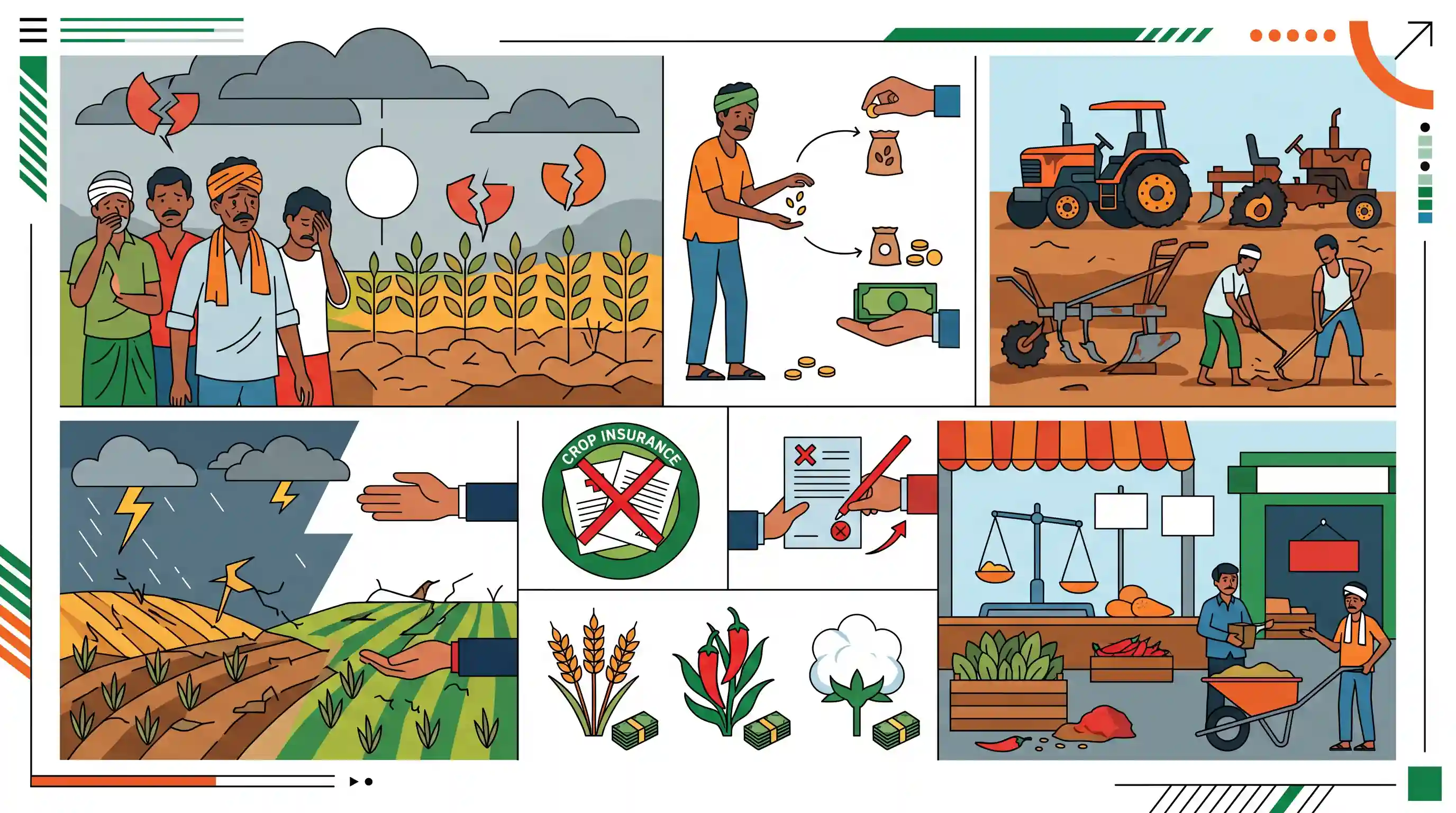
The YSR Congress Party (YSRCP) has strongly criticized the Andhra Pradesh Agriculture Budget for 2026-27, asserting it fails to address mounting agrarian distress. Key grievances include inadequate allocations for seed subsidies, farm mechanization, and price stabilization through Markfed. The opposition party further condemned the state government for withdrawing free crop insurance, halting zero-interest subsidies, failing to compensate for Cyclone Mocha crop losses, and providing insufficient Minimum Support Price (MSP) and procurement support across various crops.
Key Points
- The YSR Congress Party criticized the Andhra Pradesh Agriculture Budget (2026-27) for inadequate allocations, including ₹240 crore for seed subsidies and ₹139.65 crore for farm mechanization.
- The agrarian crisis has been exacerbated by the withdrawal of free crop insurance, non-payment of zero-interest subsidies, and a lack of compensation for damages caused by Cyclone Mocha.
- Farmers growing cash crops and pulses are suffering as market prices have fallen below the Minimum Support Price (MSP), alongside a decline in paddy output and insufficient procurement support.
- An allocation of ₹500 crore for price stabilization through Markfed was condemned as grossly insufficient given the declining agricultural production over the past 20 months.
Important Terms
Minimum Support Price (MSP)

The pre-announced guaranteed price at which the government purchases crops from farmers to prevent distress sales and ensure income stability during market price crashes.
UPSC context
GS Paper 3: Agricultural pricing, food security, and government procurement policies. Critical for understanding farmer-government negotiations and rural economy.
Agrarian Distress
A condition of persistent economic hardship in the farming sector, manifesting through rising indebtedness, low profitability, and vulnerability to climate-induced crop failures.
UPSC context
GS Paper 3: Issues related to farm subsidies, rural development, and farmer suicides. Tests socio-economic analysis of the primary sector.
Markfed (AP)
A state-level cooperative federation that acts as a nodal agency for procuring agricultural produce (like pulses and coarse grains) and distributing inputs like fertilizers and seeds.
UPSC context
GS Paper 3: Agricultural marketing and the role of cooperative societies in decentralized procurement and supply chain management.
Price Stabilization Fund (PSF)
A government fund used for market interventions to mitigate extreme price volatility of essential agri-horticultural commodities, primarily pulses, onions, and potatoes, through buffer stocking.
UPSC context
GS Paper 3: Buffer stocks, food inflation management, and government market intervention schemes.
Pradhan Mantri Fasal Bima Yojana (PMFBY)
A flagship national insurance scheme providing comprehensive financial protection to farmers against crop loss due to non-preventable natural risks like drought, floods, and pests.
UPSC context
GS Paper 2 & 3: Government welfare schemes and agricultural risk management. Tests knowledge of social security in farming.
Market Intervention Scheme (MIS)
An ad-hoc procurement scheme for horticultural and perishable commodities not covered under MSP, implemented when prices fall below the cost of production due to bumper harvests.
UPSC context
GS Paper 3: Price policy for perishables and protecting farmers from the 'cobweb' effect in horticultural markets.
Prelims Trap
The Price Stabilization Fund is utilized by state agencies exclusively to procure paddy and wheat at Minimum Support Price.
PSF primarily regulates price volatility of essential agri-horticultural commodities (like pulses and onions) to control inflation, rather than routine MSP procurement of cereals.
Static Concepts Connected
What is the Price Stabilization Fund (PSF) and how does it function?
- Core Objective: Created to regulate extreme price volatility of selected essential commodities (like pulses, onions, potatoes) to protect both consumers and farmers from sudden price shocks.
- Implementing Agencies: Central and State agencies like NAFED, FCI, and MARKFED undertake strategic procurement and market intervention using interest-free advances from this corpus.
How does PMFBY differ from SDRF in providing agricultural financial protection?
- PMFBY (Insurance): A voluntary, premium-based scheme covering yield losses from pre-sowing to post-harvest, triggered by crop-cutting experiments or localized weather events.
- SDRF (Disaster Relief): A statutory fund under the Disaster Management Act providing immediate, ex-gratia relief for natural calamities (e.g., cyclones), independent of farmer insurance enrollment.
Cross-Topic Patterns
Fiscal Federalism vs. Farm Safety Nets
State withdrawals from PMFBY due to high premium subsidy burdens reflect the direct impact of state fiscal health (GS2) on agricultural safety nets and rural food security (GS3).
Climate extremes mapping to distress sales
Post-cyclone crop damage often leads to diminished grain quality. Without robust state procurement and timely relaxation in Fair Average Quality (FAQ) norms, farmers are forced into severe distress sales.

Expect a 2026 prelims question contrasting the operational mandate of the Price Stabilization Fund (PSF) with standard MSP procurement.
Linked PYQs · 4
Linked PYQs · 4
- 2018MainsGS3
What do you mean by Minimum Support Price (MSP)? How will MSP rescue the farmers from the low income trap?
- 2017MainsGS3
How do subsidies affect the cropping pattern, crop diversity and economy of farmers? What is the significance of crop insurance, minimum support price and food processing for small and marginal farmers?
- 2023MainsGS3
What are the direct and indirect subsidies provided to farm sector in India? Discuss the issues raised by the World Trade Organization (WTO) in relation to agricultural subsidies.
- 2024MainsGS3
Elucidate the importance of buffer stocks for stabilizing agricultural prices in India. What are the challenges associated with the storage of buffer stock? Discuss.
