Uttar Pradesh Agricultural Sector Growth and Lab to Land Initiatives
Source:The Hindu ↗
Why It Matters
Provides a concrete state-level case study (Uttar Pradesh) of how agricultural extension services (KVKs), 'Lab to Land' technology transfer, and food processing integration can drastically improve agricultural growth rates. This is highly useful empirical evidence for Mains GS3 answers on agriculture.
Summary
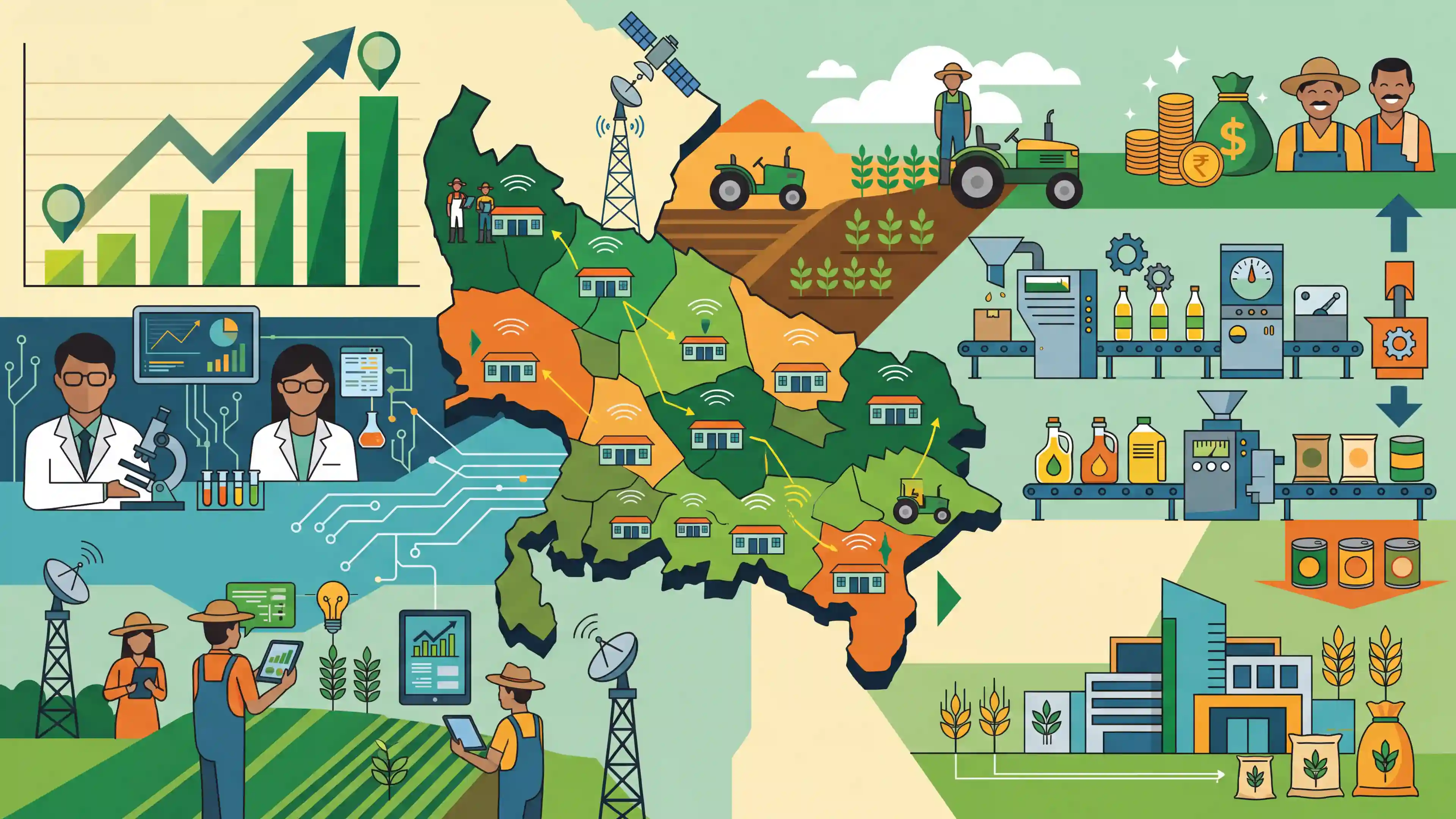
The Chief Minister of Uttar Pradesh has highlighted a significant transformation in the state's agricultural sector, reporting a jump in its growth rate from around 8% to 18%. This revival is primarily attributed to strategic interventions such as connecting farmers directly with agricultural research through the 'Lab to Land' concept and revitalizing Krishi Vigyan Kendras across the state's nine agro-climatic zones. The administration stresses that agriculture must evolve beyond traditional cultivation to incorporate value addition and food processing—drawing parallels to the manufacturing sector—thereby increasing farmer profitability. Establishing institutions like the International Rice Research Institute regional center in Varanasi further strengthens localized agricultural extension services and farm productivity.
Key Points
- Uttar Pradesh's agriculture sector growth has reportedly surged from 8% to nearly 18% since 2017, driven by value addition and technological interventions.
- The successful implementation of the 'Lab to Land' concept has bridged the gap between agricultural scientists and farmers across the state's nine diverse agro-climatic zones.
- The government prioritized reviving inactive Krishi Vigyan Kendras (KVKs) and establishing agricultural centers, such as the IRRI in Varanasi, to disseminate modern, yield-enhancing techniques.
- Emphasizing value addition, the administration equates the potential profitability of modern, processed agriculture with that of the manufacturing sector.
Important Terms
Krishi Vigyan Kendras (KVKs)

District-level agricultural science centers established by ICAR to bridge the gap between research and farmers through training, on-farm testing, and technology demonstration.
UPSC context
GS Paper 3: Agriculture extension and technology. Key for questions on productivity and farm distress.
Lab to Land Concept
A strategic ICAR initiative focused on transferring laboratory-developed agricultural technologies and innovations directly to small and marginal farmers' fields to improve yield and socio-economic status.
UPSC context
GS Paper 3: E-technology in aid of farmers and institutional extension services.
Agro-Climatic Zones
Geographical areas classified by climate, soil, and water resources to optimize crop selection and productivity. Uttar Pradesh is divided into nine specific zones.
UPSC context
GS Paper 1 (Geography) and GS Paper 3 (Cropping Patterns). Relevant for regional agricultural planning.
Food Processing and Value Addition
The process of transforming raw agricultural produce into high-value products to reduce wastage, increase shelf life, and enhance farmer profitability.
UPSC context
GS Paper 3: Food processing and related industries. Essential for 'doubling farmers income' topics.
International Rice Research Institute (IRRI)
An international organization specializing in rice productivity; its South Asia Regional Centre (ISARC) in Varanasi serves as a hub for localized research and value addition.
UPSC context
GS Paper 2 & 3: International institutions and agricultural R&D. Varanasi hub is a significant regional development.
Agricultural Extension Services
Public or private educational programs that disseminate scientific knowledge, technology, and market information to farmers to improve farm management and productivity.
UPSC context
GS Paper 3: Major topic regarding technology transfer and institutional support in agriculture.
Prelims Trap
Krishi Vigyan Kendras (KVKs) are statutory bodies fully funded and managed exclusively by State Governments.
KVKs are not statutory bodies. They are 100% centrally sponsored by ICAR and can be hosted by State Agricultural Universities, ICAR institutes, or NGOs.
Static Concepts Connected
What are Krishi Vigyan Kendras (KVKs) and how are they administered?
- Mandate: They serve as district-level frontline agricultural extension centers for technology assessment, demonstration, and capacity building of farmers.
- Funding: They are 100% centrally sponsored projects financed by the Government of India through the Indian Council of Agricultural Research (ICAR).
- Host agencies: KVKs are not managed by a single entity; they can be administered by State Agricultural Universities, ICAR institutes, or recognized NGOs.
What criteria define Agro-Climatic Zones in Indian planning?
- Origin: The Planning Commission initially demarcated India into 15 broad agro-climatic zones during the 7th Five Year Plan to decentralize agricultural planning.
- Key parameters: Zones are classified geographically based on soil type, rainfall, temperature, and water resource availability to optimize crop suitability.
- State-level micro-planning: States further divide these broad categories into localized sub-zones (e.g., UP's 9 zones like Tarai or Bundelkhand) for targeted extension services.
Cross-Topic Patterns
Agro-Climatic Planning + Climate Resilience
Mapping extension services to specific agro-climatic zones aligns directly with the National Innovations in Climate Resilient Agriculture (NICRA) objectives for scaling drought- or flood-resistant crops.
Food Processing + Dalwai Committee
Shifting focus from basic cultivation to value addition embodies the Ashok Dalwai Committee's strategy for doubling farmers' income through post-harvest secondary agriculture.

Expect a multi-statement Prelims question testing the funding structure, host agencies, and frontline mandate of Krishi Vigyan Kendras.
Linked PYQs · 5
Linked PYQs · 5
- 2023MainsGS3
How does e-Technology help farmers in production and marketing of agricultural produce? Explain it.
- 2020MainsGS3
What are the challenges and opportunities of food processing sector in the country? How can income of the farmers be substantially increased by encouraging food processing?
- 2022MainsGS3
Elaborate the scope and significance of the food processing industry in India.
- 2025MainsGS3
Examine the scope of the food processing industries in India. Elaborate the measures taken by the government in the food processing industries for generating employment opportunities.
- 2023MainsGS3
Explain the changes in cropping pattern in India in the context of changes in consumption pattern and marketing conditions.
