Kerala farmers shift to social media for technical advisories
Source:The Hindu ↗
Why It Matters
It provides concrete empirical data on the changing landscape of agricultural extension services. This is highly relevant for GS3 answers on 'e-technology in the aid of farmers', demonstrating how digital and social media are filling the gap left by traditional, state-led extension bodies whose reach remains minimal.
Summary
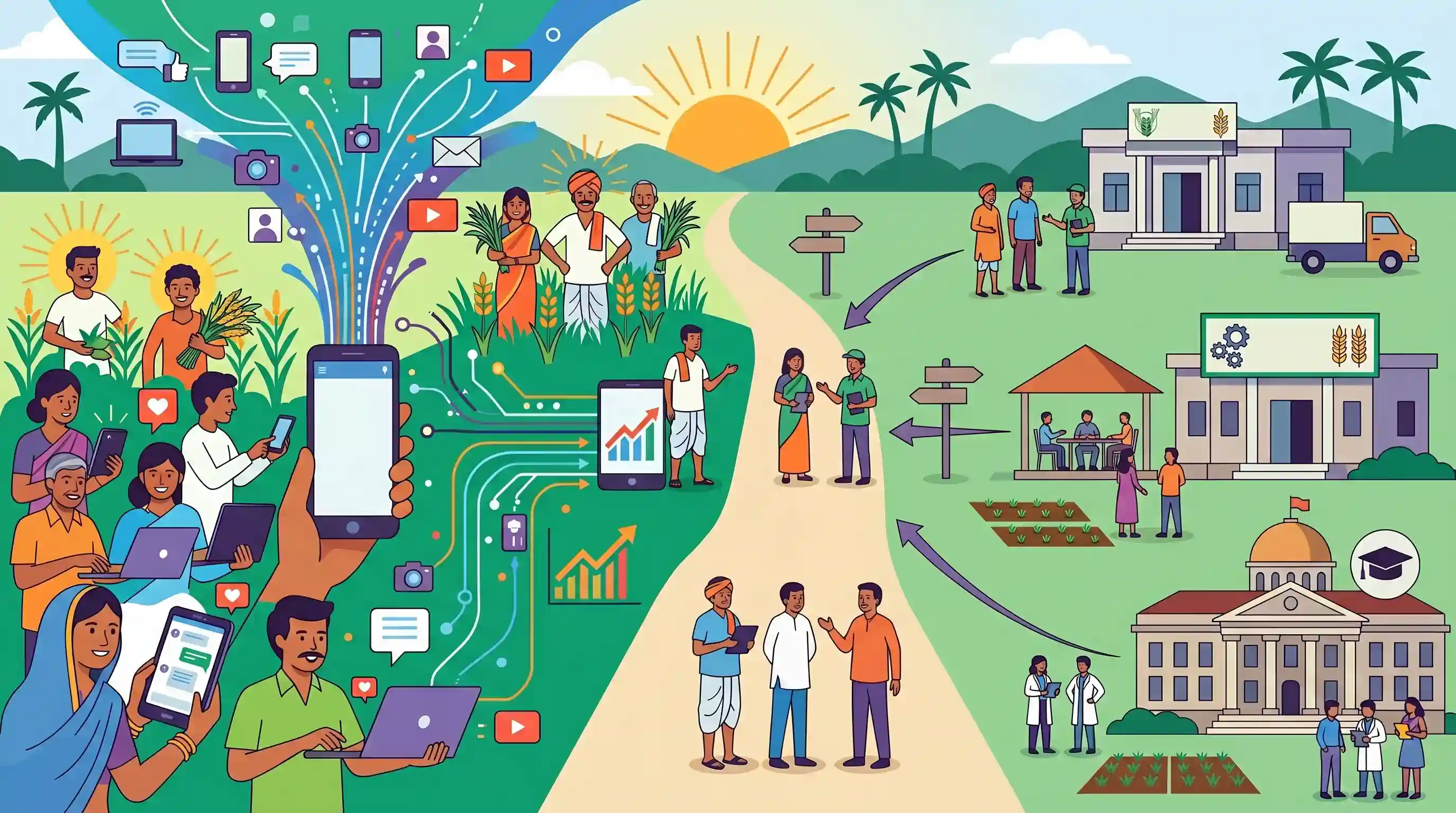
According to the 'Situation Assessment Survey of Agricultural Households 2024-25' conducted by Kerala's Economics and Statistics Department, farmers in the state are increasingly relying on social media, mass media, and smartphones for technical farming advice. Nearly 42.5% of agricultural households use these digital sources, contrasting sharply with the low utilization of formal institutional extension services like ATMA (2.37%), Krishi Vigyan Kendras (1.56%), and agricultural universities (3.19%). The data underscores a transformative shift in agricultural extension services, driven by digital technology, while exposing the limited reach of traditional government advisory mechanisms.
Key Points
- A significant 42.48% of agricultural households in Kerala use social media, mass media, and smartphones for farming-related technical advisory services.
- Traditional government extension programmes like ATMA reach only 2.37% of these households, while Krishi Vigyan Kendras (KVKs) are accessed by just 1.56%.
- State agriculture departments and progressive farmers account for 13.78% and 14.5% respectively as sources of technical advice.
- Only 3.19% of agricultural households rely on institutions like the Kerala Agricultural University for advisory support.
- The findings reflect a substantial shift towards digital e-extension services and highlight the under-penetration of formal institutional extension networks among farmers.
Important Terms
Situation Assessment Survey (SAS)

A comprehensive periodic survey capturing data on income, expenditure, debt, and technology adoption among farming families to guide agricultural policy and planning.
UPSC context
GS Paper 3 (Agriculture/Economy); provides the empirical basis for evaluating farm distress and the goal of doubling farmers' income.
Krishi Vigyan Kendras (KVKs)
District-level agricultural science centers under the ICAR that bridge the gap between research and practice through frontline demonstrations, training, and on-farm testing.
UPSC context
GS Paper 3 (Agriculture Extension); crucial for understanding "Lab-to-Land" initiatives and institutional tech-support for farmers.
Agricultural Technology Management Agency (ATMA)
A district-level registered society responsible for decentralized technology dissemination and coordinating research-extension activities through a participatory, multi-agency approach.
UPSC context
GS Paper 3 (Agriculture); tests knowledge of decentralized administrative reforms and location-specific technology management in farming.
Agriculture Extension Services
Knowledge-sharing systems that provide farmers with technical advice, scientific research, and best practices to improve productivity, income, and sustainable farm management.
UPSC context
GS Paper 3 (E-technology in aid of farmers); relevant for the transition from physical to digital advisory models.
Farmer Producer Organisations (FPOs)
Collectives of small and marginal farmers registered as companies or cooperatives to leverage economies of scale for better input procurement and market access.
UPSC context
GS Paper 3 (Agriculture); vital for discussing farmer empowerment, reducing middleman dependence, and enhancing collective bargaining power.
E-technology in the aid of farmers
The use of digital tools like smartphones, social media, and apps to provide farmers with real-time weather, market data, and technical advisory services.
UPSC context
GS Paper 3 (Syllabus topic); central to modernizing Indian agriculture and addressing the challenge of information asymmetry.
Prelims Trap
The Situation Assessment Survey of Agricultural Households 2024-25 is a nationwide survey conducted by the NSO.
While the NSO conducts the famous national SAS rounds, the 2024-25 survey cited here is state-specific, conducted by Kerala's Economics and Statistics Department.
Static Concepts Connected
What are the distinct roles of KVKs and ATMA in agriculture extension?
- Krishi Vigyan Kendras (KVKs): Function primarily under ICAR as Farm Science Centres for on-farm testing, frontline demonstrations, and capacity building of farmers.
- ATMA: A registered society at the district level for decentralized, bottom-up planning of extension activities, integrating multiple line departments and research institutions.
What are the key national digital agriculture extension initiatives?
- mKisan Portal: A portal that sends targeted advisory SMS to farmers in local languages from agricultural experts and scientists.
- Kisan Suvidha App: An omnichannel app providing critical, timely information on weather, market prices, plant protection, and fertilizers.
- AgriStack (IDEA): A foundational digital public infrastructure creating unique farmer IDs to streamline service delivery, credit, and personalized extension.
Cross-Topic Patterns
Agri-extension meets Digital Public Infrastructure
The shift to smartphone-led advisory paves the way for integrating DPI like AgriStack, enabling AI-driven, localized crop advisory via WhatsApp bots instead of physical KVK visits.
Kerala's rural-urban demographic continuum
Kerala's high digital literacy and rural-urban continuum uniquely accelerate this social media adoption, creating a model that contrasts sharply with agrarian states heavily reliant on traditional input dealers.

Expect a GS-3 mains question evaluating the failure of traditional agricultural extension (ATMA/KVK) versus the rise of digital advisory.
Linked PYQs · 1
Linked PYQs · 1
- 2023MainsGS3
How does e-Technology help farmers in production and marketing of agricultural produce? Explain it.
