Shifting agricultural policy from food security to farmer income
Source:The Hindu ↗
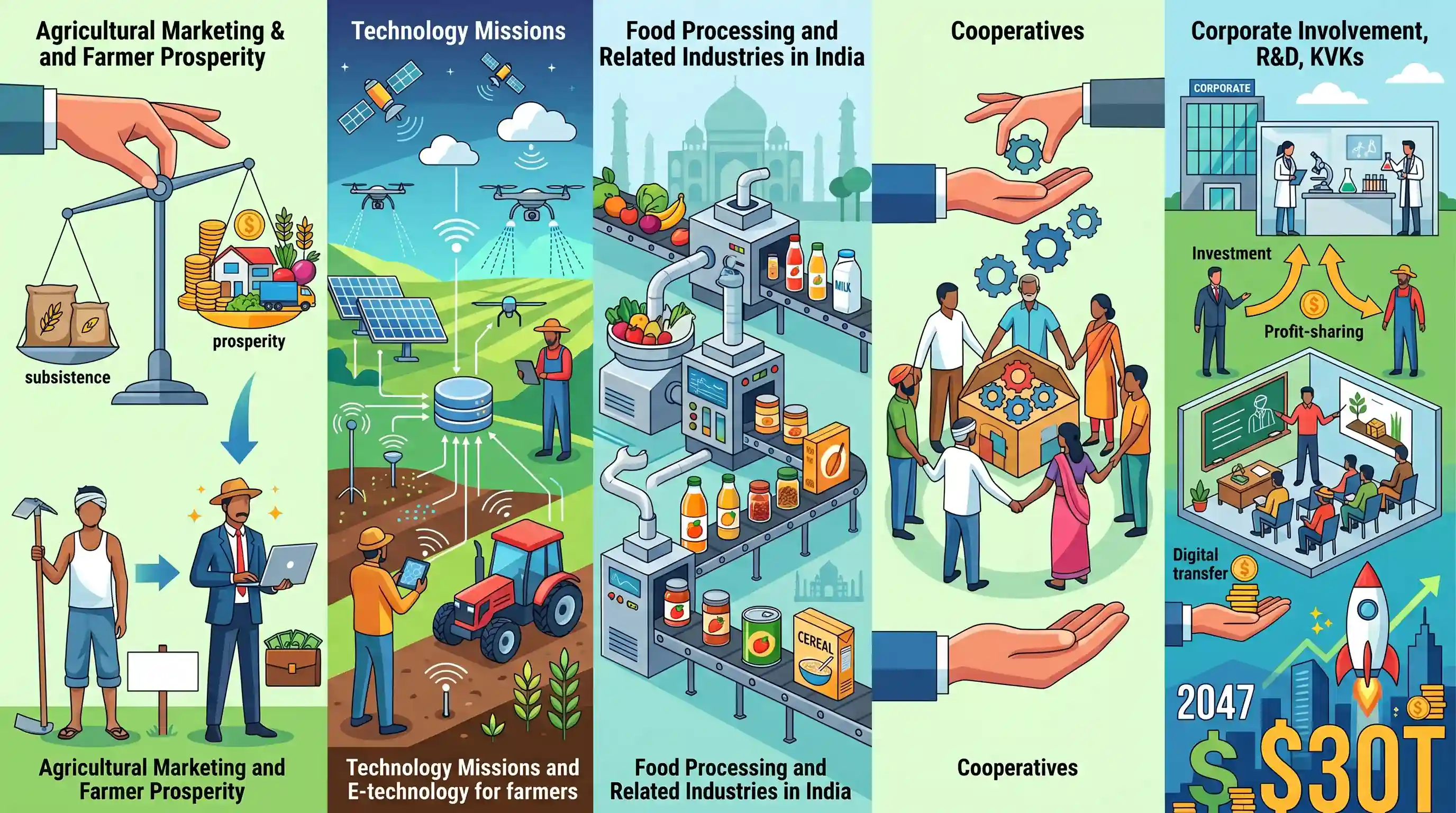
Why It Matters
Highlights the evolving policy narrative from a production-centric agricultural model to an income-centric approach, directly relevant to the 'Doubling Farmers Income' agenda, the role of cooperatives, and integrating value addition in the rural economy.
Summary
Vice-President Jagdeep Dhankhar, speaking at the Tamil Nadu Agricultural University, called for a paradigm shift in the national agricultural agenda from focusing solely on food security to prioritizing farmer prosperity. He emphasized the necessity of transforming farmers from primary producers into entrepreneurs and value-adders, advocating for a robust cooperative ecosystem facilitated by the Ministry of Cooperation. Dhankhar welcomed corporate involvement in agriculture but insisted on equitable profit-sharing with farmers and increased corporate investment in agricultural R&D. Additionally, he highlighted the vital role of Krishi Vigyan Kendras (KVKs) in capacity building and defended the PM Kisan Samman Nidhi as an essential mechanism for agricultural justice and direct support, crucial for India's ambition to become a $30 trillion economy by 2047.
Key Points
- Vice-President Jagdeep Dhankhar emphasized shifting India's agricultural policy focus from basic food security to ensuring farmer prosperity.
- He urged farmers to transition from mere producers to entrepreneurs, traders, and value-adders, leveraging the government's cooperative ecosystem.
- Corporate entry into agriculture was welcomed, provided companies share profits equitably with farmers and invest significantly in agricultural R&D.
- Institutions like Krishi Vigyan Kendras (KVKs) were highlighted as crucial for building technological awareness and fostering rural entrepreneurship.
- The PM Kisan Samman Nidhi was defended as a necessary tool of justice and direct empowerment for farmers, rather than a political freebie.
Important Terms
PM Kisan Samman Nidhi

A Central Sector Scheme providing ₹6,000 annually in three equal installments to all landholding farmer families via Direct Benefit Transfer to supplement financial needs and ensure crop health.
UPSC context
GS3: Agriculture/Economics. Tests knowledge of direct income support, DBT mechanisms, and government interventions for doubling farmers' income.
Ministry of Cooperation
A Union Ministry established in 2021 to provide a separate administrative, legal, and policy framework for strengthening India’s cooperative movement under the vision 'Sahkar se Samriddhi'.
UPSC context
GS2: Governance/Polity & GS3: Agriculture. Tests understanding of cooperatives, 97th Constitutional Amendment, and grassroots economic development.
Krishi Vigyan Kendras (KVKs)
District-level farm science centers established by ICAR to bridge the 'lab-to-land' gap through technology assessment, refinement, frontline demonstrations, and capacity building for farmers and rural youth.
UPSC context
GS3: Technology missions in agriculture. Tests knowledge of institutional frameworks for agricultural technology transfer and productivity improvement.
Indian Council of Agricultural Research (ICAR)
The apex autonomous organization under the Ministry of Agriculture and Farmers Welfare responsible for coordinating, guiding, and managing agricultural research and education across India.
UPSC context
GS3: Science and Technology/Agriculture. Tests understanding of India's National Agricultural Research System (NARS) and research-led food security.
Farmer Prosperity
A strategic policy shift from production-centric 'food security' to 'income-centric' agriculture, aiming to transform farmers into entrepreneurs and value-adders through better marketing, R&D, and corporate integration.
UPSC context
GS3: Agricultural Marketing/Economics. Tests conceptual clarity on shifting agricultural goals and the 'Viksit Bharat 2047' economic roadmap.
Tamil Nadu Agricultural University (TNAU)
A leading public agricultural university in Coimbatore, recognized for its role in the Green Revolution and as the alma mater of agricultural scientist Dr. M.S. Swaminathan.
UPSC context
GS3: Agriculture/Education. Relevant for institutional roles in agri-education, innovation, and bridging the gap between scientific research and farm fields.
Prelims Trap
"PM-KISAN is a Centrally Sponsored Scheme where funding is shared between the Centre and States."
PM-KISAN is a 100% Central Sector Scheme. State governments are only responsible for identifying beneficiary farmer families, but the Union bears the entire financial burden.
Static Concepts Connected
What is the mandate and administrative structure of Krishi Vigyan Kendras (KVKs)?
- Lab-to-land bridge: Serve as district-level Farm Science Centers to demonstrate and assess location-specific agricultural technologies.
- ICAR oversight: They are 100% financed by the Union Government and operate under the oversight of the Indian Council of Agricultural Research (ICAR).
- Capacity building: They conduct ongoing training programs for farmers, rural youth, and extension personnel to boost rural entrepreneurship and technology adoption.
How is PM-KISAN classified under WTO agricultural subsidy rules?
- Green Box classification: As a direct income support program decoupled from specific crop production levels, it typically falls under the WTO's Green Box.
- Non-trade distorting: Unlike Minimum Support Prices (Amber Box), decoupled direct transfers do not inherently distort trade or incentivize the overproduction of specific crops.
Cross-Topic Patterns
FPOs bridging corporate agriculture
The push for farmer-entrepreneurs relies on Farmer Producer Organizations (FPOs) to negotiate contract farming deals, mitigating the risk of corporate monopsony and ensuring equitable profit-sharing.
PM-KISAN and quasi-UBI models
Direct income transfers like PM-KISAN are frequently evaluated in GS-3 as targeted quasi-UBI experiments, marking a shift away from price-distorting agricultural input subsidies.

Expect a GS-3 mains question evaluating agricultural extension services (KVKs) and cooperatives in shifting focus to value addition.
Linked PYQs · 3
Linked PYQs · 3
- 2020MainsGS3
What are the challenges and opportunities of food processing sector in the country? How can income of the farmers be substantially increased by encouraging food processing?
- 2023MainsGS3
How does e-Technology help farmers in production and marketing of agricultural produce? Explain it.
- 2014MainsGS3
In the villages itself no form of credit organization will be suitable except the cooperative society. -All India Rural Credit Survey. Discuss this statement in the background of agricultural finance in India. What constraints and challenges do financial institutions supplying agricultural finance face? How can technology be used to better reach and serve rural clients?
