विशेषज्ञों ने उद्योगों के लिए वैज्ञानिक भूमि उपयोग नीति का प्रस्ताव रखा
स्रोत:द हिंदू ↗
क्यों मायने रखता है
The article highlights the persistent GS3 conflict between industrial land acquisition and agricultural preservation. It introduces a nuanced argument for policy reform: the need to scientifically quantify industrial land requirements and the critical need to protect groundwater-irrigated, multi-cropped lands (not just canal-irrigated areas) to ensure national food security.
सारांश
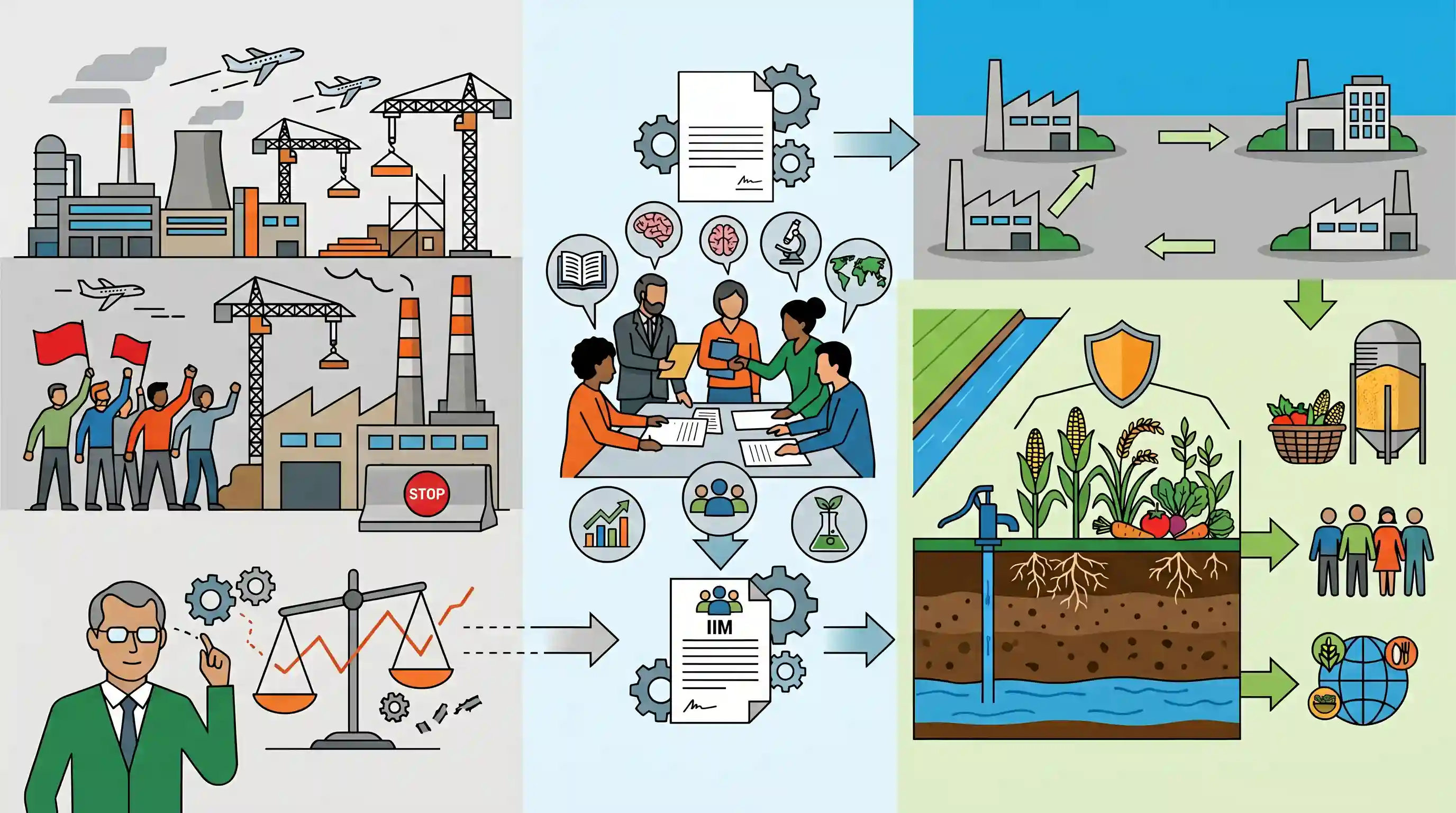
The article details a proposal by agri-economist Dr. T.N. Prakash Kammaradi to formulate a comprehensive state policy governing land acquisition for industries. Responding to prolonged farmer protests in Devanahalli over land acquisition for an aerospace park, he pointed out the lack of scientific norms determining the exact land requirements of industries. Dr. Kammaradi suggested that institutions like IIM-B, ISEC, and ICAR help draft a transparent land-use plan balancing industrial decentralization with agricultural preservation. Crucially, he advocated that acquisition exemptions must cover fertile, groundwater-irrigated lands supporting multiple crops—not just canal-irrigated areas—to secure long-term food security.
मुख्य बिंदु
- Farmers in Devanahalli, Karnataka, have been protesting for over 1,190 days against land acquisition for a proposed Defence and Aerospace Park.
- Agri-economist Dr. T.N. Prakash Kammaradi highlights the absence of clear governmental norms to scientifically assess the quantum of land required by various industries, sometimes leading to disproportionate land allocations.
- He proposes a comprehensive, transparent land-use policy drafted in consultation with academic institutions like IIM-B, ISEC, and ICAR to ensure decentralized industrial growth and optimal land utilization.
- To safeguard food and nutritional security, he argues that land acquisition exemptions should be expanded from just canal-irrigated command areas to include fertile, groundwater-irrigated lands that support multi-cropping.
महत्वपूर्ण शब्द
Indian Council of Agricultural Research (ICAR)

Apex body under the Ministry of Agriculture for coordinating and managing research and education in agriculture, horticulture, fisheries, and animal sciences across India.
UPSC context
GS Paper III (Agriculture/Research); tests institutional architecture for food security and technological advancements in farming.
Institute for Social and Economic Change (ISEC)
A premier interdisciplinary social science research institute in Bengaluru, providing evidence-based policy feedback to Central and State governments on sustainable development and rural transformation.
UPSC context
GS Paper III (Economic Development); relevant for the role of specialized research bodies in evidence-based policy formulation.
Karnataka Agricultural Prices Commission (KAPC)
A state-level advisory body in Karnataka that recommends crop prices and market interventions to ensure remunerative returns for farmers based on production costs.
UPSC context
GS Paper III (Agriculture/MSP); tests knowledge of state-level mechanisms for agrarian welfare and crop pricing.
Indian Institute of Management-Bengaluru (IIM-B)
A top-tier public management institute whose Centre for Public Policy (CPP) bridges the gap between management scholarship and governance across various economic sectors.
UPSC context
GS Paper II (Public Policy); tests the involvement of academic institutions in drafting industrial and land-use policies.
Indian Institute of Plantation Management (IIPM)
An autonomous sectoral management institute specialized in the plantation and agri-business sectors, providing education and training for tea, coffee, rubber, and spices.
UPSC context
GS Paper III (Agriculture/Major Crops); relevant for understanding management and value-chain development in the plantation sector.
प्रारंभिक ट्रैप
The LARR Act 2013 absolutely prohibits the acquisition of multi-crop irrigated land for any industrial or infrastructure projects.
Acquisition of multi-crop irrigated land is restricted, not absolutely prohibited. It can be acquired under exceptional circumstances as a last resort, requiring compensatory wasteland development.
संबंधित अवधारणाएँ
How does the LARR Act 2013 safeguard agricultural land and food security?
- Exceptional use only: Prohibits acquiring multi-crop irrigated land except under exceptional circumstances as a demonstrably last resort.
- Compensatory development: Mandates developing an equivalent area of cultivable wasteland for agriculture if multi-crop irrigated land is acquired.
- District limits: Requires State governments to fix a strict limit on the total net sown area that can be acquired within a district.
Under which Constitutional jurisdiction do land and land acquisition fall?
- State List: 'Land' (including rights in or over land, land tenures, and agriculture) is listed under Entry 18 of the State List.
- Concurrent List: 'Acquisition and requisitioning of property' is listed under Entry 42 of the Concurrent List, empowering both the Centre and States to legislate.
अंतर-विषय पैटर्न
Groundwater vs Canal Irrigation bias
Legal frameworks often equate 'irrigated land' strictly with canal command areas, leaving fertile groundwater-irrigated farms vulnerable to acquisition despite groundwater supplying over 60% of India's irrigation.
Industrial Corridors & Land Use Policy
The push for indigenous defense/aerospace hubs frequently clashes with agriculture. This underscores the long-pending need for a statutory National Land Utilisation Policy directing industries to arid wastelands.

LARR Act provisions on multi-crop irrigated land and constitutional jurisdiction over land acquisition are highly probable for 2026 Prelims.
संबद्ध PYQ · 5
संबद्ध PYQ · 5
- 2014MainsGS3
The Right to Fair Compensation and Transparency in Land Acquisition, Rehabilitation and Resettlement Act, 2013 has come into effect from 1st January, 2014. What are the key issues which would get addressed with the Act in place? What implications would it have on industrialization and agriculture in India?
- 2021MainsGS3
How did land reforms in some parts of the country help to improve the socio-economic conditions of marginal and small farmers?
- 2023MainsGS3
State the objectives and measures of land reforms in India. Discuss how land ceiling policy on landholding can be considered as an effective reform under economic criteria.
- 2020MainsGS3
Suggest measures to improve water storage and irrigation system to make its judicious use under depleting scenario.
- 2019MainsGS3
Elaborate the impact of National Watershed Project in increasing agricultural production from water-stressed areas.
