Uttarakhand Agriculture Department Drafts New Crop Fencing Policy
Source:timesofindia ↗
Why It Matters
Human-wildlife conflict and subsequent agricultural abandonment are the leading causes of outmigration and the rise of 'ghost villages' in Uttarakhand's hills. State-specific measures, migration trends, and agrarian policy parameters are highly relevant for UKPSC PCS Prelims.
Summary
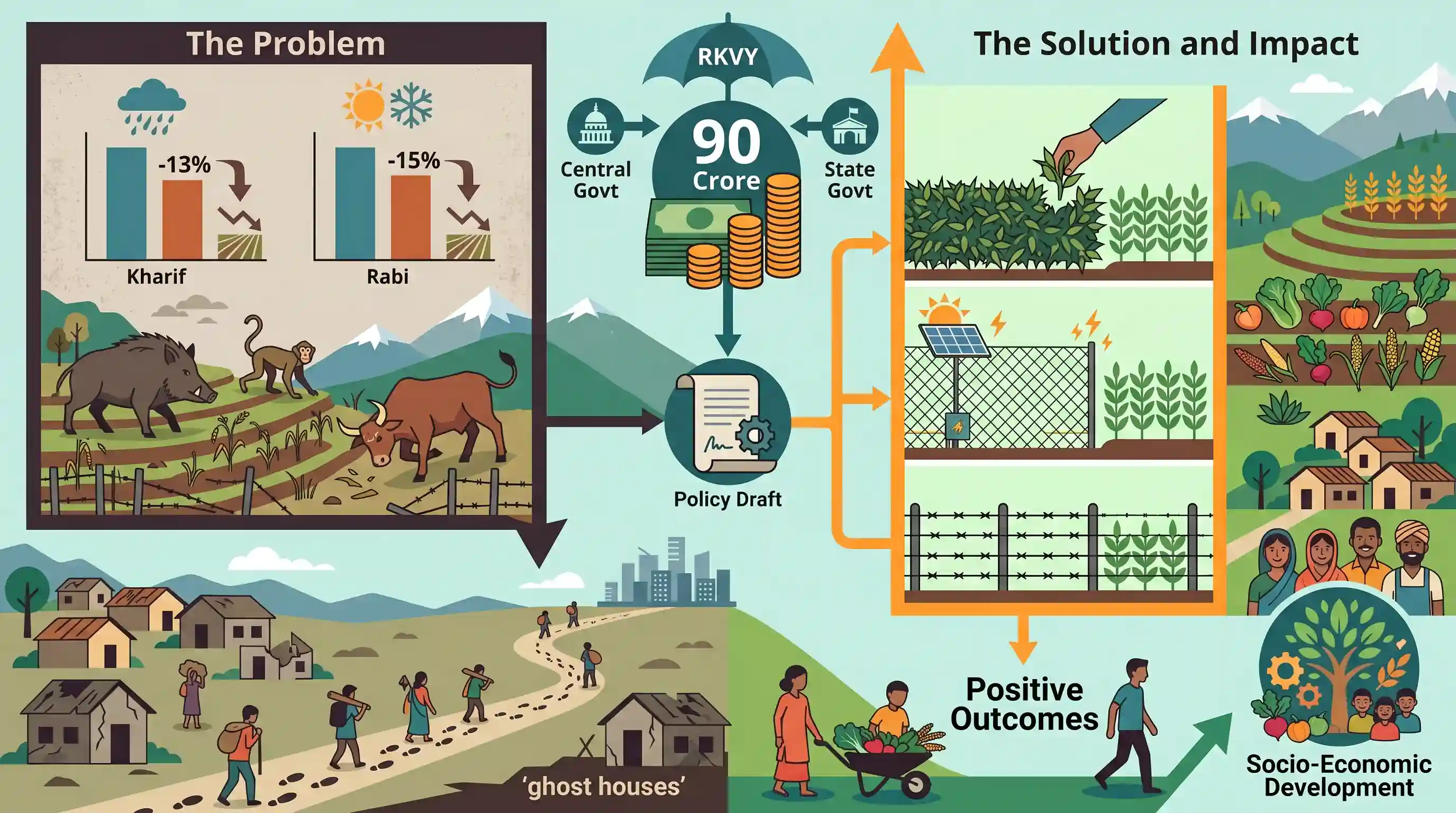
The Uttarakhand Agriculture Department has drafted a dedicated fencing policy to safeguard crops from wildlife and stray animals. Under this policy, vegetative, solar, and barbed-wire fencing will be funded to prevent crop loss—a primary driver of outmigration in hill districts. The policy follows a Rs 90 crore central allocation and addresses severe agricultural contractions where Kharif and Rabi cultivation areas shrank by 13% and 15% respectively.
Key Points
- The Uttarakhand Agriculture Department has prepared a draft 'fencing policy' offering multiple solutions (vegetative, barbed-wire, and solar fencing) to protect farmlands from wildlife and stray animals.
- Monkeys, wild boars, and blue bulls (nilgai) are identified as the primary species causing crop damage, particularly in Almora, Pauri, and Uttarkashi districts.
- The Uttarakhand Migration Prevention Commission has highlighted crop depredation by wildlife as a major driver of outmigration from hill regions.
- Due to crop raids and conflict, the state's agricultural footprint has declined significantly: between 2016-17 and 2021-22, the area under Kharif cultivation fell by 13% and Rabi cultivation fell by 15%.
- This is the first time the Uttarakhand state government will provide dedicated funds for farmland fencing. The draft policy follows a 2025 Union budget announcement of Rs 90 crore by Union Minister Shivraj Singh Chouhan during a visit to Chamoli, of which Rs 25 crore was released in June 2026.
- Previously, crop fencing was supported under the Centrally Sponsored Rashtriya Krishi Vikas Yojana (RKVY) before central funding for this component was discontinued.
Important Terms
Fencing Policy (Draft)

A policy drafted by Uttarakhand's Agriculture Department to provide dedicated financial support for vegetative, solar, and barbed-wire farming barriers, protecting crops from wildlife and stray animals to halt agriculture-induced migration.
UPSC context
GS Paper III (Agriculture & Wildlife Conflict), testing state-level strategies to prevent crop damage and rural outmigration in hilly terrains.
Rashtriya Krishi Vikas Yojana (RKVY)
A centrally sponsored scheme launched in 2007 (now PM-RKVY) by the Ministry of Agriculture and Farmers Welfare to promote state-led, decentralized planning and flexible investment in agriculture and allied sectors.
UPSC context
GS Paper II (Government Schemes) & Paper III (Agriculture), testing decentralized funding, state autonomy, and holistic agricultural growth models.
Uttarakhand Migration Prevention Commission
A state body formed in 2017 to analyze rural outmigration challenges, recommend multi-sectoral grassroot development policies, and facilitate reverse migration to prevent hill villages from turning uninhabited.
UPSC context
GS Paper I (Demography/Migration) & Paper II (Regional Governance), testing institutional strategies to address rural distress and outmigration in mountain regions.
Union Ministry of Agriculture and Farmers' Welfare
The central government ministry responsible for administering agricultural policies, national food security programs, and major funding schemes such as PM-RKVY and PM-Kisan to boost farmers' income.
UPSC context
GS Paper II (Union Ministries) & Paper III (Agricultural Policy), testing knowledge of national governance, food security, and state-centre agricultural collaborations.
Uttarakhand Agriculture Department
The state authority tasked with administering agriculture and horticulture schemes, managing food security, and implementing targeted initiatives like the Aroma Revolution and crop fencing in Uttarakhand.
UPSC context
GS Paper III (State Agriculture Extension) & Paper II (Governance), testing administrative measures for crop diversification and regional farming development.
Prelims Trap
The Union Ministry of Environment permanently declares wild boars and nilgai as vermin across all Himalayan states to protect agriculture.
Wild animals can only be declared vermin under Section 62 of WPA 1972 via temporary, state-specific notifications, not permanently or universally.
Static Concepts Connected
What is the funding and administrative structure of the Rashtriya Krishi Vikas Yojana (RKVY)?
- Scheme Nature: Launched in 2007 as a Centrally Sponsored Scheme, now restructured under PM-RKVY to provide states flexibility in agricultural planning.
- Funding Pattern: Shared between Center and States, with a 90:10 ratio specifically designated for Himalayan and North Eastern states.
How does the Wildlife (Protection) Act, 1972 regulate crop-damaging animals?
- Section 62: Empowers the Centre to declare certain wild animals as vermin for a specified area and period, removing their protection temporarily.
- Section 11: Authorizes the Chief Wildlife Warden to permit hunting of wild animals that become dangerous to human life or standing crops.
Cross-Topic Patterns
Human-Wildlife Conflict & Internal Migration
Crop depredation acts as an environmental push factor, converting agrarian communities into economic migrants and creating ghost villages in ecologically sensitive hill states.
Cooperative Federalism in Agriculture Funding
The evolution of RKVY to PM-RKVY demonstrates how federal agricultural schemes balance central funding with state-level flexibility to address hyper-local ecological crises.

State-specific ecological push factors of internal migration (e.g. crop depredation) likely to feature in 2026 GS-3 Mains.
Linked PYQs · 3
Linked PYQs · 3
- 2025UKPSC_PRELIMSGS1
Which of the following districts of Uttarakhand has the highest agricultural land ?
- 2025UKPSC_PRELIMSGS1
Consider the following statements with reference to animal husbandry in Uttarakhand. Select the correct answer from the codes given below : 1. Animal husbandry is a supplementary occupation of agriculture. 2. Sheep rearing in the mountainous areas has been affected by environmental degradation.
- 2024UKPSC_PRELIMSGS1
'Chaumu Deity' is worshipped in Uttarakhand for
