Vice President Jagdeep Dhankhar Resigns Amid Institutional Friction
Source:The Hindu ↗
Why It Matters
This unprecedented resignation brings into sharp focus the constitutional provisions related to the Vice-President (Article 67), the complex procedure for the impeachment of High Court judges under the Judges (Inquiry) Act, 1968, and the ongoing debate surrounding parliamentary sovereignty versus judicial independence in India's constitutional framework.
Summary
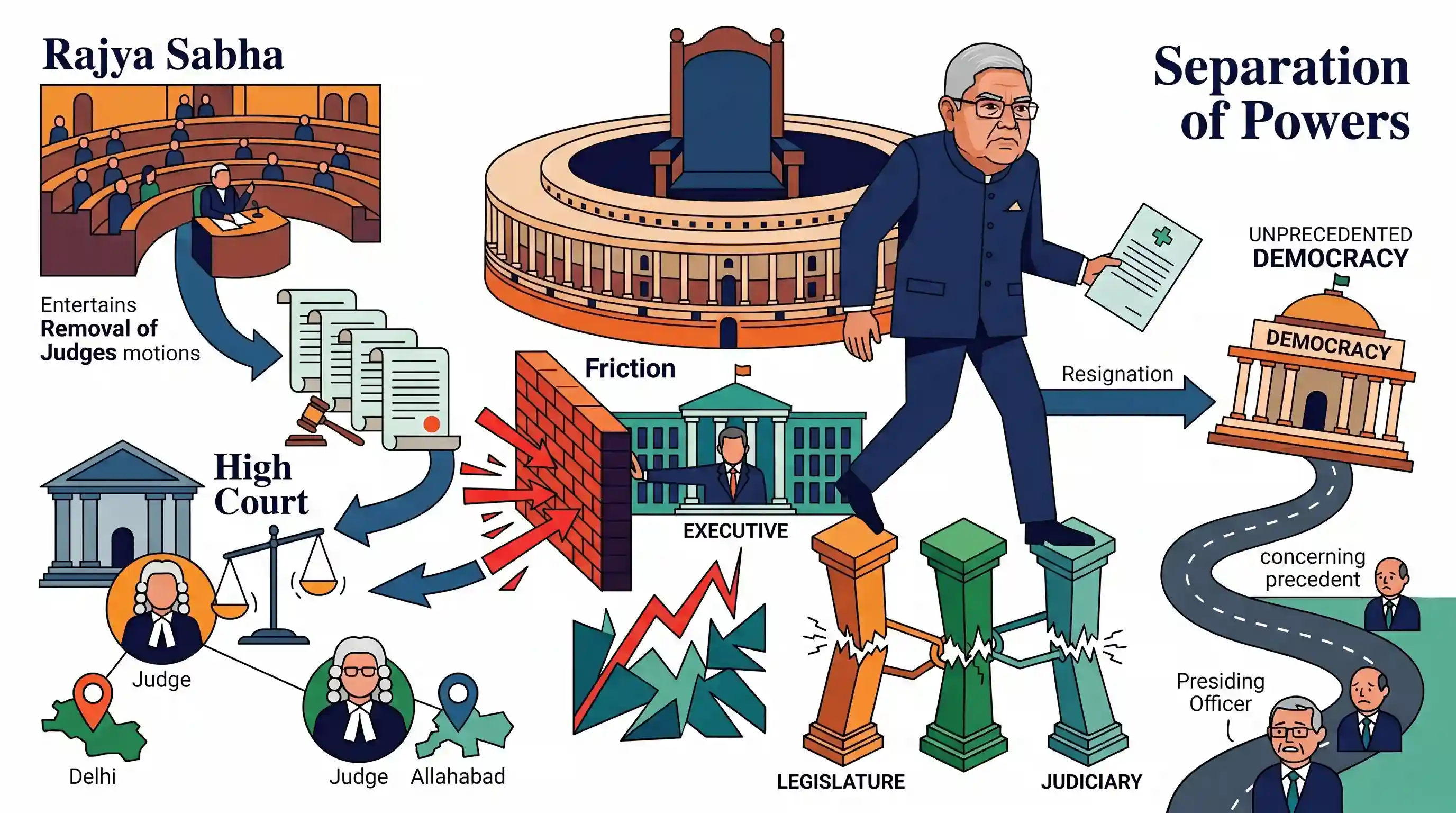
Jagdeep Dhankhar abruptly resigned as Vice-President of India, formally citing health reasons but seemingly driven by an escalating constitutional and political impasse with the ruling BJP government. As the Chairman of the Rajya Sabha, Dhankhar championed parliamentary supremacy and judicial accountability. However, his decision to entertain Opposition-backed motions for the removal of High Court judges (including a Delhi High Court judge and Allahabad High Court's Justice Shekhar Kumar Yadav) according to parliamentary rules clashed with the executive's stance. His sudden exit highlights significant friction regarding the separation of powers and sets a unique, concerning precedent for parliamentary democracy and the independence of presiding officers.
Key Points
- Vice-President Jagdeep Dhankhar unexpectedly resigned, marking the first such exit in India's history not driven by presidential elevation.
- While citing health reasons, the resignation is widely seen as the fallout of severe executive-legislature friction over judicial accountability and parliamentary procedures.
- The primary conflict arose from Dhankhar accepting Opposition motions to remove High Court judges (including Justice Shekhar Kumar Yadav and a Delhi High Court judge) on corruption and misconduct charges.
- As an activist Rajya Sabha Chairman, Dhankhar's firm stance on parliamentary supremacy versus judicial independence put him on a collision course with the ruling government's political strategy.
Important Terms
Vice President of India

The second-highest constitutional office in India. The holder serves as the ex-officio Chairman of the Rajya Sabha and can resign by addressing the President under Article 67(a).
UPSC context
GS Paper II: Constitutional Posts. Tests knowledge of election, powers, and removal/resignation procedures of high constitutional functionaries.
Rajya Sabha
The Upper House of India's Parliament. It represents the states and Union Territories, is a permanent body, and its Chairman (the Vice President) presides over its proceedings.
UPSC context
GS Paper II: Parliament and State Legislatures. Tests understanding of the role, composition, and powers of the Council of States.
Removal of Judges
The constitutional process (under Articles 124 and 218) for ousting HC/SC judges on grounds of 'proved misbehaviour' or 'incapacity,' initiated via a motion in either House of Parliament.
UPSC context
GS Paper II: Structure and Functioning of Judiciary. Focuses on judicial independence vs. accountability and the check-and-balance role of Parliament.
Separation of Powers
A constitutional principle ensuring that the Executive, Legislature, and Judiciary operate within their own spheres, preventing any one branch from encroaching on the powers of the others.
UPSC context
GS Paper II: Constitutional Framework. Tests the ability to analyze friction between different organs of the state.
Parliamentary Supremacy
The principle that Parliament has the final authority to make laws and oversee the executive, often debated in India alongside the doctrine of Judicial Review.
UPSC context
GS Paper II: Indian Constitution. Critical for analyzing the power balance between the legislature and the judiciary.
Judicial Accountability
The requirement for judges to be answerable for their conduct. It involves balancing the independence of the judiciary with mechanisms like the Judges (Inquiry) Act, 1968.
UPSC context
GS Paper II: Governance and Judiciary. Tests concepts of ethics, transparency, and the mechanism for addressing judicial misconduct.
Prelims Trap
The Deputy Chairman of Rajya Sabha acts as the Acting Vice-President until a new election is held.
The Constitution has no provision for an 'Acting Vice-President'. The Deputy Chairman merely assumes the duties of presiding over the Rajya Sabha, not the office of the VP.
Static Concepts Connected
What is the statutory process for the removal of a High Court Judge?
- Initiation: A removal motion requires signatures from at least 100 Lok Sabha MPs or 50 Rajya Sabha MPs under the Judges (Inquiry) Act, 1968.
- Admission Discretion: The Presiding Officer of the respective House has absolute discretionary power to either admit or refuse the motion.
- Investigation Committee: If admitted, the Presiding Officer forms a three-member committee (Supreme Court judge, High Court Chief Justice, eminent jurist) to investigate charges.
- Parliamentary Vote: Removal requires a special majority vote in both Houses during the same session, followed by a Presidential order (Articles 124(4) and 218).
How is a constitutional vacancy handled if the Vice-President resigns mid-term?
- Resignation Letter: The VP addresses a written resignation to the President of India (Article 67a), which takes immediate effect without needing parliamentary acceptance.
- Upper House Leadership: The Deputy Chairman performs the duties of the Chairman of the Rajya Sabha while the office of the VP remains entirely vacant.
- Election Timeline: Unlike the 6-month cap for a Presidential vacancy, the Constitution only mandates that elections to fill a VP vacancy be held "as soon as possible".
Cross-Topic Patterns
Judicial Independence vs Parliamentary Oversight
Dhankhar’s tenure frequently highlighted the tension between judicial review (like striking down NJAC) and parliamentary supremacy, now culminating in the weaponization of the Judges Inquiry Act.
Politicization of the Presiding Officer
This incident parallels recent controversies around the Speaker's partisan roles in anti-defection cases (10th Schedule), highlighting structural vulnerabilities regarding the true independence of legislative presiding officers in India.

Expect a multi-statement Prelims 2026 question combining the Judges Inquiry Act with the VP's resignation and RS Chairman vacancy rules.
Linked PYQs · 3
Linked PYQs · 3
- 2004PrelimsGS1
The resolution for removing the Vice-president of India can be moved in the:
- 2023MainsGS2
Compare and contrast the British and Indian approaches to Parliamentary sovereignty.
- 2020MainsGS2
Judicial Legislation is antithetical to the doctrine of separation of powers as envisaged in the Indian Constitution. In this context justify the filing of large number of public interest petitions praying for issuing guidelines to executive authorities.
