Agniveer Recruitment Scheme and Retention Policy Updates
Source:The Hindu ↗
Why It Matters
It provides critical insights into India's evolving defence human resource policy, military modernization, and employment framework under the Agnipath scheme, which is vital for GS3 (Security) and GS2 (Governance).
Summary
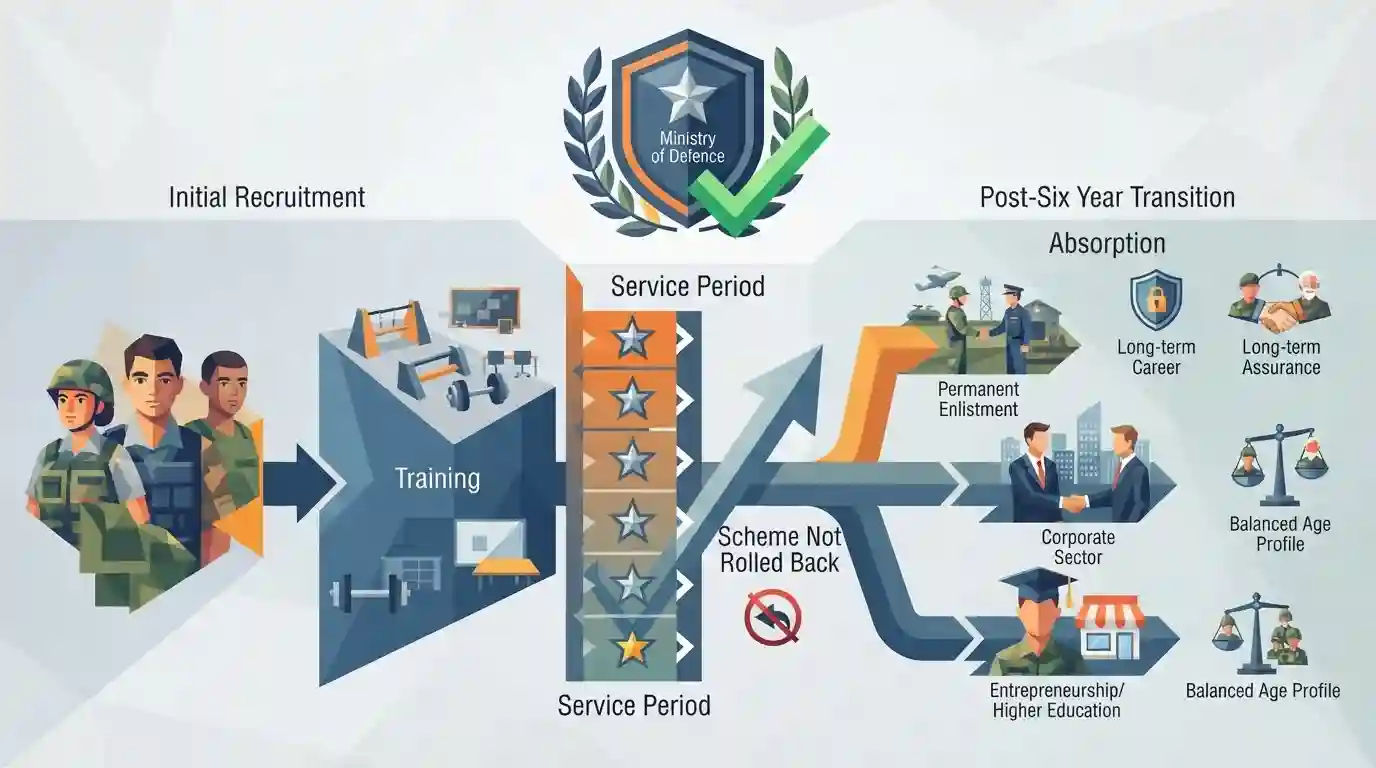
The Ministry of Defence addressed clarifications regarding the Agniveer military recruitment scheme, stating that it has not been rolled back and that all eligible recruits will be absorbed after a six-year period. This update highlights ongoing policy refinements to balance troop age profiles with long-term career assurance for defence personnel.
Key Points
- The Ministry of Defence clarified that the Agniveer recruitment scheme has not been rolled back.
- Plans are structured to ensure all eligible recruits under the scheme are absorbed after a service period extended or set around six years.
- The scheme addresses structural human resource policies and modernization of the Indian military's age profile.
- Balancing youth profiles with professional continuity remains a key focus of the defence recruitment strategy.
Important Terms
Agnipath scheme

A military recruitment model for the Indian Armed Forces introduced to induct soldiers (Agniveers) below officer rank for short-term engagements, aimed at maintaining a youthful and technologically adept troop profile.
UPSC context
UPSC Mains GS Paper 3 (Security): Tests understanding of defence reforms, military human resource policies, and national security challenges.
Agniveer scheme
Soldiers recruited into the Indian Armed Forces under the Agnipath short-term recruitment scheme, with recent policy updates allowing eligible personnel to be absorbed into the regular cadre after six years.
UPSC context
UPSC Mains GS Paper 3 (Security): Relevant for evaluating government interventions in manpower management, employment, and youth welfare within security forces.
Ministry of Defence
The apex government body charged with formulating and executing defence policy and overseeing all matters relating to the Indian Armed Forces and national security.
UPSC context
UPSC Mains GS Paper 2 (Governance) & GS Paper 3 (Security): Tests knowledge of organizational structure and administrative control over national security institutions.
Static Concepts Connected
What are the constitutional provisions and parliamentary oversight mechanisms governing India's Armed Forces?
- Constitutional Command: Supreme Command of the defence forces of the Union is vested in the President of India under Article 53(2).
- Parliamentary Control: Parliament exercises legislative control over defence expenditure through the annual Demands for Grants and oversight by the Estimates Committee.
- Administrative Setup: The Department of Military Affairs (DMA), headed by the Chief of Defence Staff (CDS), handles matters relating to the armed forces alongside the Ministry of Defence.
Cross-Topic Patterns
Agniveer Absorption + Demographic Dividend Pressures
The shift from short-term contractual military recruitment to assured absorption pathways reflects evolving domestic employment pressures intersecting with national defence modernization and fiscal budget allocations.

Agnipath policy changes (retention rates, age profile impact) will feature in GS-3 Defence/HR policy application questions.
Linked PYQs · 2
Linked PYQs · 2
- 2023MainsGS2
Skill development programmes have succeeded in increasing human resources supply to various sectors. In the context of the statement analyse the linkages between education, skill and employment.
- 2023MainsGS2
The crucial aspect of development process has been the inadequate attention paid to Human Resource Development in India. Suggest measures that can address this inadequacy.
