Student union election protests escalate across Rajasthan universities
Source:The Hindu ↗
Why It Matters
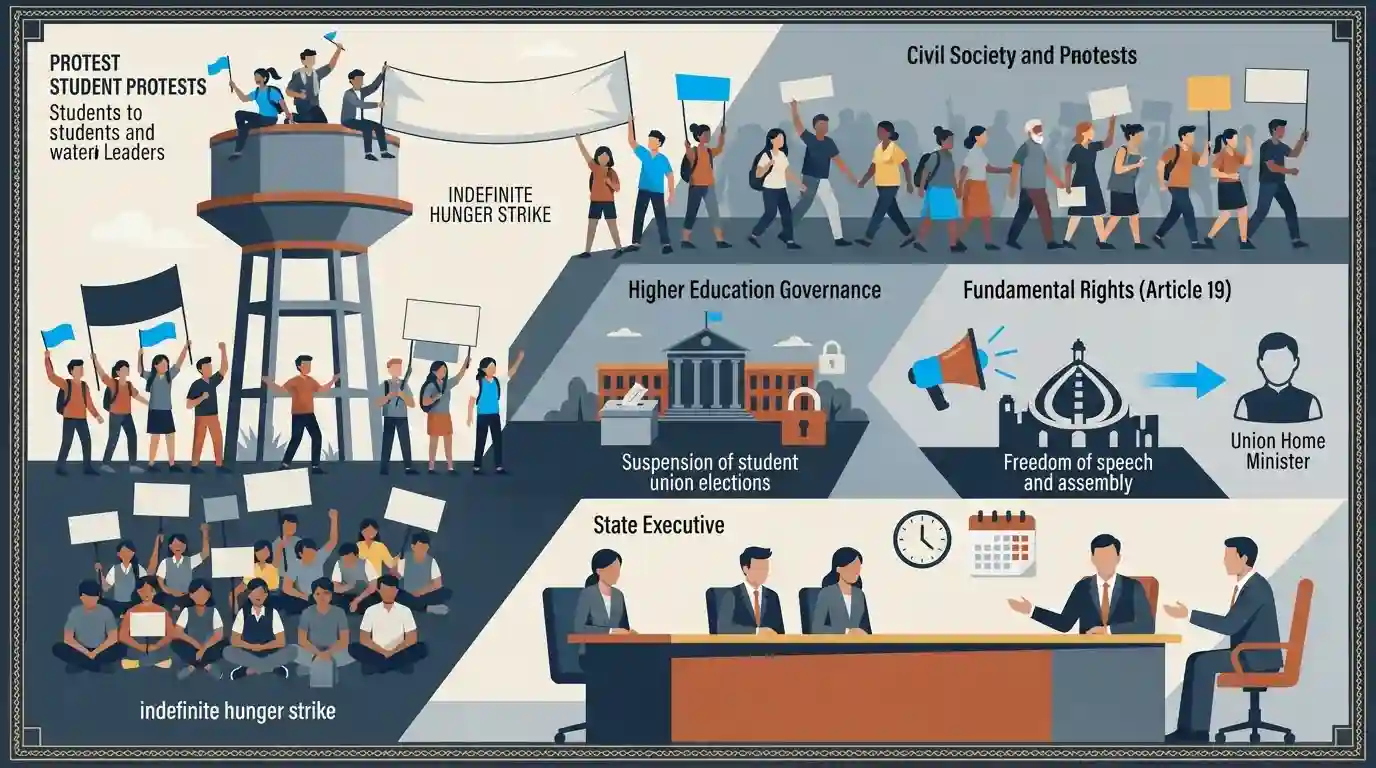
Highlights the intersection of student politics, the constitutional right to peaceful assembly (Article 19), and the role of the State Executive in conflict resolution and higher education administration.
Summary
The National Students’ Union of India (NSUI) has escalated its agitation in Rajasthan to demand the restoration of student union elections. Protests took dramatic turns with leaders climbing a water tank and launching indefinite hunger strikes. Following intervention by Congress leaders, the state government agreed to hold discussions, scheduling a meeting between the student delegation, Deputy Chief Minister Premchand Bairwa, and Chief Minister Bhajanlal Sharma. Additionally, the protesters are demanding an apology from Union Home Minister Amit Shah over a recent alleged police lathi-charge on youths at Jantar Mantar in New Delhi.
Key Points
- NSUI leaders in Rajasthan have intensified protests demanding the restoration of student union elections in colleges and universities.
- The agitation included symbolic demonstrations like climbing a water tank and an indefinite hunger strike by student leaders.
- Protesters will hold dialogues with Rajasthan Deputy Chief Minister and Higher Education Minister Premchand Bairwa, as well as Chief Minister Bhajanlal Sharma.
- The students also strongly condemned an alleged lathi-charge on youths at Delhi's Jantar Mantar, demanding a public apology from Union Home Minister Amit Shah.
- Senior Congress leaders intervened to facilitate negotiations and urged the state government to address the legitimate demands of the students.
Important Terms
National Students' Union of India (NSUI)

A prominent student organization and the student wing of the Indian National Congress. It actively participates in campus politics, frequently organizing protests and agitations to demand democratic rights for students.
UPSC context
GS Paper 2 (Pressure Groups/Civil Society). Highlights the role of student organizations in political mobilization and demanding institutional accountability.
Student Union Elections
Democratic exercises held in higher education institutions to elect student representatives. Their conduct and restoration are heavily debated, often balancing democratic participation against potential disruptions to academic schedules.
UPSC context
GS Paper 2 (Higher Education Governance). Tests awareness of institutional democracy, youth participation, and relevant educational reforms.
Lyngdoh Committee
A committee formed in 2006 under Supreme Court directives to frame a regulatory framework for student union elections. It recommended age limits and strict expenditure caps to eliminate money and muscle power.
UPSC context
GS Paper 2 (Governance/Education). Crucial for questions regarding electoral reforms within university campuses and maintaining academic standards.
Right to Peaceful Assembly (Article 19)
A Fundamental Right under Article 19(1)(b) of the Constitution that permits citizens to assemble peacefully without arms, serving as the legal bedrock for democratic protests and student agitations.
UPSC context
GS Paper 2 (Fundamental Rights). Evaluates the balance between democratic protests, civil liberties, and the state's imposition of public order.
Prelims Trap
The Constitution explicitly guarantees the Right to Protest under Article 19.
The Right to Protest is implicitly derived from Article 19(1)(a) and 19(1)(b). It is not explicitly named in the Constitution, nor does it include the Right to Strike.
Static Concepts Connected
What are the core mandates of the J.M. Lyngdoh Committee regarding campus elections?
- Age & Attendance: Mandates strict age limits (e.g., 17-22 for Undergraduates) and a minimum of 75% academic attendance to be eligible to contest.
- Financial Caps: Strictly caps election expenditure and explicitly prohibits the use of external political party funds to curb money power on campus.
- Criminal Record: Candidates must not have a previous criminal record, nor should they have been tried or convicted of any criminal offense.
What is the constitutional validity and rank of a Deputy Chief Minister?
- Extra-constitutional post: The post is not mentioned in the Constitution; it is purely a political arrangement designed to balance regional or coalition dynamics.
- Oath and Rank: A Deputy CM is sworn in simply as a Cabinet Minister under Article 164 and enjoys the same pay, perks, and rank.
Cross-Topic Patterns
Article 19 limits & Section 144
Student protests frequently clash with state public order mechanisms, bridging Fundamental Rights (Art 19) with executive powers under Section 144 of the BNSS/CrPC.
Broadening electoral reforms
The Lyngdoh guidelines for student unions mirror broader Election Commission efforts to curb money and muscle power (criminalization) in national politics.

Questions linking the 'implicit' Right to Protest (Art 19) versus the statutory Right to Strike remain a high-probability Polity trap.
Linked PYQs · 2
Linked PYQs · 2
- 2024RPSC_PRELIMSGS1
Fundamental Rights provided by which of the following groups of Articles are granted only to 'Citizens' of India?
- 2025RPSC_PRELIMSGS1
Which group of fundamental rights, provided by the articles, are exclusively conferred upon ‘citizens’ of India?
