Tripura Introduces Pink Marking for Autorickshaws to Curb Violations
Source:Indian Express ↗
Why It Matters
Effective urban mobility requires strict regulation of para-transit vehicles (like autorickshaws), which often cause congestion due to permit violations. Visual compliance measures like color-coding offer a low-cost, effective governance tool for local transport authorities.
Summary
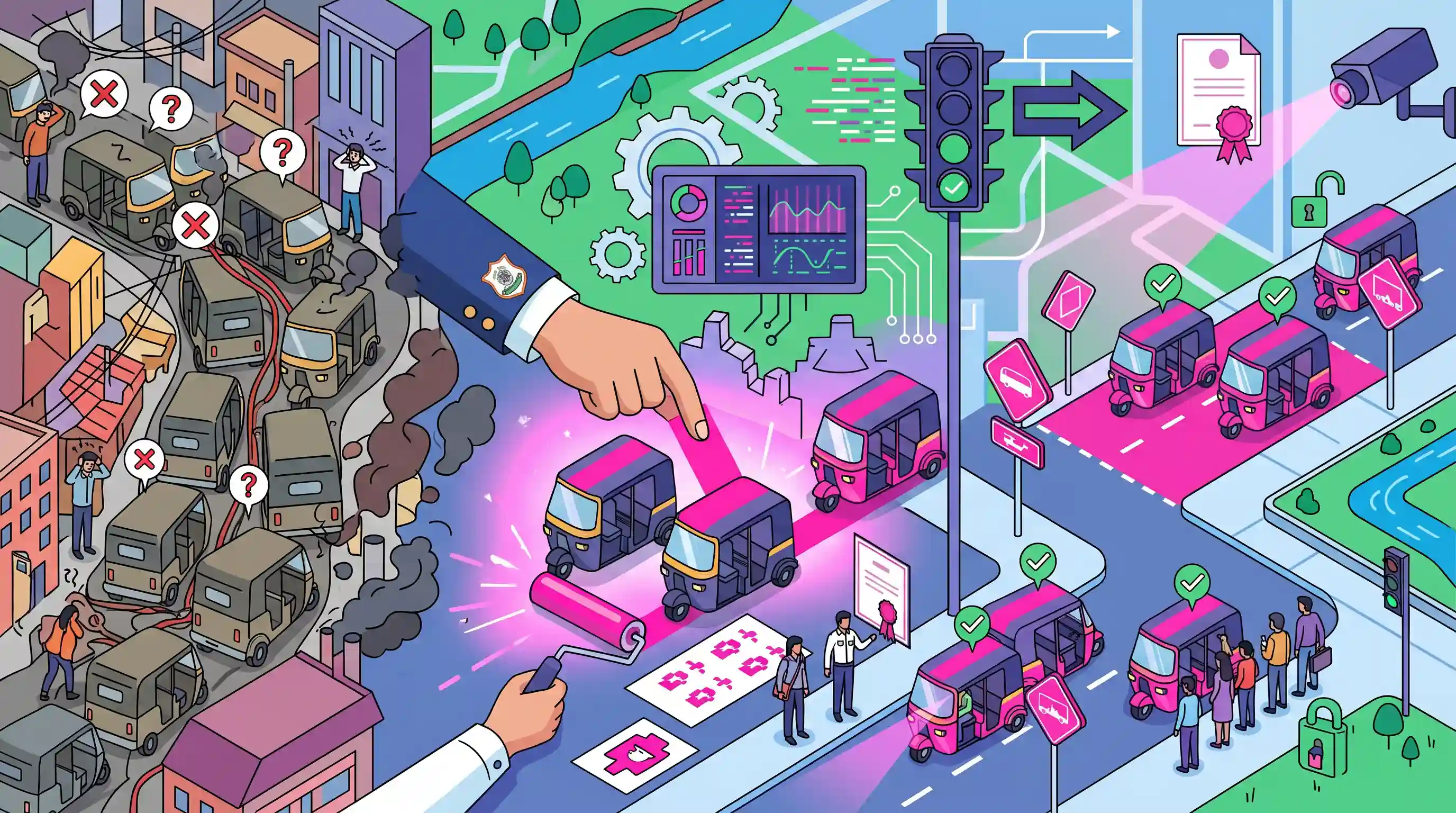
The Tripura government is implementing a "pink marking" system for autorickshaws in Agartala to combat permit violations and ease traffic congestion. This move aims to easily identify legally permitted vehicles operating within designated zones, thereby streamlining urban transport management. Unregulated para-transit modes like autorickshaws often lead to urban traffic chaos, and this regulatory mechanism will assist traffic authorities in enforcing rules and ensuring better urban mobility.
Key Points
- A new "pink marking" initiative is being introduced for autorickshaws in Agartala, Tripura to visually identify authorized vehicles.
- The scheme is designed to curb permit violations by distinguishing permitted autorickshaws from those operating illegally or outside their designated zones.
- This regulatory measure aims to reduce traffic congestion and improve overall urban transport management in the city.
- The initiative highlights the challenges of regulating para-transit systems in expanding urban centers and the use of simple compliance tools for better governance.
Important Terms
Agartala Municipal Corporation (AMC)

The municipal body governing Tripura's capital; notably the oldest in Northeast India (est. 1871). It manages urban planning, civic infrastructure, and local governance.
UPSC context
GS II (Urban Local Bodies); tests the role of ULBs in urban management and infrastructure development.
Tripura Transport Department
The state-level executive authority responsible for enforcing transport laws, issuing vehicle permits, and regulating public transport services across Tripura.
UPSC context
GS II (Executive & Governance); relevant for state-level policy implementation and regulatory compliance in transport.
Para-transit
Also known as Intermediate Public Transport (IPT); flexible, demand-responsive transport (like autorickshaws) that fills gaps between private vehicles and formal mass transit.
UPSC context
GS III (Infrastructure); critical for discussing 'last-mile connectivity' and informal economy challenges in urban planning.
Urban Mobility
The comprehensive system allowing efficient movement of people and goods within a city, including infrastructure, transit modes, and regulatory policies to reduce congestion.
UPSC context
GS III (Sustainable Development/Infrastructure); key for questions on the National Urban Transport Policy and Smart Cities.
Route Permit
A legal authorization designating specific geographical areas or routes where a commercial vehicle is allowed to operate, preventing unregulated traffic influx.
UPSC context
GS II (Regulatory Bodies); tests knowledge of administrative mechanisms used to manage public utilities and transport.
Motor Vehicles Act, 1988
India’s primary central legislation governing road transport, vehicle registration, and licensing. It provides the legal basis for state-level traffic regulations.
UPSC context
GS II (Statutory Provisions); fundamental for road safety, federalism in transport regulation, and legislative powers.
Prelims Trap
The Pink Marking initiative for autorickshaws in Agartala is a women-exclusive transport scheme ensuring female safety.
Unlike Pink Auto schemes elsewhere, Agartala's pink marking is purely a geographic regulatory tool to distinguish city-permitted autos from out-of-zone ones to curb congestion.
Static Concepts Connected
What is Intermediate Public Transport (IPT) or Para-transit?
- Core Definition: Flexible, informal transport services like autorickshaws and e-rickshaws that bridge the gap between private vehicles and formal mass transit.
- Last-Mile Connectivity: They are crucial for providing last-mile connectivity to formal transit hubs (metro/bus stations) in Indian urban centers.
- Regulatory Challenges: Their informal nature and lack of spatial regulation frequently lead to urban traffic bottlenecks and unbalanced route coverage.
What are the core tenets of the National Urban Transport Policy (NUTP) 2006?
- People-Centric Approach: Prioritizes the mobility of people over vehicles by promoting public transport and Non-Motorized Transport (NMT).
- System Integration: Advocates for the integration of informal para-transit systems into comprehensive city mobility plans as organized feeder services.
- Sustainability & Equity: Focuses on equitable allocation of road space, transit-oriented development (TOD), and lowering the carbon footprint of urban travel.
Cross-Topic Patterns
Deceptive scheme nomenclature
UPSC often tests deceptive scheme intent. Do not confuse administrative route-compliance tools (Agartala's pink marking) with women-centric empowerment initiatives like 'Pink Autos' in other states.
Low-tech urban governance
Color-coding fleets provides a low-cost, high-impact spatial regulation tool for Urban Local Bodies in tier-2/3 cities lacking expensive digital surveillance infrastructure.

Expect a multi-statement question on urban mobility mixing NUTP-2006 principles with the regulation of informal para-transit networks.
Linked PYQs · 2
Linked PYQs · 2
- 2014MainsGS3
National Urban Transport Policy emphasises on 'moving people' instead of 'moving vehicles'. Discuss critically the success of the various strategies of the Government in this regard.
- 2024MainsGS2
Analyse the role of local bodies in providing good governance at local level and bring out the pros and cons merging the rural local bodies with the urban local bodies.
