ISRO Space Missions Heavy Payloads and Docking Technology
Source:Indian Express ↗
Why It Matters
ISRO's capabilities in heavy-lift launch vehicles (LVM3) and advanced technological demonstrators like SpaDeX are frequent focal points for UPSC GS3 Science and Technology questions. Furthermore, Gaganyaan and NISAR are landmark missions with high probability of appearing in both Prelims and Mains.
Summary
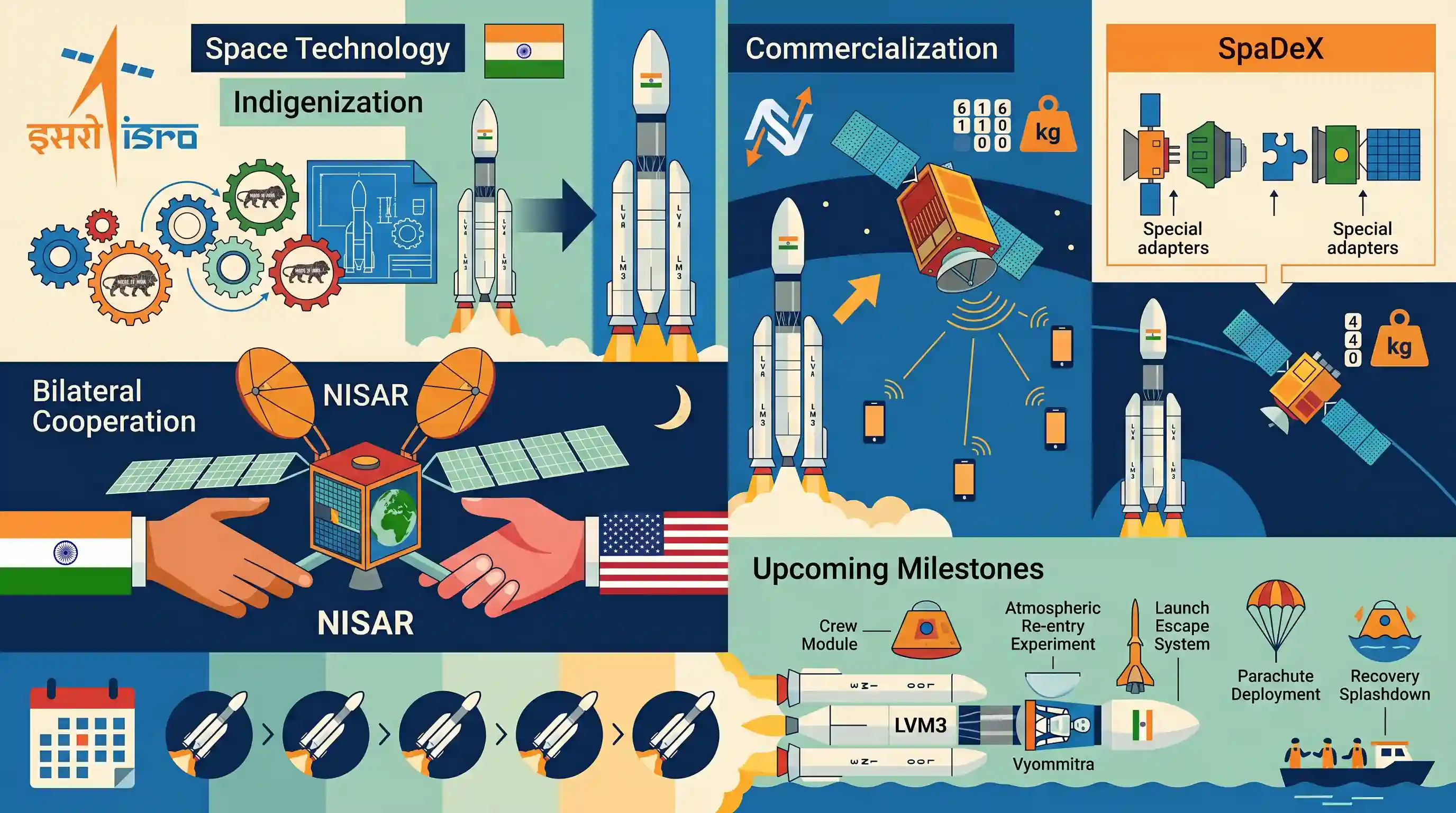
The article highlights the recent successes and upcoming milestones of the Indian Space Research Organisation (ISRO). Key achievements include the successful deployment of a 6,100-kg commercial satellite by the LVM3-M6 rocket into Low-Earth Orbit, marking the heaviest payload carried by an Indian rocket. ISRO also completed the SpaDeX mission to demonstrate space docking, the joint India-US NISAR mission for detailed Earth imaging, and the LVM3-M5 launch placing a 4,400-kg satellite in geosynchronous orbit. Looking ahead, ISRO plans at least six more launches by March, prominently featuring the first uncrewed test flight for the Gaganyaan human spaceflight programme.
Key Points
- The LVM3-M6 successfully launched the 6,100-kg Bluebird Block-2 commercial satellite into Low-Earth Orbit, demonstrating ISRO's heavy payload capability.
- ISRO has emerged as a major player in the global commercial space sector, having deployed 434 foreign satellites for 34 countries.
- Major technological leaps this year include the SpaDeX mission (demonstrating space docking capabilities) and the joint India-US NISAR earth-observation mission.
- ISRO is targeting at least six more launches before March, most notably the first uncrewed flight of the Gaganyaan human spaceflight programme carrying a humanoid robot.
Important Terms
Gaganyaan programme

India's first human spaceflight mission aiming to launch a 3-member crew to Low Earth Orbit (400km) and return them safely after a three-day mission.
UPSC context
GS Paper III: Space Technology. Tests knowledge of indigenous human-rated launch systems and India's strategic space autonomy.
NISAR mission
A joint NASA-ISRO Earth-observation mission using dual-frequency Synthetic Aperture Radar (L-band and S-band) to monitor global environmental changes, natural hazards, and resource management.
UPSC context
GS Paper III: International Relations/Environment. High-stakes bilateral technology cooperation and climate monitoring application.
SpaDeX mission
ISRO's Space Docking Experiment aimed at demonstrating autonomous rendezvous, docking, and undocking between two spacecraft, a prerequisite for building the Bharatiya Antariksh Station.
UPSC context
GS Paper III: Indigenization of Technology. Tests understanding of complex orbital maneuvers required for space stations and lunar missions.
LVM3 (Launch Vehicle Mark 3)
India's heaviest three-stage launch vehicle, capable of placing 4,000kg satellites into GTO and 8,000kg into LEO; known as the workhorse for heavy commercial missions.
UPSC context
GS Paper III: Scientific Achievements. Tests evolution of launch capacity from PSLV/GSLV to heavy-lift heavy-lift commercial dominance.
Bluebird Block-2
A 6,100kg commercial satellite for direct-to-mobile broadband connectivity; its launch by LVM3-M6 set a record for the heaviest commercial payload from Indian soil.
UPSC context
GS Paper III: Commercialization of Space. Relates to NewSpace India Limited (NSIL) and global market competitiveness.
CMS-03 satellite
An advanced communication satellite launched to GTO via LVM3-M5, providing high-performance services for tele-education, disaster response, and strategic communication across the Indian subcontinent.
UPSC context
GS Paper III: Development & Applications. Focuses on satellite infrastructure supporting socio-economic and strategic connectivity goals.
Prelims Trap
"The LVM3 launch vehicle can carry payloads of up to 8,000 kg into Geosynchronous Transfer Orbit (GTO)."
UPSC often swaps orbit payload limits. LVM3 can carry ~8,000 kg to Low Earth Orbit (LEO), but its capacity to the higher GTO is only ~4,000 kg.
Static Concepts Connected
What is Space Docking and why is it critical for ISRO?
- Definition: Joining two independent spacecraft in orbit so they can function temporarily or permanently as a single unified structure.
- Strategic Need: Crucial for assembling the upcoming Bharatiya Antariksha Station (BAS), enabling crew transfers for Gaganyaan, and future lunar sample return missions.
- Technological Hurdles: Requires highly precise autonomous rendezvous capabilities, exact thruster control, and advanced robotic capture mechanisms to safely connect in orbit.
How do Low Earth Orbit (LEO) and Geosynchronous Transfer Orbit (GTO) differ?
- Altitude Profile: LEO operates at an altitude up to 2,000 km, whereas GTO is an elliptical transfer path with an apogee near 35,786 km.
- Payload Implications: Because LEO is much closer, launch vehicles like ISRO's LVM3 can carry double the payload weight to LEO compared to GTO.
- Application: LEO is ideal for earth observation (NISAR) and space stations, while GTO is used to transfer communication satellites to Geostationary orbits.
Cross-Topic Patterns
NSIL and Space Sector Privatisation
ISRO's commercial successes highlight the mandate of NSIL and IN-SPACe to shift ISRO from routine operational launches to core R&D under the 2023 Space Policy.
NISAR & Indo-US iCET framework
The NASA-ISRO Synthetic Aperture Radar (NISAR) serves as a tangible strategic deliverable under the broader Indo-US Initiative on Critical and Emerging Technology (iCET).

Expect a 2026 Prelims question mapping SpaDeX docking tech and LVM3 payload limits to the upcoming Bharatiya Antariksha Station timeline.
Linked PYQs · 4
Linked PYQs · 4
- 2016MainsGS3
Discuss India's achievements in the field of Space Science and Technology. How the application of this technology has helped India in its socio-economic development?
- 2017MainsGS3
India has achieved remarkable successes in unmanned space missions including the Chandrayaan and Mars Orbitter Mission, but has not ventured into manned space missions. What are the main obstacles to launching a manned space mission, both in terms of technology and logistics? Examine critically.
- 2025PrelimsGS1
Consider the following space missions : I. Axiom-4 II. SpaDeX III. Gaganyaan How many of the space missions given above encourage and support micro-gravity research?
- 2018PrelimsGS1
With reference to India's satellite launch vehicles, consider the following statements: 1. PSLVs launch the satellites useful for Earth resources monitoring whereas GSLVs are designed mainly to launch communication satellites. 2. Satellites launched by PSLV appear to remain permanently fixed in the same position in the sky, as viewed from a particular location on Earth. 3. GSLV Mk III is a four-staged launch vehicle with the first and third stages using solid rocket motors; and the second and fourth stages using liquid rocket engines. Which of the statements given above is/are correct?
