President Murmu gives assent to state Uniform Civil Code bills
Source:hindustantimes ↗
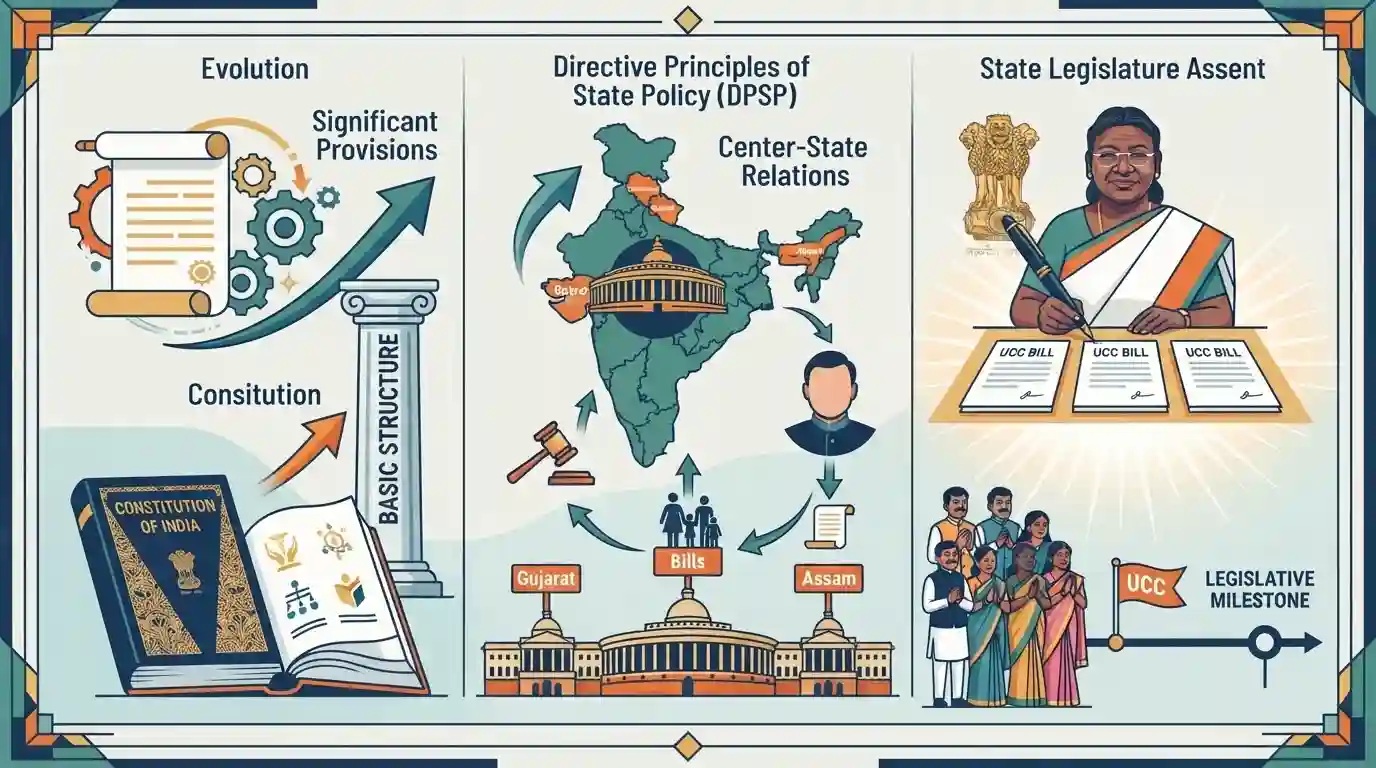
Why It Matters
This development marks a crucial constitutional and legal milestone regarding the implementation of the Uniform Civil Code across multiple states via presidential assent, highlighting cooperative federalism, state-level legislative powers, and the interpretation of Article 44.
Summary
The Uniform Civil Code (UCC) Bills passed by the states of Uttarakhand, Gujarat, and Assam have officially received assent from President Droupadi Murmu, marking a significant milestone in India's legislative landscape regarding civil laws and the implementation of Article 44 of the Constitution.
Key Points
- The Uniform Civil Code (UCC) bills passed by the legislative assemblies of Uttarakhand, Gujarat, and Assam have received the assent of President Droupadi Murmu.
- Uttarakhand was the first state in post-independence India to pass a UCC bill, setting a precedent for other states.
- The Uniform Civil Code is rooted in Article 44 of the Directive Principles of State Policy (DPSP) under Part IV of the Indian Constitution, which mandates the State to secure for citizens a uniform civil code throughout the territory of India.
Important Terms
Uniform Civil Code (UCC) Bills

Legislative proposals enacted by state assemblies (such as Uttarakhand, Gujarat, and Assam) to govern personal matters like marriage, divorce, and inheritance uniformly, requiring presidential assent to override concurrent-list conflicts.
UPSC context
Important for UKPSC Mains GS Paper II under Indian Polity - Centre-State Relations, State Legislature, and Federal Structure.
Article 44 of the Constitution
A Directive Principle of State Policy (DPSP) under Part IV of the Indian Constitution which mandates that the State shall endeavor to secure a uniform civil code for citizens throughout India.
UPSC context
Crucial for UKPSC GS Paper II (Indian Constitution, Directive Principles of State Policy, and Governance).
President of India
The head of the Indian state whose assent is constitutionally required under Article 201 for certain state-level bills reserved by the Governor, enabling them to become law.
UPSC context
Relevant for UKPSC GS Paper II under Executive Powers, Legislative Procedure, and Federal Polity.
Prelims Trap
Uniform Civil Code under Article 44 is a justiciable fundamental right enforceable by the Supreme Court.
Article 44 falls under Part IV (DPSPs), which are non-justiciable by courts, unlike Fundamental Rights under Part III.
Static Concepts Connected
What are the key constitutional provisions and judicial milestones related to Article 44 and Uniform Civil Code?
- Constitutional Mandate: Article 44 directs the State to endeavour to secure for the citizens a uniform civil code throughout the territory of India.
- Non-Justiciable Nature: DPSPs are non-justiciable principles contained in Part IV of the Constitution, guiding policy formulation rather than judicial enforcement.
- Judicial Precedents: Landmark Supreme Court rulings like Shah Bano (1985) and Sarla Mudgal (1995) have repeatedly urged Parliament to enact a nationwide UCC.
Cross-Topic Patterns
UCC State Bills vs. Concurrent List
State-level legislative initiatives test the boundaries of Concurrent and State lists under the Seventh Schedule, particularly regarding personal laws.
DPSPs vs. Fundamental Rights in Federalism
Article 44 implementation highlights the non-justiciable nature of DPSPs versus fundamental rights and judicial interpretation.

Article 44 + State Assent + DPSP enforcement will likely be tested via multi-statement questions in UKPSC Prelims.
Linked PYQs · 4
Linked PYQs · 4
- 2024UKPSC_PRELIMSGS1
The mind of the makers of the Constitution of India is reflected in which of the following ?
- 2024UKPSC_PRELIMSGS1
Regarding the Directive Principles of State Policy, which one of the following statements is not correct ?
- 2024UKPSC_PRELIMSGS1
According to the Constitution of India, who among the following is the Head of the State ?
- 2024UKPSC_PRELIMSGS1
Which of the following statements is not correct regarding the issuance of Ordinance by the President ?
