Madhya Pradesh Plans to Enact Uniform Civil Code in Upcoming Session
Source:etv-bharat ↗
Why It Matters
The Uniform Civil Code is a highly relevant constitutional, political, and socio-legal topic for MPPSC State Service Prelims. Understanding the historical context (B.N. Rao Committee, 1835 British report), constitutional positioning (Article 44), landmark judicial verdicts (Shah Bano, Sarla Mudgal, Shabnam Hashmi), and recent state-level initiatives (Uttarakhand, Assam, Gujarat, and now Madhya Pradesh) is vital for state-level civil services aspirants.
Summary
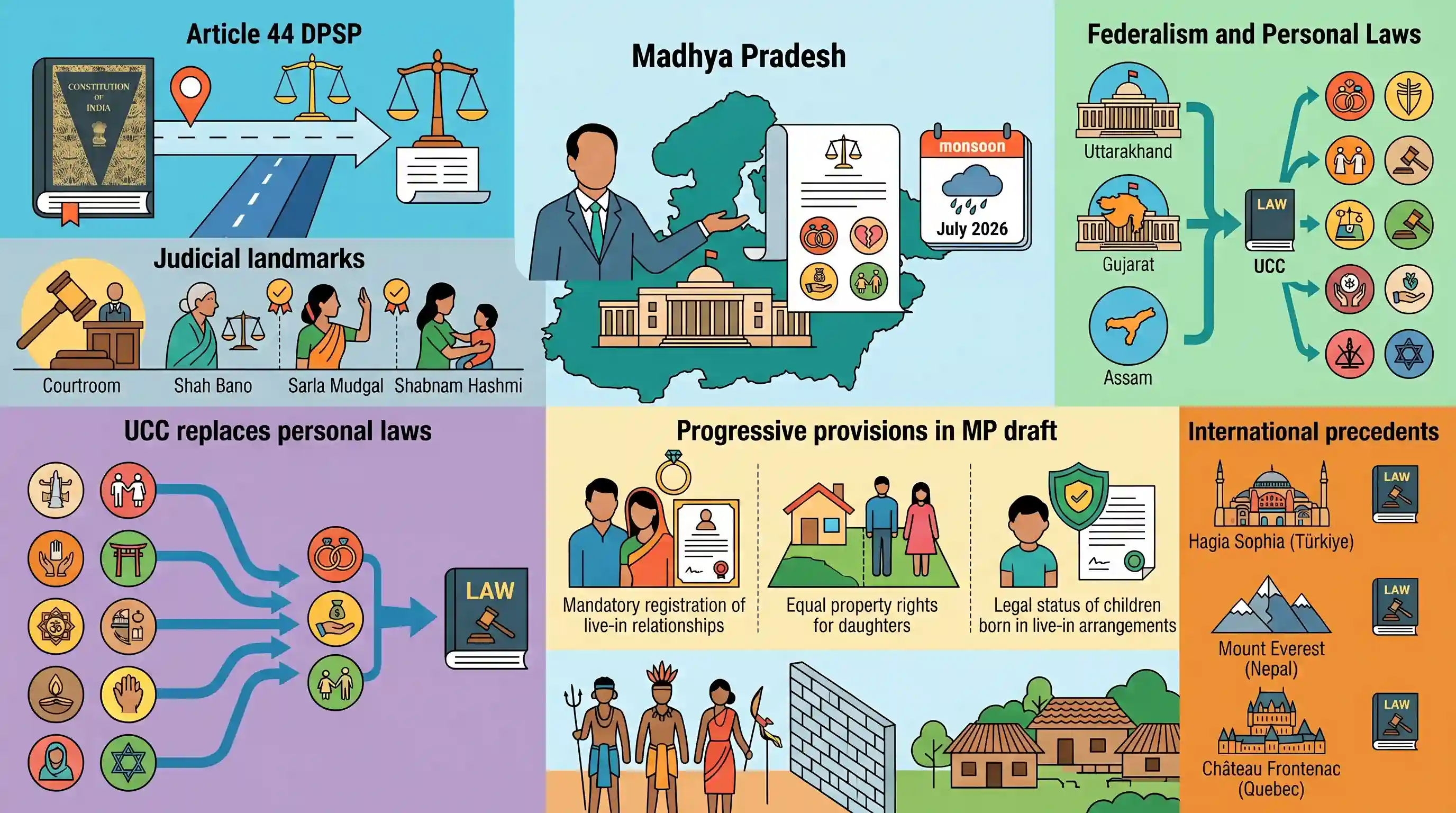
The Madhya Pradesh government plans to introduce a Uniform Civil Code (UCC) Bill in the July 2026 monsoon session of the Assembly, making it the latest state to move towards UCC after Uttarakhand, Gujarat, and Assam. The proposed draft aims to replace religion-based personal laws with a single uniform law governing marriage, divorce, inheritance, and adoption. Distinct progressive provisions under consideration in Madhya Pradesh include the compulsory registration of live-in relationships, equal property rights for daughters, and the legal status of children born in live-in arrangements, while keeping tribal communities exempted. The article contextualizes this development within India's constitutional framework (Article 44 DPSP), historical legal committees (B.N. Rao Committee), key judicial pronouncements (Shah Bano, Sarla Mudgal, and Shabnam Hashmi), and international legal precedents (Türkiye, Nepal, and Quebec).
Key Points
- Madhya Pradesh Chief Minister Dr. Mohan Yadav indicated plans to introduce a Uniform Civil Code (UCC) Bill in the state Assembly's monsoon session in July 2026, following the footsteps of Uttarakhand, Gujarat, and Assam.
- The proposed MP UCC draft includes progressive measures such as compulsory registration of live-in relationships, equal inheritance rights for daughters, granting ancestral property rights to children born out of live-in relationships, and a proposed exemption for tribal communities.
- Article 44 of the Directive Principles of State Policy (DPSP) in Part IV of the Indian Constitution tasks the State to endeavor to secure a UCC for all citizens throughout India.
- Historically, the concept of a uniform civil law goes back to an 1835 British report (which excluded personal laws) and the 1941 B.N. Rao Committee formed to codify Hindu personal laws, which led to the Hindu Succession Act of 1956.
- Several landmark Supreme Court rulings have highlighted the importance of Article 44, including the Shah Bano Case (1985), Sarla Mudgal Case (1995 - where Justice Kuldip Singh remarked that Article 44 was kept in 'cold storage'), and Shabnam Hashmi Case (2014 - extending adoption rights under the Juvenile Justice Act).
- The 21st Law Commission's 2018 report, however, noted that a UCC was 'neither necessary nor desirable at this stage,' emphasizing that territorial integrity should not compromise the nation's diverse customs.
- Global examples of uniform laws include Türkiye (which established a secular civil code in 1926 under a 99% Muslim population), Nepal (which implemented the National Civil Code of 2017), and Quebec in Canada.
Important Terms
Uniform Civil Code (UCC) Bill

A proposed legislation to replace diverse religion-based personal laws with a single, uniform civil framework governing marriage, divorce, inheritance, and adoption for all citizens regardless of their religious faith.
UPSC context
GS Paper II (Polity & Governance); tests understanding of Article 44, federalism, gender justice, and balancing fundamental rights with legal uniformity.
21st Law Commission of India
A government-appointed advisory body that, in 2018, opined that formulating a nationwide Uniform Civil Code is "neither necessary nor desirable at this stage," recommending religious personal law reforms instead.
UPSC context
GS Paper II (Polity & Governance); evaluates analytical understanding of institutional standpoints on codifying family laws and reforming personal laws.
B.N. Rao Committee
Also known as the Hindu Law Committee of 1941, it was tasked with examining and recommending the codification of Hindu personal law, paving the way for gender-equal succession rights.
UPSC context
GS Paper I (Modern History) & GS II (Polity); tests knowledge of the pre-independence origins of personal law codification.
Hindu Succession Act, 1956
A landmark legislation codifying intestate succession laws for Hindus, Buddhists, Jains, and Sikhs, significantly amended in 2005 to grant daughters equal coparcenary rights in ancestral property.
UPSC context
GS Paper II (Polity & Social Justice); examines laws related to vulnerable sections, gender equality in inheritance, and personal law reforms.
Juvenile Justice Act
A secular legislation governing child welfare that provides a religion-neutral pathway for adoption, serving as an enabling statute that transcends traditional religious personal laws.
UPSC context
GS Paper II (Governance & Welfare Schemes); tests knowledge of secular child-protection statutes and judicial landmarks like the Shabnam Hashmi case.
Prelims Trap
A state legislature cannot enact a Uniform Civil Code because Article 44 mandates a uniform code, placing personal laws under the Union List.
Personal laws (marriage, succession) fall under Entry 5 of the Concurrent List. States can legislate on UCC, requiring Presidential assent under Article 254(2) if it conflicts with central laws.
Static Concepts Connected
What is the constitutional and federal framework governing the enactment of a Uniform Civil Code?
- Concurrent List: Entry 5 of List III covers marriage, divorce, adoption, and succession, giving both Parliament and State Legislatures power to legislate on these matters.
- Article 254(2): If a state UCC conflicts with existing central laws, it must receive presidential assent under Article 254(2) to be valid in that state.
- Article 44 Status: Article 44 directs the State to endeavor to secure a UCC, but being a DPSP, it is non-justiciable under Article 37.
How have major judicial milestones shaped the legal discourse around Article 44?
- Shah Bano Case 1985: The Supreme Court noted that Article 44 would aid national integration and urged the state to secure a common civil code.
- Sarla Mudgal Case 1995: Held that converting to Islam to contract a second marriage without dissolving the first Hindu marriage is bigamous and void.
- Shabnam Hashmi 2014: Recognized the right to adopt as a secular right under the Juvenile Justice Act, overriding restrictive personal laws.
Cross-Topic Patterns
Federal patchwork vs. National uniformity
Individual states enacting distinct UCCs creates localized variations in civil laws, challenging the concept of a single 'uniform' code across India under Article 44.
Tribal customary rights vs. Article 44
Exempting tribal communities from state UCCs highlights the constitutional balance between civil uniformity and Article 371/Sixth Schedule protections for indigenous customs.

State UCCs will likely test the intersection of Concurrent List Entry 5, Article 254(2) Presidential assent, and tribal exemptions under Part X.
Linked PYQs · 3
Linked PYQs · 3
- 2023MPPSC_PRELIMSGS1
The Directive Principles of State Policy are explained in Part IV of the Indian Constitution. This system has been taken from the Constitution of which country ?
- 2024MPPSC_PRELIMSGS1
In which of the following cases did the Supreme Court of India declare the prevalence of Fundamental Rights over Directive Principles of the State Policy in case of conflict between the two ?
- 2024MPPSC_PRELIMSGS1
K.M. Munshi was related to :
