ISRO Resumes Satellite Launch Schedule After Seven-Month Pause
Source:Indian Express ↗
Why It Matters
Important for understanding India's space program trajectory, launch vehicle infrastructure, and advancements in satellite technology.
Summary
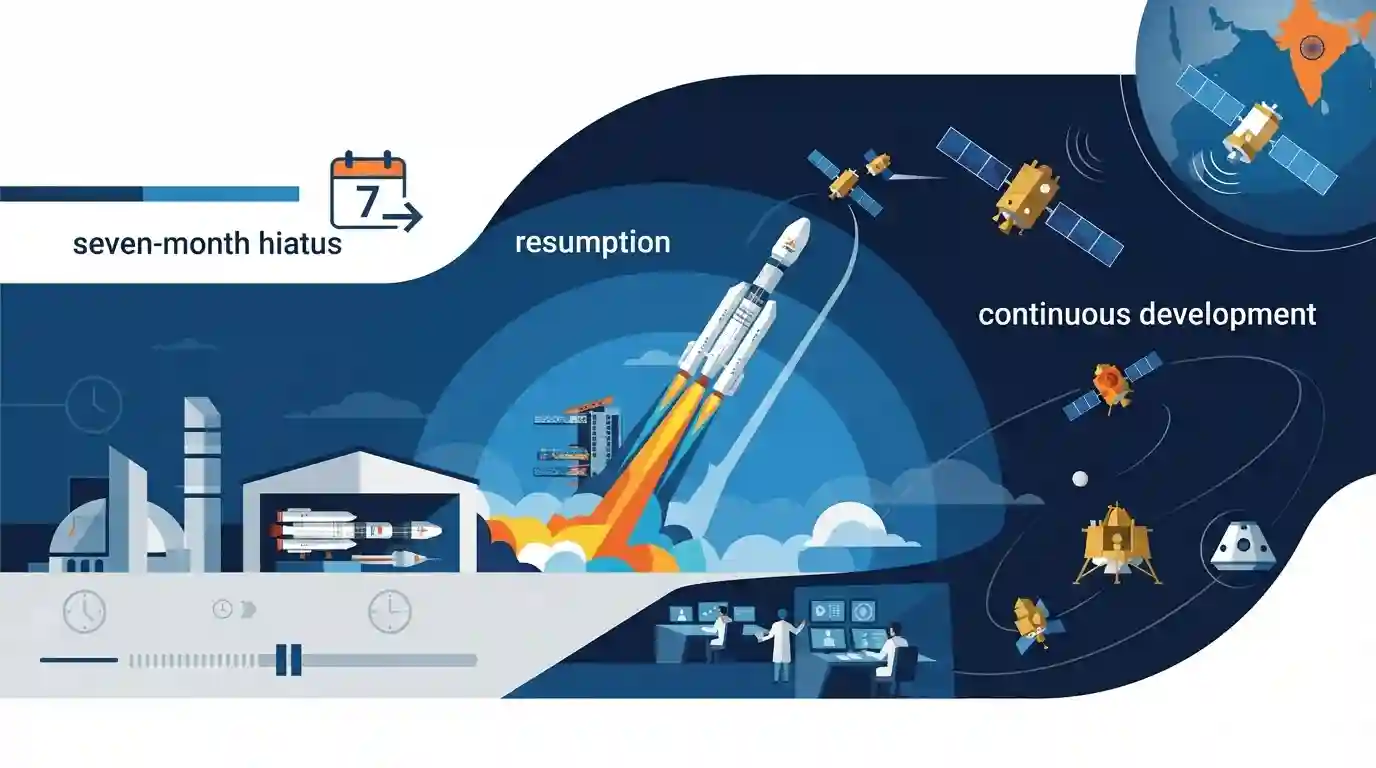
After a seven-month hiatus, ISRO prepares to launch a key satellite, marking a major resumption of India's space missions and showcasing its continuous development in space technology and launch vehicles.
Key Points
- ISRO resumed its satellite launch schedule following a seven-month hiatus.
- The mission involves deploying a critical satellite from the Satish Dhawan Space Centre in Sriharikota.
- Highlights India's robust space capabilities, launch vehicle reliability, and continuous Earth observation and communication advancements.
Important Terms
ISRO

India's national space agency responsible for planning, executing, and promoting space research, satellite launches, and interplanetary missions for national development and scientific advancement.
UPSC context
UPSC Prelims/Mains (GS Paper III - Science & Technology): Tests knowledge of Indian space achievements, institutions, and major policy initiatives.
EOS-05 (GISAT-1A)
An advanced Earth observation satellite launched by ISRO (also known as GISAT-1A or Hawkeye) designed for continuous real-time imaging of the Indian subcontinent from a high geostationary orbit.
UPSC context
UPSC Prelims/Mains (GS Paper III - Science & Technology): Tests awareness of satellite applications in disaster management, remote sensing, and national security.
Geosynchronous Satellite Launch Vehicle (GSLV)
ISRO's three-stage launch vehicle featuring an indigenous cryogenic upper stage, engineered to place heavier communication and Earth observation satellites into geosynchronous transfer and geostationary orbits.
UPSC context
UPSC Prelims/Mains (GS Paper III - Science & Technology): Tests understanding of India's indigenous launch vehicle technology, rocket stages, and cryogenic capabilities.
Prelims Trap
Assuming GSLV is used exclusively for all remote sensing and Earth observation missions launched from Sriharikota.
Aspirants often confuse the primary payloads of PSLV and GSLV; PSLV primarily handles sun-synchronous/Earth observation payloads while GSLV handles heavier geostationary communication satellites.
Static Concepts Connected
What are the major orbital regimes used by ISRO for satellite deployment?
- Low Earth Orbit (LEO):: Altitude range of 160 to 2,000 km; ideal for Earth observation and remote sensing.
- Sun-Synchronous Orbit (SSO):: Specialized LEO passing over poles; provides constant sun-illumination for cartography and surveillance.
- Geostationary Orbit (GEO):: Altitude of ~35,786 km matching Earth's rotation; used for continuous broadcast and communication.
Cross-Topic Patterns
Space Tech + Commercial Diplomacy (NSIL)
ISRO's commercial arm, NewSpace India Limited (NSIL), leverages launch reliability for international payload contracts, linking space tech directly to export earnings and techno-diplomacy.

ISRO launch vehicle capabilities and orbit mechanics (LEO, SSO, GEO) are prime targets for match-the-following prelims questions.
Linked PYQs · 1
Linked PYQs · 1
- 2018PrelimsGS1
With reference to India's satellite launch vehicles, consider the following statements: 1. PSLVs launch the satellites useful for Earth resources monitoring whereas GSLVs are designed mainly to launch communication satellites. 2. Satellites launched by PSLV appear to remain permanently fixed in the same position in the sky, as viewed from a particular location on Earth. 3. GSLV Mk III is a four-staged launch vehicle with the first and third stages using solid rocket motors; and the second and fourth stages using liquid rocket engines. Which of the statements given above is/are correct?
