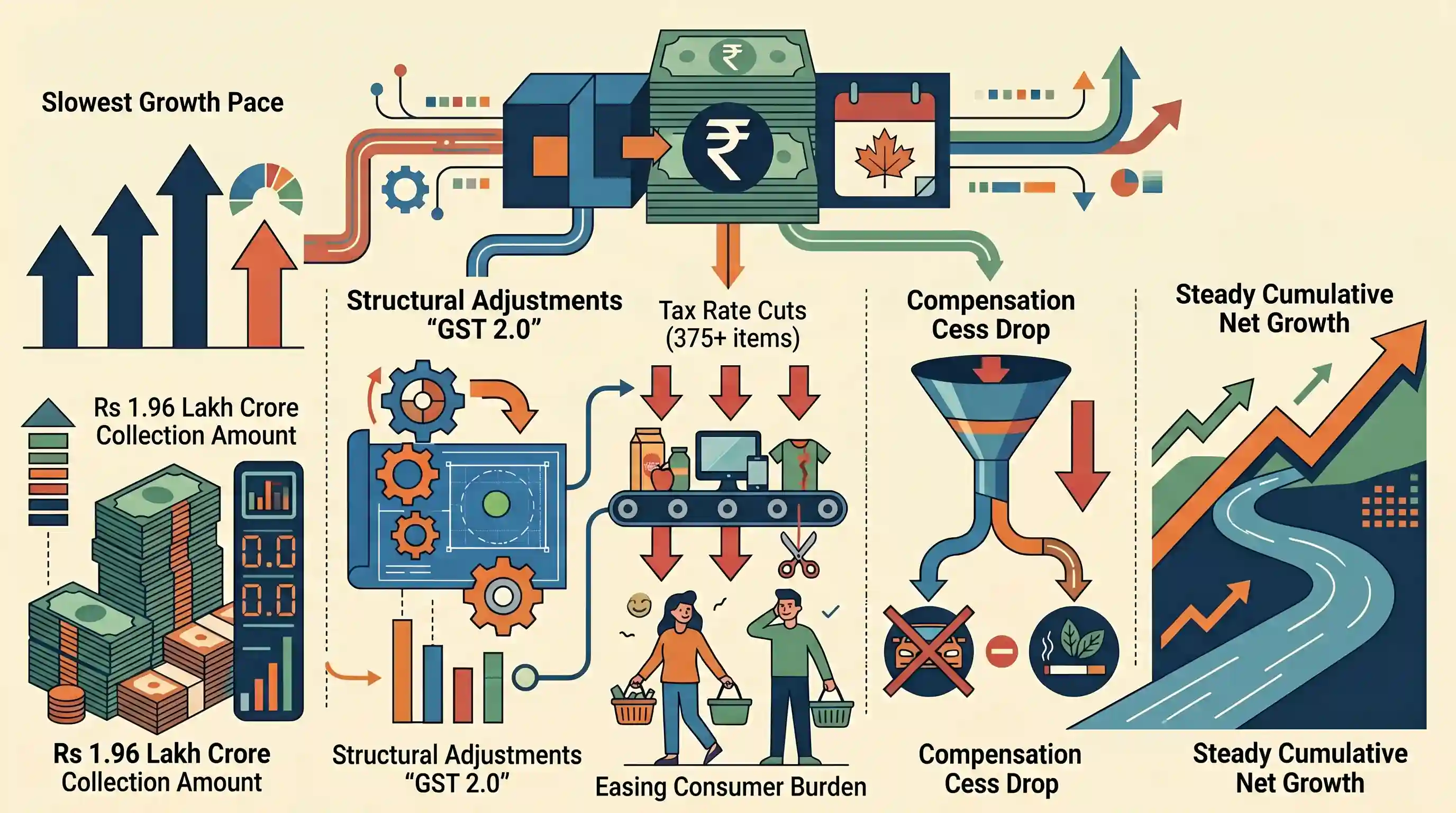
Impact of tax rationalisation on monthly GST revenue collections
Source:Indian Express ↗
Why It Matters
The data reflects the real-world impact of tax rationalization on government revenue streams. It is crucial for UPSC aspirants to understand the balance between lowering tax rates to boost consumption (tax buoyancy) and maintaining adequate fiscal resources, as well as the transition of the compensation cess mechanism.
Summary
Gross Goods and Services Tax (GST) collections in October registered a 4.6% year-on-year growth, amounting to Rs 1.96 lakh crore, marking the slowest growth pace in the current financial year. This deceleration in revenue growth is primarily driven by structural adjustments under 'GST 2.0', which saw tax rate cuts implemented across more than 375 items to ease the burden on consumers. Additionally, the collection of compensation cess dropped significantly by 38%, following its removal from major categories like automobiles, being retained solely for tobacco products. However, the overall cumulative net collections for the fiscal year continue to show steady growth.
Key Points
- Gross GST collections in October rose by 4.6% year-on-year to Rs 1.96 lakh crore, the slowest growth recorded in the current financial year.
- The deceleration is largely attributed to recent 'GST 2.0' tax rationalization measures, which involved rate cuts on over 375 items.
- Compensation cess collections witnessed a sharp 38% decline as the levy was withdrawn from products like automobiles, remaining applicable only on tobacco and related items.
- Despite the monthly slowdown, the cumulative gross GST collections for April-October period grew by 9.4% year-on-year to reach Rs 12.74 lakh crore.
Important Terms
Goods and Services Tax (GST) Act

A destination-based indirect tax on the supply of goods and services, replacing multiple central and state taxes to create a unified national market.
UPSC context
GS Paper 3: Indian Economy; tests understanding of landmark tax reforms and fiscal federalism.
Goods and Services Tax (Compensation to States) Act
A law ensuring states are compensated for revenue losses arising from GST implementation, originally for five years; currently extended to March 2026 for loan repayments.
UPSC context
GS Paper 2 & 3: Federalism and Fiscal Policy; tests Centre-State financial relations and GST revenue mechanisms.
Goods and Services Tax Network (GSTN)
The technological backbone of India's indirect tax system, providing the shared IT infrastructure for taxpayer registration, return filing, and computation of tax settlements.
UPSC context
GS Paper 3: E-governance and IT infrastructure; tests digital transformation in public finance and tax administration.
Central Board of Indirect Taxes and Customs (CBIC)
The apex statutory body under the Ministry of Finance responsible for formulating and implementing policies related to GST, Customs, and Central Excise.
UPSC context
GS Paper 3: Institutional framework; tests the administrative and executive structure of India's indirect tax regime.
GST Council
A constitutional body (Article 279A) chaired by the Union Finance Minister that makes recommendations to the Union and States on all GST-related issues.
UPSC context
GS Paper 2: Constitutional Bodies; tests cooperative federalism and the consensus-based decision-making process in taxation.
GST 2.0
The next-generation phase of GST reforms focusing on rate rationalization (two-slab structure), citizen-centric relief, and improved ease of doing business.
UPSC context
GS Paper 3: Economic Development; tests knowledge of contemporary structural reforms in India's taxation system.
Prelims Trap
GST Compensation Cess is levied on all luxury goods to compensate states for revenue loss.
Under GST 2.0, the cess is retained exclusively on tobacco products (removed from automobiles) and its current purpose is solely to repay COVID-19 pandemic-era borrowings, not for ongoing state revenue compensation.
Static Concepts Connected
What is the Inverted Duty Structure (IDS) under GST?
- Definition: A situation where the tax rate on raw material inputs is higher than the tax rate on the final finished product.
- Blocked Capital: It leads to the accumulation of unutilized Input Tax Credit (ITC), effectively blocking the working capital of domestic manufacturers.
- Compliance Burden: Forces businesses to file for complex ITC refunds, increasing administrative friction and discouraging domestic value addition (Make in India).
What is the current status of the GST Compensation Cess?
- Original Purpose: Introduced in 2017 to guarantee a 14% annual tax revenue growth to states for five years post-GST rollout.
- Pandemic Borrowing: During the pandemic, the Centre borrowed on behalf of states via a back-to-back loan facility to bridge severe compensation shortfalls.
- March 2026 Extension: The levy is extended to March 2026 strictly to repay the principal and interest of those pandemic loans, not to fund new state compensation.
Cross-Topic Patterns
Fiscal Federalism & State Autonomy
The shift to GST 2.0 slabs and the sunset of the broader compensation cess deeply impacts states' independent revenue generation and Centre-State fiscal trust.
Macro-Consumption & Tax Buoyancy
Slowing GST growth despite massive rate cuts provides critical data on tax elasticity, indicating how Inverted Duty corrections impact macro consumption and working capital cycles.

Expect a 2026 Prelims multi-statement question on GST 2.0 slabs, combining 'Inverted Duty Structure' with the new bounds of Compensation Cess.
Linked PYQs · 3
Linked PYQs · 3
- 2019MainsGS3
Enumerate the indirect taxes which have been subsumed in the Goods and Services Tax (GST) in India. Also, comment on the revenue implications of the GST introduced in India since July 2017.
- 2020MainsGS3
Explain the rationale behind the Goods and Services Tax (Compensation to States) Act of 2017. How has COVID-19 impacted the GST compensation fund and created new federal tensions?
- 2017PrelimsGS1
What is/are the most likely advantages of implementing 'Goods and Services Tax (GST)'? 1. It will replace multiple taxes collected by multiple authorities and will thus create a single market in India. 2. It will drastically reduce the 'Current Account Deficit' of India and will enable it to increase its foreign exchange reserves. 3. It will enormously increase the growth and size of economy of India and will enable it to overtake China in the near future. Select the correct answer using the code given below:
