Alwar School Infrastructure Protests and Rural Education Challenges
Source:The Hindu ↗
Why It Matters
Demonstrates the persistent gaps in rural public education infrastructure and illustrates the role of civic action and grassroots mobilization in demanding government accountability and effective public service delivery.
Summary
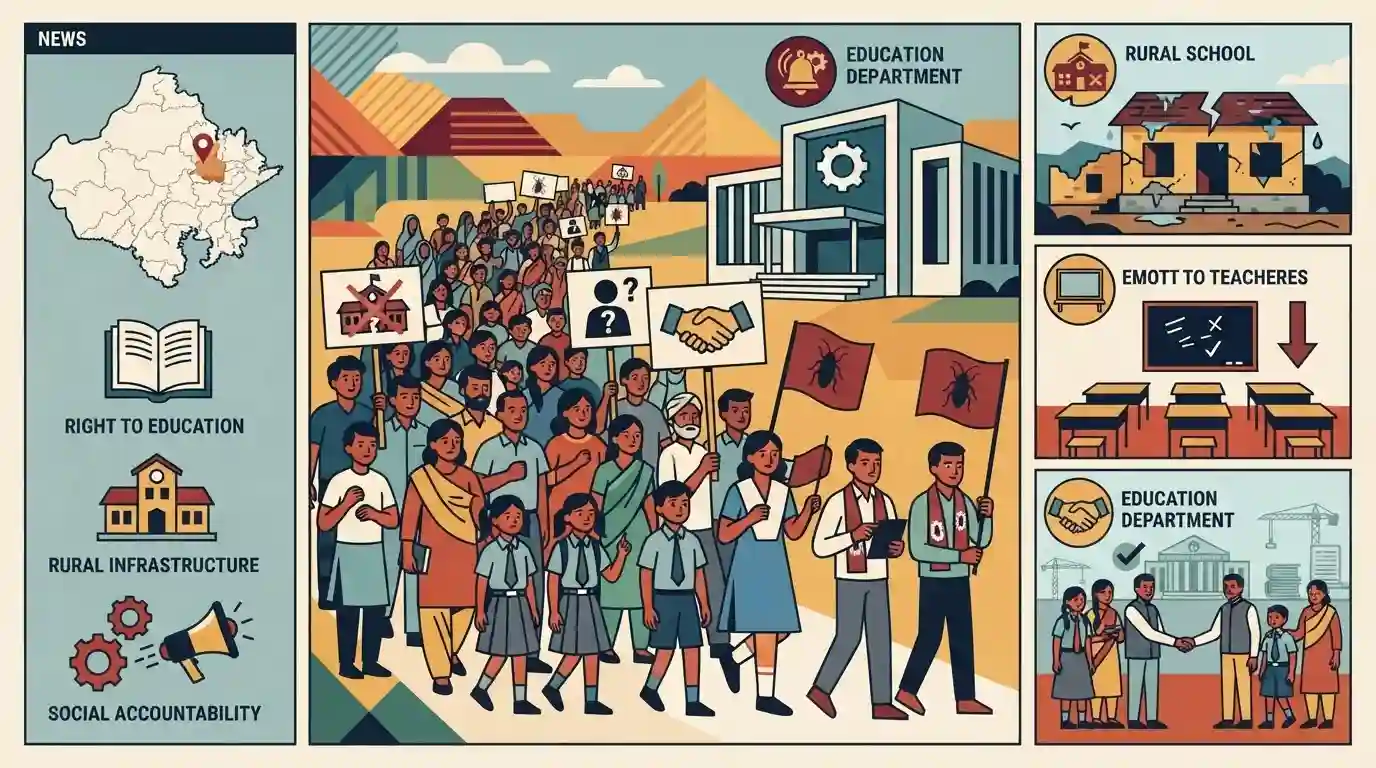
A massive protest by school students and local residents in Rajasthan's Alwar district, supported by Cockroach Janta Party (CJP) activists, successfully compelled the Education Department to commit to urgent infrastructure repairs and address teacher shortages. The protests highlighted the broader issue of dilapidated rural school buildings across the state and the need for adequate funding mechanisms to ensure the fundamental right to education.
Key Points
- Students and residents in Alwar's Jodhawas protested the dilapidated condition of their government school and a severe shortage of teachers, with 5 out of 6 senior posts vacant.
- The agitation gained momentum when Cockroach Janta Party (CJP) activists joined, pointing out that 84,000 classrooms across Rajasthan are in disrepair, affecting 15 lakh children.
- State Education Minister Madan Dilawar previously acknowledged a ₹20,000 crore requirement for school buildings, but CJP activists criticized the release of only ₹500 crore and suggested utilizing alternative sources like the PM CARES Fund.
- Following the protests, Chief District Education Officer Mahesh Gupta assured immediate repairs within a week, construction of new classrooms in three months, and additional infrastructural improvements by the village panchayat.
Important Terms
Cockroach Janta Party (CJP)

An Indian satirical youth political movement founded in May 2026 by Abhijeet Dipke. It mobilizes Gen-Z discontent regarding education, employment, and democratic accountability, heavily utilizing social media and on-the-ground protests.
UPSC context
RPSC Paper III: Political Dynamics. Tests awareness of contemporary youth movements and civil society activism impacting state policies.
Education Department (Rajasthan)
The state government body in Rajasthan responsible for administering school education, managing infrastructure, addressing teaching staff vacancies, and ensuring the implementation of the Right to Education.
UPSC context
RPSC Paper III: State Administration. Tests knowledge of the institutional mechanisms responsible for public service delivery and education infrastructure.
PM CARES Fund
A national emergency relief fund. It is cited by accountability movements like the CJP as an example of non-transparent government spending, highlighting the need for adequate and accountable funding mechanisms.
UPSC context
RPSC Paper III: Public Administration. Tests understanding of public finance, transparency, and accountability in government initiatives.
Bharatiya Janata Party (BJP)
A major political party and the current ruling party in India and Rajasthan. The Cockroach Janta Party's name (CJP) serves as a direct, satirical parody of the BJP's name.
UPSC context
RPSC Paper III: Indian Political System. Tests awareness of mainstream political entities and their interactions with emerging social movements.
Prelims Trap
"The Right to Education (RTE) Act, 2009 shifted elementary education from a Directive Principle to a Fundamental Right."
The 86th Constitutional Amendment Act (2002) shifted the mandate to a Fundamental Right (Art 21A). The RTE Act (2009) is merely the enabling legislation. Aspirants often conflate the two.
Static Concepts Connected
What are the key infrastructure and management mandates of the RTE Act 2009?
- Infrastructure Norms: Mandates all-weather buildings, barrier-free access, separate toilets for girls and boys, and safe drinking water facilities.
- Pupil-Teacher Ratio (PTR): Prescribes minimum ratios for primary (1:30) and upper primary (1:35) levels to strictly prevent teacher shortages in rural schools.
- School Management Committees: Requires the formation of SMCs comprising 75% parents/guardians to actively monitor school functioning and prepare school development plans.
How are Panchayati Raj Institutions (PRIs) constitutionally tied to rural school education?
- 11th Schedule Mandate: Introduced by the 73rd Amendment, it lists education, including primary and secondary schools (Item 17), under the functional domain of PRIs.
- Local Execution: Gram Panchayats are tasked with maintaining basic school infrastructure and overseeing the local execution of centrally sponsored schemes like Samagra Shiksha.
Cross-Topic Patterns
Social Accountability & RTE Enforcement
Public protests and School Management Committees (SMCs) act as decentralized oversight. RPSC frequently tests these community-driven social accountability mechanisms in rural service delivery and governance.
Article 21A vs State Fiscal Constraints
The gap between Rajasthan's ₹20,000 crore infrastructure requirement and its ₹500 crore allocation highlights the classic constitutional tension between justiciable fundamental rights (Article 21A) and state fiscal capacity constraints.

Expect a multi-statement question linking RTE Act infrastructure mandates with the role of Panchayats (11th Schedule) in school management.
Linked PYQs · 3
Linked PYQs · 3
- 2024RPSC_PRELIMSGS1
Which of the following is purpose of the Rajasthan Urban Development Authority?
- 2025RPSC_PRELIMSGS1
What has been formed in place of the Chief Minister Rajasthan Economic Reforms Advisory Council (CMRETAC)?
- 2025RPSC_PRELIMSGS1
What is the main objective of the “Rajasthan Urban Area Development Program (Phase-III)”?
