Madhya Pradesh Announces Special Courts To Handle Exam Malpractices
Source:etv-bharat ↗
Why It Matters
This development highlights state-level administrative reforms to ensure the integrity of public examinations and rapid justice delivery. Understanding the historical context of fast-track courts and the locations of key judicial/administrative centers in MP is highly relevant for MPPSC Prelims.
Summary
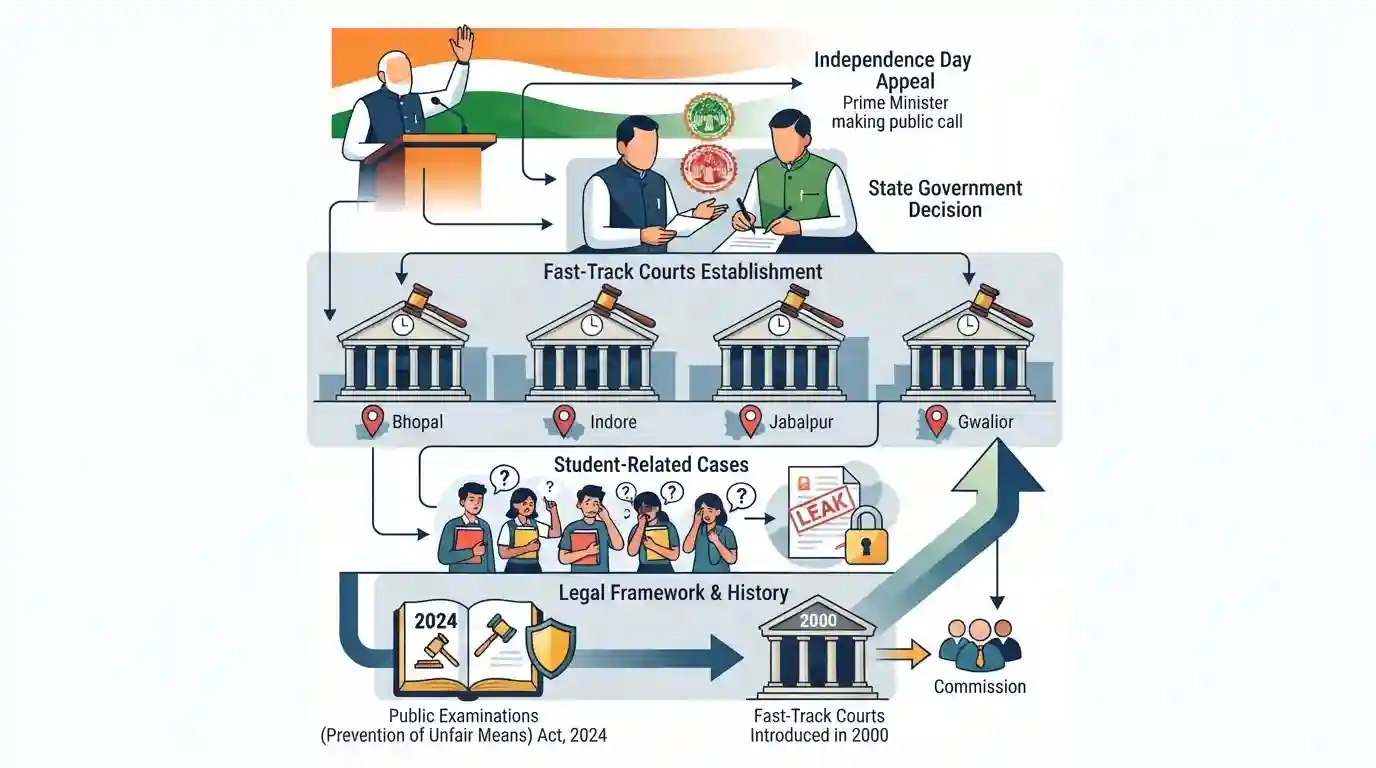
Following PM Narendra Modi's Independence Day appeal for strict action against exam irregularities, the Madhya Pradesh government, led by CM Mohan Yadav, announced the establishment of four dedicated fast-track courts. These courts, located in Bhopal, Indore, Jabalpur, and Gwalior, will exclusively handle student-related cases such as paper leaks and examination fraud. This move aligns with the stringent measures introduced in the Public Examinations (Prevention of Unfair Means) Act, 2024. Fast-track courts were originally introduced in India in 2000, acting on the recommendations of the 11th Finance Commission, to expedite pending judicial cases.
Key Points
- Madhya Pradesh has announced the establishment of four fast-track courts specifically for hearing student-related cases, including exam irregularities and paper leaks.
- These fast-track courts will be set up in the major cities of Bhopal, Indore, Jabalpur, and Gwalior.
- The decision follows PM Narendra Modi's Independence Day address emphasizing the need for strict action against those involved in paper leaks.
- Fast-track courts were initially introduced in India in the year 2000 based on the recommendations of the 11th Finance Commission.
Important Terms
Public Examinations (Prevention of Unfair Means) Act, 2024

A central legislation enacted to curb malpractices, paper leaks, and organized cheating in public examinations. It prescribes strict penalties, including up to 10 years of imprisonment and heavy fines for offenders and complicit service providers.
UPSC context
GS Paper 2 (Governance). Tests knowledge of recent legislative frameworks ensuring transparency, accountability, and integrity in public recruitment and examinations.
Fast-Track Courts
Specialized judicial benches established to expedite the trial and disposal of high-priority cases. Operating with strict timelines, they aim to reduce judicial backlog and deliver swift justice in matters like heinous crimes and examination fraud.
UPSC context
GS Paper 2 (Judiciary). Tests understanding of justice delivery mechanisms, judicial reforms, and initiatives addressing the massive pendency of cases in India.
11th Finance Commission
A constitutional body constituted to recommend the distribution of tax revenues. In 2000, it notably recommended the establishment of 1,734 Fast-Track Courts to clear the massive backlog of lower court cases, providing central financial allocations.
UPSC context
GS Paper 2 (Polity). Tests knowledge of Finance Commission mandates and their historical role in funding state-level judicial infrastructure and reforms.
Ministry of Law and Justice
The union government ministry responsible for managing legal affairs, legislative drafting, and the administration of justice. Through its Department of Justice, it oversees centrally sponsored schemes funding specialized judicial infrastructure like Fast-Track Special Courts.
UPSC context
GS Paper 2 (Polity). Tests awareness of the executive machinery responsible for judicial administration, legal reforms, and implementing justice-delivery schemes.
Prelims Trap
Fast Track Courts are statutory bodies established exclusively by the Union Ministry of Law and Justice.
State Governments establish FTCs in consultation with their respective High Courts. They function within the existing state judicial hierarchy, not as separate Union-mandated statutory bodies.
Static Concepts Connected
How are Fast Track Courts established and what is their judicial status in India?
- Genesis: First introduced in 2000 following the recommendations of the 11th Finance Commission to clear the massive backlog of pending cases.
- Establishment mechanism: They are established by State Governments in consultation with their respective High Courts.
- Judicial status: They are not separate constitutional courts but function as part of the existing subordinate judicial hierarchy.
What are the core provisions of the Public Examinations (Prevention of Unfair Means) Act, 2024?
- Nature of offences: All specified offences, such as paper leaks and system tampering, are classified as cognizable, non-bailable, and non-compoundable.
- Jurisdictional coverage: It comprehensively covers competitive exams conducted by central authorities, including UPSC, SSC, NTA, and Railway Recruitment Boards.
Cross-Topic Patterns
FTCs + Nirbhaya Fund
The centrally sponsored Fast Track Special Courts (FTSCs) scheme for rape and POCSO cases leverages the Nirbhaya Fund, bridging judicial pendency with women's security initiatives.
Demographic Dividend + State Capacity
Recurrent exam irregularities highlight critical deficits in state capacity, directly threatening India's ability to harness its demographic dividend by alienating educated youth.

Expect a Prelims question on the Public Examinations Act 2024, specifically testing if the offences are non-bailable and cognizable.
Linked PYQs · 2
Linked PYQs · 2
- 2002MPPSC_PRELIMSGS1
Where is the headquarters of High Court of Madhya Pradesh?
- 2023MPPSC_PRELIMSGS1
Who was the Chairman of the Twelfth Finance Commission?
