New GDP Series Methodology and Macroeconomic Growth Projections
Source:Indian Express ↗
Why It Matters
Revising the GDP series and base year is a fundamental macroeconomic exercise that alters how the size and growth rate of the economy are measured. For UPSC aspirants, understanding these methodological changes is essential as they impact key ratios like fiscal deficit to GDP, influence government policy formulation, and alter India's comparative economic standing globally.
Summary
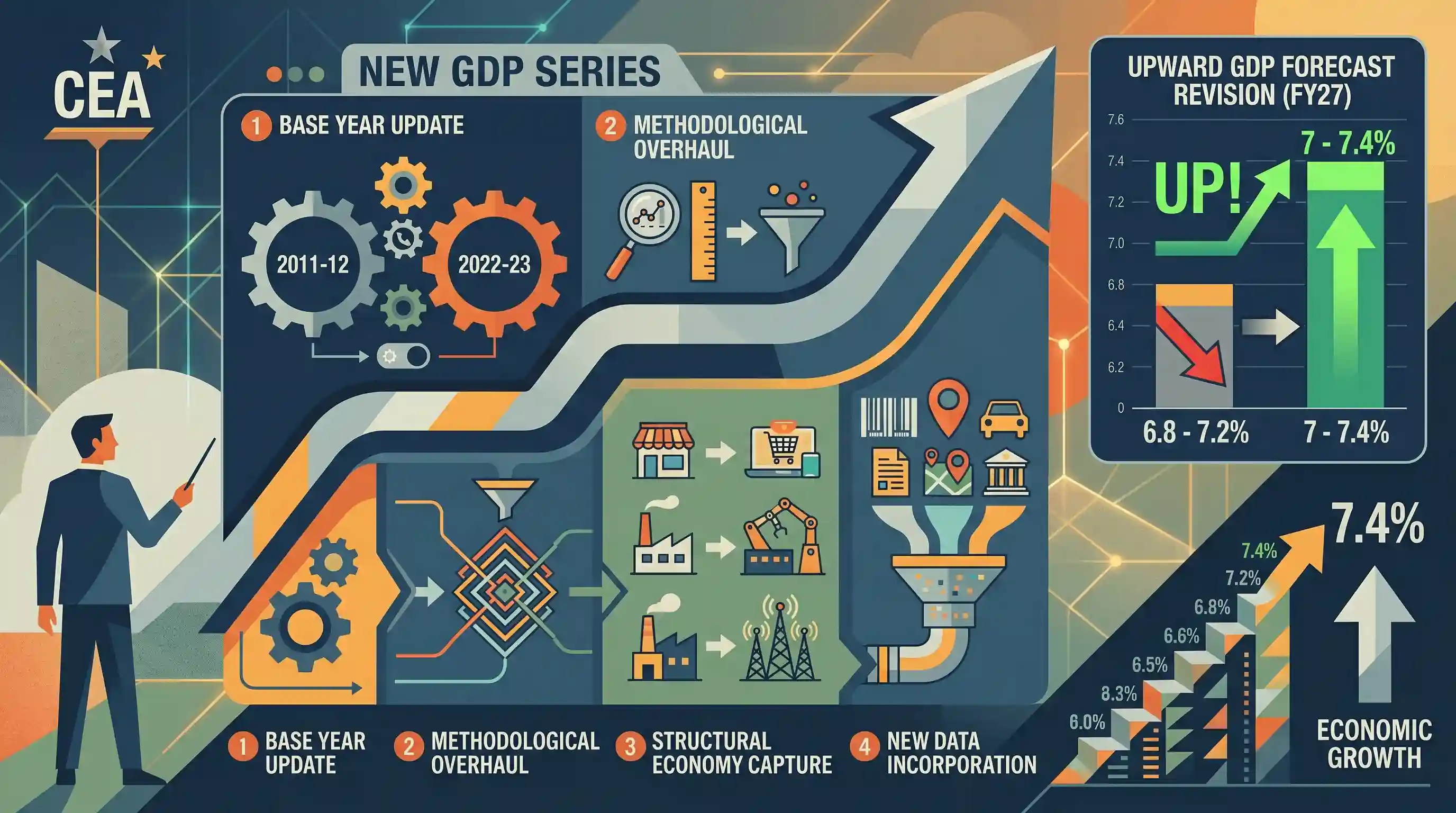
Chief Economic Advisor (CEA) V Anantha Nageswaran has indicated that India's GDP growth forecast for the fiscal year 2026-27 (FY27) has been revised upwards to 7-7.4%. This positive adjustment follows the anticipated implementation of a new GDP series. Updating a GDP series usually involves changing the base year and incorporating updated methodologies to capture structural economic changes and new data sources more accurately. Consequently, this methodological update has resulted in a more optimistic assessment of India's medium-term economic growth trajectory.
Key Points
- The economic growth forecast for FY27 has been revised upwards to a range of 7-7.4%.
- This upward revision is directly attributed to the anticipated introduction of a new GDP series.
- A new GDP series typically involves updating the base year to better reflect structural shifts, incorporate new data sets, and accurately measure the current economic landscape.
- The Chief Economic Advisor (CEA) highlighted this revision, underlining its significance for India's medium-term macroeconomic outlook.
Important Terms
National Statistical Office (NSO)

The central agency under MoSPI responsible for collecting, compiling, and releasing official statistics, including India's Gross Domestic Product (GDP) and Index of Industrial Production (IIP).
UPSC context
GS Paper III: Indian Economy; essential for understanding the institutional framework of economic data collection and statistical credibility.
Chief Economic Advisor (CEA)
A high-ranking economist who heads the Economic Division of the Department of Economic Affairs and serves as the primary advisor to the government on macroeconomic policy.
UPSC context
GS Paper II & III: Governance and Economy; relevant for roles in policy formulation and authorship of the Economic Survey.
Base Year
A specific reference year used to compare economic indicators over time, updated periodically to reflect structural changes, new industries, and current price levels in the economy.
UPSC context
GS Paper III: Economic Growth and Development; tests knowledge of how 'Real GDP' and inflation are measured accurately.
Real GDP
An inflation-adjusted measure reflecting the value of all goods and services produced by an economy in a year, calculated using constant prices from a designated base year.
UPSC context
GS Paper III: Macroeconomics; critical for comparing actual economic growth across different time periods without price distortions.
Double Deflation
A refined statistical method where the value of output and the value of intermediate inputs are deflated separately using specific price indices to derive real value added.
UPSC context
GS Paper III: Economic Methodology; a technical term relevant for understanding modern improvements in India's national accounting practices.
Economic Survey
The annual flagship document of the Ministry of Finance that reviews the economy's performance over the past year and provides a roadmap for future reforms.
UPSC context
GS Paper III: Indian Economy; the most critical document for Prelims and Mains regarding official economic data and policy direction.
Prelims Trap
The Ministry of Finance issues the new GDP series and base year revisions.
Aspirants confuse the CEA's growth forecasts with the actual statistical calculation. The new GDP series and base year revisions are strictly the mandate of the NSO under MoSPI.
Static Concepts Connected
Why is the GDP base year revised periodically?
- Structural shifts: Captures new sectors (e.g., digital services) and modernizes the basket of goods and services to reflect current consumption and production patterns.
- Inflation adjustment: Resets the reference price level to calculate Real GDP more accurately, minimizing distortions from outdated inflation metrics.
- Global standards: Aligns national accounts with the latest UN System of National Accounts (SNA) using newer administrative data like MCA21.
What distinguishes Real GDP from Potential GDP?
- Real GDP: The actual value of all final goods and services produced within a country, measured at constant base-year prices to remove the effect of inflation.
- Potential GDP: The maximum sustainable economic output achievable when all resources (labor, capital) are fully and efficiently employed without triggering inflationary pressures.
Cross-Topic Patterns
GST integration and formalization
Using GST datasets in the new GDP series captures unorganized sector shifts, linking macroeconomic measurement directly to the ongoing structural formalization of the Indian economy.
Denominator effect on Fiscal Deficit
A higher GDP baseline alters fiscal deficit-to-GDP and debt-to-GDP ratios. This denominator effect is a crucial metric for FRBM path reviews and sovereign credit rating upgrades.

Expect a multi-statement question on the new GDP base year, testing the roles of NSO vs Finance Ministry, SNA alignment, and GST data.
Linked PYQs · 3
Linked PYQs · 3
- 2021MainsGS3
Explain the difference between computing methodology of India's Gross Domestic Product (GDP) before the year 2015 and after the year 2015.
- 2020MainsGS3
Define potential GDP and explain its determinants. What are the factors that have been inhibiting India from realizing its potential GDP?
- 2000PrelimsGS1
The new Gross Domestic Product (GDP) series released by the Central Statistical Organisation (CSO) in February 1999 is with reference to base price of
