West Bengal accepts central Waqf law ending federal deadlock
Source:Indian Express ↗
Why It Matters
This development is a prime case study of friction and resolution in Centre-State relations, highly relevant for GS Paper 2 topics on federalism and state autonomy. It also touches upon the governance of minority institutions and charitable endowments, illustrating the administrative frameworks and political contestations involved in managing religious properties.
Summary
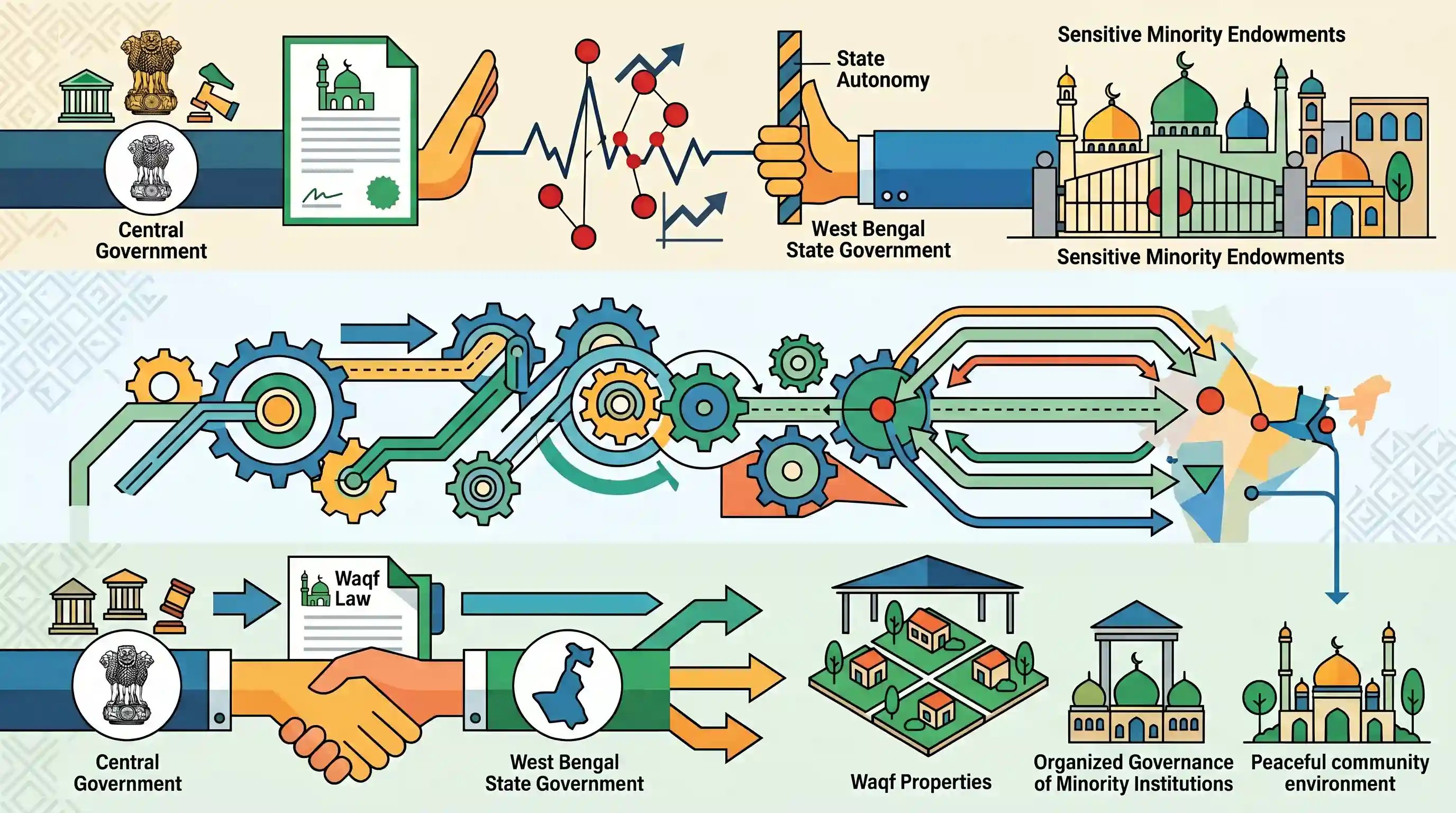
The West Bengal government has ended a months-long deadlock by agreeing to accept the Centre's new Waqf law. The state's initial opposition was rooted in concerns over state autonomy, perceived centralisation by the Union Government, and the sensitive nature of governing minority religious endowments. This development highlights the complex dynamics of Centre-State relations and the practical compulsions of cooperative federalism in India, especially concerning the administration of Waqf properties and religious institutions.
Key Points
- The West Bengal government has agreed to implement the Centre's new Waqf law, ending a months-long political and administrative deadlock.
- The state initially opposed the legislation, citing concerns over state autonomy, perceived centralisation, and interference in minority rights.
- The resolution of the deadlock highlights the practical realities and eventual compromises inherent in India's cooperative federalism and Centre-State legislative dynamics.
- The governance of Waqf properties involves sensitive issues regarding religious endowments, property rights, and minority welfare administration.
Important Terms
Waqf (Amendment) Bill, 2024

A proposed law reforming the 1995 Act, aiming to increase transparency, mandate non-Muslim and female representation, and empower District Collectors in Waqf property determination.
UPSC context
GS Paper II (Polity/Governance); tests understanding of legislative reforms, minority rights, and administrative oversight.
State Waqf Board
Statutory bodies established at the state level to manage and protect Muslim charitable endowments (Auqaf) and ensure their usage for religious or social welfare.
UPSC context
GS Paper II (Governance); important for questions on the management of religious institutions and statutory bodies.
Concurrent List (Entry 28)
A constitutional provision in the Seventh Schedule (Entry 28) allowing both Parliament and State Legislatures to make laws regarding religious endowments and institutions.
UPSC context
GS Paper II (Federalism); tests knowledge of the division of powers between the Union and States.
Cooperative Federalism
The constitutional principle where the Union and State governments work in partnership to implement national policies while respecting state autonomy.
UPSC context
GS Paper II (Polity); a core theme in Centre-State relations and federal governance dynamics.
Central Waqf Council
A statutory advisory body under the Ministry of Minority Affairs that advises the Union and state governments on Waqf administration and oversees state boards.
UPSC context
GS Paper II (Statutory Bodies); relevant for institutional frameworks governing minority affairs.
Mutawalli
The designated custodian or manager of a Waqf property responsible for its day-to-day administration in accordance with the donor's charitable intent.
UPSC context
GS Paper I/II (Social Justice/Polity); tests awareness of traditional roles in minority religious administration.
Prelims Trap
"State Waqf Boards are exclusively composed of Muslim members to uphold minority rights under Article 26."
The Waqf (Amendment) Act 2025 explicitly mandates the inclusion of non-Muslim members and Muslim women in State Waqf Boards to ensure administrative transparency.
Static Concepts Connected
What are the constitutional provisions governing religious endowments and charities in India?
- Concurrent List: Entry 28 of List III allows both Parliament and State Legislatures to enact laws regarding charities, charitable institutions, and religious endowments.
- Article 26: Protects the fundamental right of every religious denomination to establish and maintain institutions for religious and charitable purposes, and manage its own affairs.
- Article 254 (Repugnancy): Establishes that if a State law contradicts a Central law on a Concurrent List subject (like Waqf), the Central law prevails unless the State law has Presidential assent.
Cross-Topic Patterns
Concurrent List power tussles
State opposition to Central laws on Concurrent subjects (like Waqf) mirrors earlier federal deadlocks seen with the implementation of the Central Farm Laws and the Motor Vehicles (Amendment) Act.
Transparency vs. Article 26 autonomy
Mandating non-Muslims on Waqf boards echoes the broader judicial and legislative push to balance religious autonomy with administrative accountability, akin to ongoing disputes over Hindu temple management.

Expect a Prelims question testing the Concurrent List status of religious endowments alongside the new composition rules of Waqf Boards.
Linked PYQs · 3
Linked PYQs · 3
- 2024MainsGS2
What changes has the Union Government recently introduced in the domain of Centre-State relations ? Suggest measures to be adopted to build the trust between the Centre and the States and for strengthening federalism.
- 2022MainsGS2
“While the national political parties in India favour centralisation, the regional parties are in favour of State autonomy.” Comment.
- 2024MainsGS2
Public charitable trusts have the potential to make India's development more inclusive as they relate to certain vital public issues. Comment.
