Gurugram Police Labour Liaison Teams for Industrial Dispute Resolution
Source:The Hindu ↗
Why It Matters
Provides a practical case study of proactive policing and conflict resolution strategies in industrial areas. It is highly relevant for GS3 questions on internal security challenges (such as mob violence) and GS2 topics concerning governance, dispute resolution, and the role of police in society.
Summary
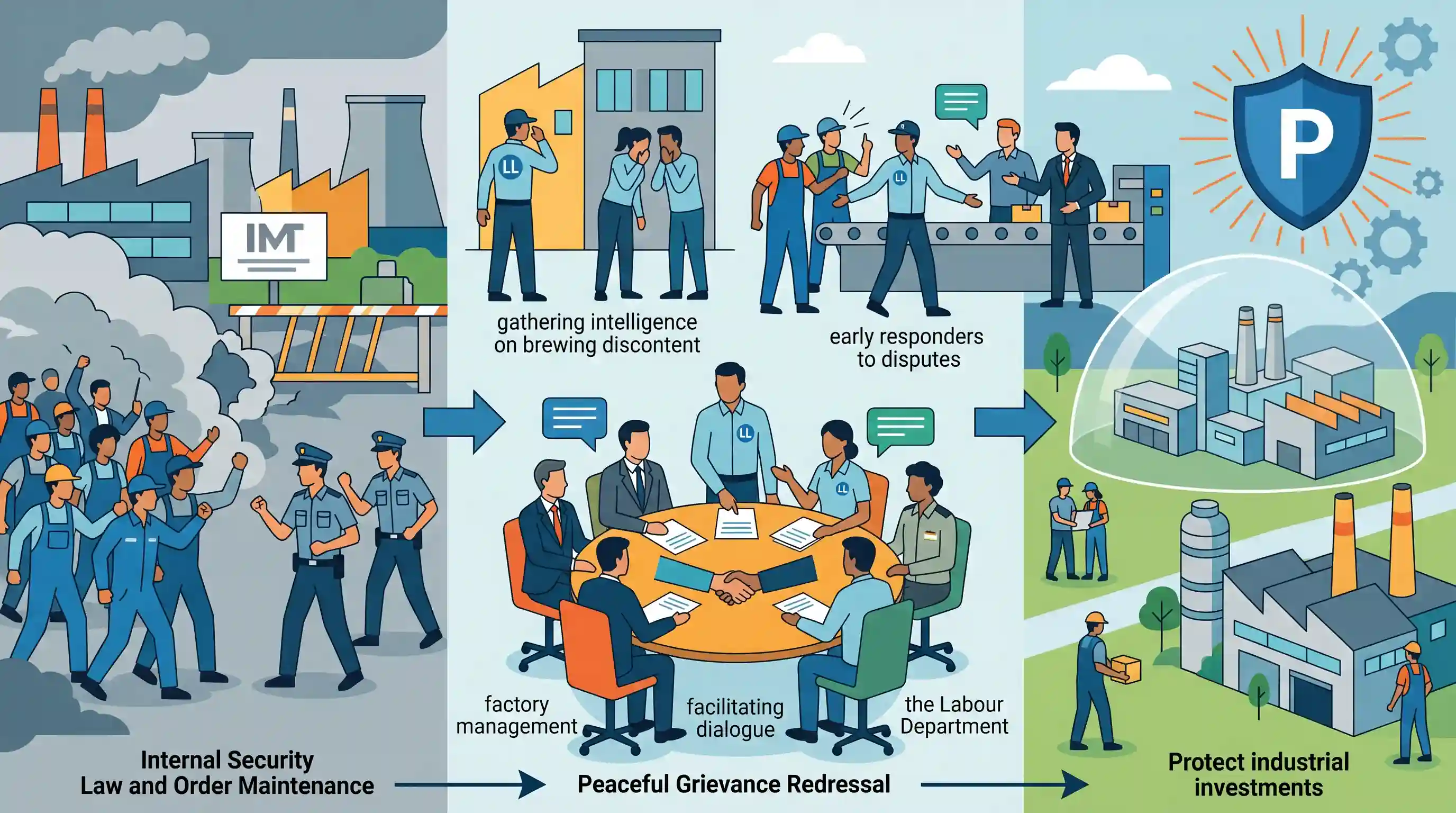
In response to recent violent clashes between workers and police at the Industrial Model Township in Manesar, the Gurugram Police have formed specialized Labour Liaison and Industrial Co-ordination Teams (LLICT) across all police stations. These teams aim to proactively manage industrial relations by gathering intelligence on brewing discontent, acting as early responders to disputes, and facilitating dialogue between factory management, worker unions, and the Labour Department. The initiative represents a strategic shift towards community and proactive policing to maintain law and order, protect industrial investments, and ensure peaceful grievance redressal in major manufacturing hubs.
Key Points
- Following violent clashes in IMT Manesar, Gurugram Police have established 'Labour Liaison and Industrial Co-ordination Teams' (LLICT) in all police stations.
- These dedicated teams are mandated to gather intelligence on potential labour unrest, act as first responders during disputes, and facilitate communication between industry management and workers.
- The initiative emphasizes proactive policing, involving regular meetings with HR managers and union leaders, to resolve disputes amicably and prevent them from escalating into mob violence.
- The deployment of female officers within LLICTs is also intended to address the specific grievances and safety concerns of female industrial employees.
Important Terms
Labour Liaison and Industrial Co-ordination Teams (LLICT)

Specialized units within the Gurugram Police designed to proactively manage industrial relations, facilitate dialogue between management and workers, and prevent labor disputes from escalating into violence.
UPSC context
GS II/III: Police Reforms and Internal Security; tests understanding of specialized policing and conflict resolution in industrial hubs.
Industrial Model Township (IMT) Manesar
A premier industrial hub in Haryana developed by HSIIDC, critical to India's automotive sector and a focal point for studying industrial-labor dynamics and unrest.
UPSC context
GS III: Infrastructure and Economic Development; highlights the importance of industrial corridors and townships in state economies.
Proactive Policing
A policing strategy focusing on crime prevention and problem-solving through early intervention and community engagement, moving beyond traditional 'reactive' models of responding after crimes occur.
UPSC context
GS II: Governance and Police Reforms; relevant for discussions on modernizing the Indian Police Service and community-oriented policing.
Labour Department
The state-level executive agency responsible for enforcing labor laws, mediating industrial disputes, and overseeing the welfare and registration of trade unions and workers.
UPSC context
GS II/III: Governance and Social Justice; pertains to the tripartite relationship between the state, industry, and labor.
Bellsonica Auto Component India Private Limited
A Tier-I automotive supplier in Manesar whose recent labor-management disputes over permanent employment and union rights served as a catalyst for regional police reforms.
UPSC context
GS III: Industrial Relations; functions as a case study for understanding labor grievances and management-union conflicts.
Automobile Industry Contractual Workers Union (AICWU)
A labor organization advocating for the rights of non-permanent employees in Haryana's industrial belt, illustrating the legal complexities of contractualization in India's workforce.
UPSC context
GS III: Indian Economy and Labour Issues; relevant for analyzing the challenges of contractual labor and collective bargaining.
Prelims Trap
Data on industrial disputes, closures, and lockouts is compiled by the National Crime Records Bureau (NCRB).
While NCRB tracks riots and crime, macro data on industrial disputes, closures, and lay-offs across factories in India is officially compiled by the Labour Bureau.
Static Concepts Connected
What are the statutory grievance redressal mechanisms under the Industrial Disputes Act, 1947?
- Applicability: It is statutorily mandated for any industrial establishment employing 20 or more workmen.
- Composition: Committees have a maximum of six members, with equal representation from employers and workmen.
- Female Representation: The Act legally mandates proportionate representation for female workers within these internal Grievance Redressal Committees.
What were the key provisions of the colonial Trade Disputes Act of 1929?
- Dispute Resolution: It established Courts of Inquiry and Boards of Conciliation to manage labor strikes and lockouts.
- Strike Restrictions: It made sudden strikes in public utility services illegal without prior notice.
- Political Strikes Ban: The Act strictly banned strikes that were conducted for political purposes rather than trade disputes.
Cross-Topic Patterns
Police reforms intersecting labor laws
The shift towards specialized LLICTs demonstrates proactive community policing extending into industrial relations, bridging the gap between traditional law enforcement and the Labour Department's statutory domain.
Colonial acts vs modern dispute resolution
The evolution from the colonial-era Trade Disputes Act of 1929 to modern statutory Grievance Redressal Committees marks a transition from strict strike suppression to institutionalized, decentralized dialogue.

2026 Prelims may test the Industrial Disputes Act, specifically the 20-worker threshold and mandatory female representation in GRCs.
Linked PYQs · 3
Linked PYQs · 3
- 2017MainsGS3
Mob violence is emerging as a serious law and order problem in India. By giving suitable examples, analyze the causes and consequences of such violence.
- 2022PrelimsGS1
In India, which one of the following compiles information on industrial disputes, closures, retrenchments and lay-offs in factories employing workers ?
- 2017PrelimsGS1
The Trade Disputes Act of 1929 provided for
