Jaipur Administration Seals Coaching Centres Over Fire Safety Norms
Source:The Hindu ↗
Why It Matters
Public safety in educational institutions and the regulation of coaching hubs (which host thousands of students in Rajasthan cities like Jaipur and Kota) are crucial areas of municipal governance. For RPSC RAS Prelims, understanding the enforcement powers of municipal corporations, urban local body regulations under the Rajasthan Municipal Act, 2009, and state disaster management protocols is essential.
Summary
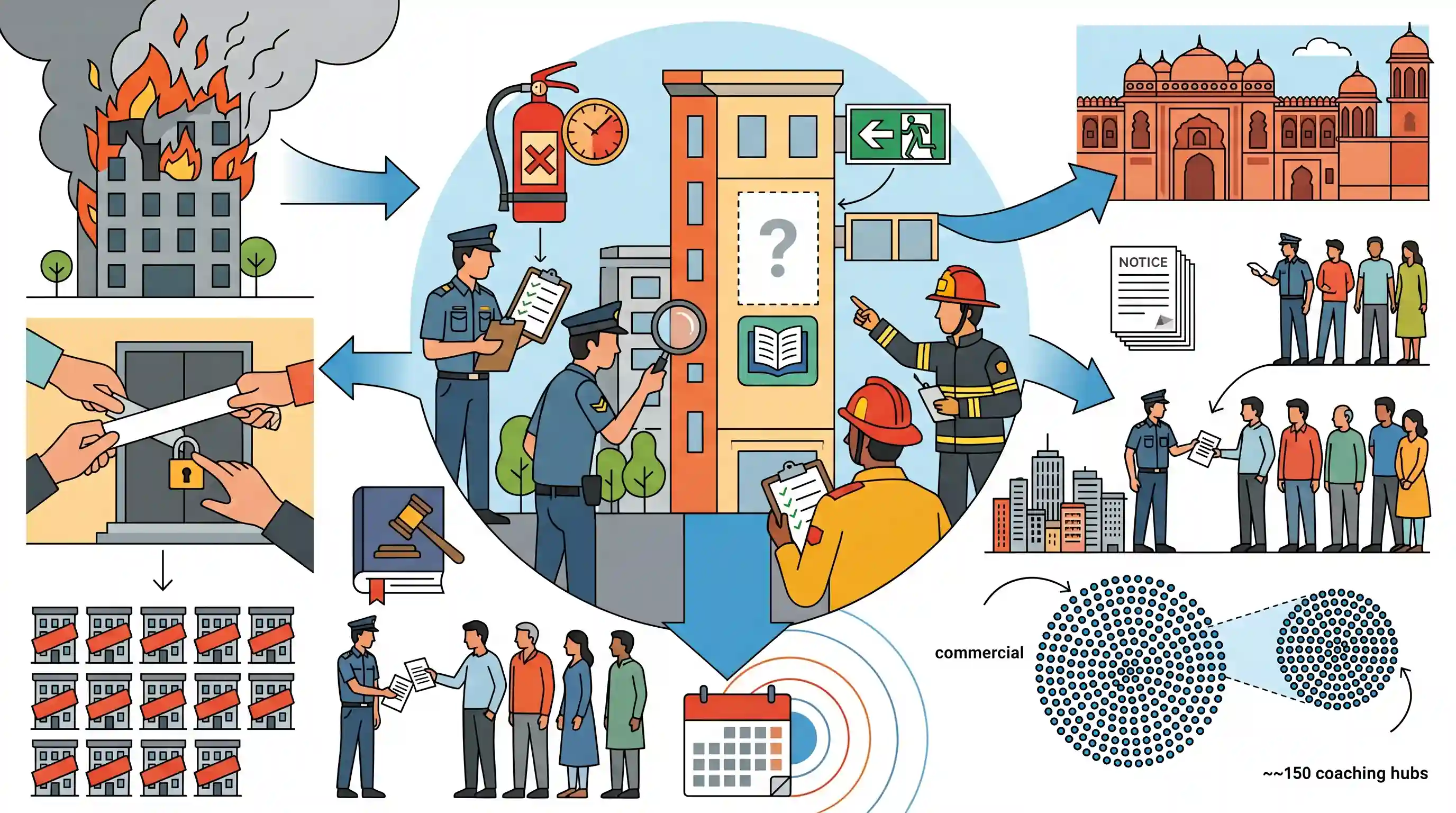
Following a tragic fire in Lucknow that killed 15 people, the Jaipur administration and municipal corporation carried out inspections of fire safety compliance across coaching institutes and libraries. The crackdown resulted in the sealing of 14 establishments and the issuance of safety notices to over 24 others for lacking proper emergency exits, expired safety equipment, or a valid Fire No Objection Certificate (NOC). Since early June, around 600 commercial units in the Jaipur Heritage area, including 150 coaching hubs, have been notified to address fire safety gaps.
Key Points
- The Jaipur administration launched a major safety enforcement drive on June 23, 2026, targeting fire safety violations in coaching centres and libraries.
- The crackdown followed a fatal fire accident in Aliganj, Lucknow, on June 22, 2026, which claimed the lives of 15 people, mostly students.
- Joint teams of Jaipur Municipal Corporation (Heritage) and Jaipur Police inspected municipal fire compliance, leading to the sealing of 14 coaching institutes and issuing notices to over 24 others.
- Key compliance parameters checked included functional firefighting equipment, presence of accessible emergency exits, and mandatory Fire No Objection Certificates (NOCs).
- Chief Fire Officer Devendra Meena stated that around 600 units in the Heritage zone, including approximately 150 coaching institutes/libraries, had been served compliance notices since June 4.
Important Terms
National Building Code of India

A comprehensive national model code published by the Bureau of Indian Standards outlining standard guidelines for building construction, structural maintenance, and fire safety requirements [1.1.2].
UPSC context
GS Paper III: Disaster Management; tests regulatory frameworks, safety compliance, and enforcement challenges in urban planning.
Rajasthan Municipal Act, 2009
The primary state legislation governing urban local bodies in Rajasthan, empowering municipalities to enforce public safety, fire prevention, and commercial building regulations [1.3.2].
UPSC context
GS Paper II: Local Governance; tests state municipal laws, division of powers, and civic regulatory mechanisms.
Jaipur Municipal Corporation
The urban local body responsible for civic administration and infrastructure in Jaipur, Rajasthan, which issues trade licenses and enforces fire safety compliance [1.2.1].
UPSC context
GS Paper II: Urban Local Bodies; tests administrative efficiency, decentralized governance, and public service delivery.
Prelims Trap
The National Building Code of India is a statutory act formulated and directly enforced nationwide by the Ministry of Housing and Urban Affairs.
The NBC is not a legislative act, nor is it created by MoHUA. It is a model code drafted by the Bureau of Indian Standards (BIS) under the Ministry of Consumer Affairs, Food and Public Distribution, and must be adopted by local municipal laws to be active.
Static Concepts Connected
What is the constitutional framework governing Fire Services and municipal responsibility in India?
- Twelfth Schedule: Entry 7 of the Twelfth Schedule (Article 243W), added via the 74th Constitutional Amendment Act, designates Fire Services as a devolved function of Urban Local Bodies.
- State Discretion: Because municipal governance falls under the State List, individual states choose whether to run centralized fire services or delegate them to local municipalities.
- Statutory Duties: State acts (e.g., Rajasthan Municipal Act, 2009) codify firefighting and life safety as statutory obligatory duties of urban local bodies.
What legal standing does the National Building Code (NBC) hold for educational safety?
- Model Guidelines: The National Building Code, particularly Part 4 on Fire and Life Safety, is formulated by the Bureau of Indian Standards (BIS) as a model code.
- Judicial Mandate: In Avinash Mehrotra v. UOI (2009), the Supreme Court ruled that Article 21-A (Right to Education) implicitly includes safe learning environments, making NBC safety norms legally binding.
- NDMA Guidelines: The NDMA's National Disaster Management Guidelines on School Safety Policy (2016) mandate regular fire audits under the statutory framework of the DM Act, 2005.
Cross-Topic Patterns
Judicial Activism vs. Municipal Capacity
High-profile judicial mandates on safety standards often fail on the ground due to severe technical staff deficits and structural revenue weaknesses within local municipal bodies.
Article 21-A + Right to Safety
Reinterpreting civil rights (education) to encompass physical safety standards (disaster preparedness) bridges basic human development indicators with strict municipal building laws.

Mains 2026 may link 74th CAA municipal deficits to urban fire disasters, questioning the enforceability of NBC and Avinash Mehrotra mandates.
Linked PYQs · 1
Linked PYQs · 1
- 2021RPSC_PRELIMSGS1
According to the provisions of the Rajasthan Municipal Act, 2009, what is the maximum number of persons that the State Government can nominate in a Municipal Council?
