Jodhpur Hospital Caesarean Complications Spark Health Safety Probe
Source:times-of-india ↗
Why It Matters
This incident exposes critical safety and sanitisation failures in Rajasthan's secondary and tertiary healthcare facilities. For RPSC RAS, understanding the state of maternal healthcare, hospital safety guidelines, and relevant welfare schemes (like PMMVY) is essential for governance and social sector issues.
Summary
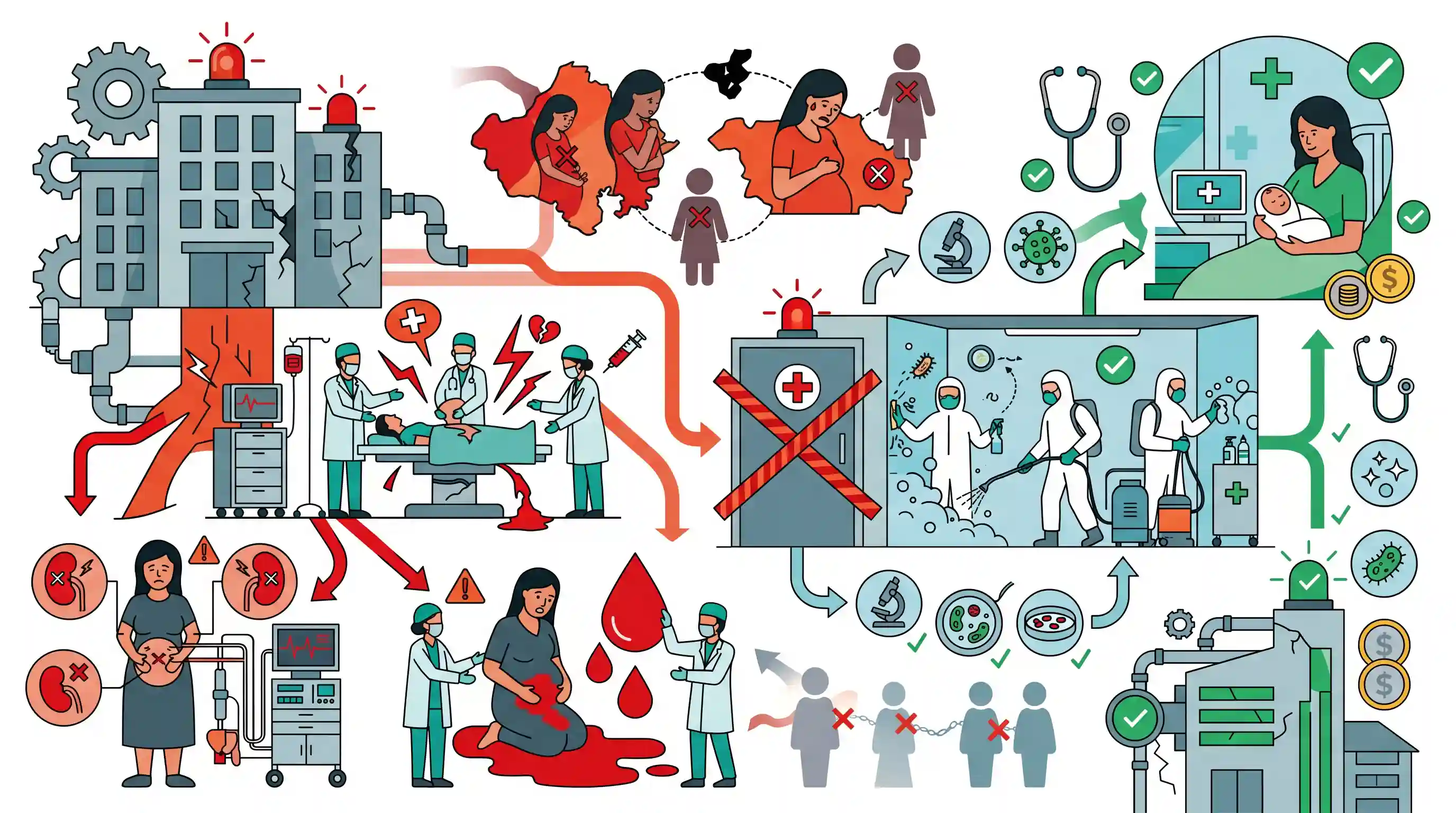
At least eight women suffered severe medical complications, including kidney failure and excessive bleeding, following caesarean surgeries at a Jodhpur district hospital. This follows previous maternal deaths under similar circumstances in Kota and Bikaner, prompting the temporary closure of the operation theatre for sanitisation and testing.
Key Points
- Eight women developed severe postoperative complications, including kidney failure, excessive bleeding, anemia, and low blood pressure, following caesarean sections at a district hospital in Jodhpur.
- Two women with severe kidney infections were referred to the Intensive Care Unit (ICU) of Mathuradas Mathur (MDM) Hospital, while the other six are being treated at the district hospital.
- This incident follows recent maternal safety failures where four women died in Kota and two in Bikaner after post-caesarean complications.
- The hospital administration has suspended all surgical operations and temporarily shut down the operation theatre (OT) to collect sterilisation and environmental samples for laboratory testing.
- The recurring complications highlight critical gaps in public healthcare infrastructure, surgical safety, and OT infection control protocols across major medical hubs in Rajasthan.
Important Terms
Pradhan Mantri Matru Vandana Yojana (PMMVY)

A centrally sponsored conditional cash transfer scheme providing ₹5,000 to pregnant and lactating mothers for their first child (and ₹6,000 for the second if a girl) to improve maternal nutrition.
UPSC context
GS Paper II: Welfare Schemes; tests knowledge of maternal healthcare benefits, financial incentives, and nutrition-focused direct benefit transfers.
Indira Gandhi Maternity Nutrition Scheme
A Rajasthan state maternal nutrition scheme (Indira Gandhi Matritva Poshan Yojana) providing ₹6,000 in instalments to pregnant women upon the birth of their second child to improve maternal and child health.
UPSC context
GS Paper II: State Schemes; tests awareness of regional interventions targeting maternal mortality, undernutrition, and behavioral shifts toward institutional delivery.
Dr. S.N. Medical College
A premier medical education and healthcare institution in Jodhpur, Rajasthan, responsible for overseeing medical research, laboratory testing, and expert investigations during public health or clinical crises in the region.
UPSC context
GS Paper II: Public Health Issues; tests understanding of the role of state medical colleges in monitoring clinical standards and addressing healthcare failures.
Mathuradas Mathur (MDM) Hospital
A major tertiary care government hospital in Jodhpur, Rajasthan, affiliated with Dr. S.N. Medical College, serving as a critical referral centre for intensive care and specialized post-operative emergency treatments.
UPSC context
GS Paper II: Health Infrastructure; tests analysis of tertiary care referral pathways, emergency critical care capacity, and management of maternal health emergencies.
AIIMS-Delhi
India's premier public medical institute and research hospital, frequently tasked by the Central Government with forming expert committees to investigate severe healthcare failures, outbreaks, or clinical lapses nationwide.
UPSC context
GS Paper II: Health Governance; tests knowledge of apex medical research bodies in setting clinical benchmarks and providing national-level expert oversight.
Prelims Trap
LaQshya is a direct benefit transfer scheme designed to financially incentivize institutional deliveries.
Aspirants often confuse LaQshya's focus on clinical quality, infection control, and labor-room safety with cash-incentive schemes like JSY or PMMVY. LaQshya does not provide direct financial assistance to beneficiaries.
Static Concepts Connected
What is the LaQshya initiative of the Union Health Ministry?
- Core Objective: Aims to reduce preventable maternal and newborn mortality by improving quality of care in Labour Rooms and Maternity Operation Theatres.
- Target Windows: Focuses on intrapartum and immediate postpartum periods, which are critical windows for preventing maternal mortality.
- SSI Benchmarks: Mandates strict adherence to protocols to keep Surgical Site Infection (SSI) rates in maternity OTs at or below 5%.
How does the Kayakalp Scheme bolster public health hygiene?
- Launch & Scope: Launched in 2015 to promote cleanliness, hygiene, waste management, and infection control in public healthcare facilities.
- Evaluation Method: Employs a three-tier system (internal, peer, and external) to audit and evaluate facility compliance.
- Funding Linkage: Incentivizes public hospitals with financial awards, linking cleanliness directly to operational funding.
Cross-Topic Patterns
Fiscal Federalism + Health Delivery
While national guidelines like LaQshya exist, state-level execution and monitoring determine local infection control, exposing the structural gaps between central policy design and state-level delivery.
Hospital Infections + AMR Crisis
Recurring post-caesarean sepsis and organ failures highlight how poor OT sanitisation breeds highly resistant hospital-acquired pathogens, a key challenge in India's National Action Plan on AMR.

LaQshya's specific operational parameters and SDG 3.1 MMR targets are highly prone to multi-statement comparison in Prelims 2026.
Linked PYQs · 1
Linked PYQs · 1
- 2023RPSC_PRELIMSGS1
Which scheme aims to improve the health and nutritional status of pregnant women and lactating mothers and their infants (0 to 6 months) by promoting the use of appropriate practices, care, and services during pregnancy, safe delivery, and breastfeeding?
