Geopolitical succession challenges in Iran and regional stability
Source:Indian Express ↗
Why It Matters
A political transition in Iran profoundly impacts the security environment of the Middle East. For India, stability in this region is critical due to energy security dependencies, a large diaspora, and vital trade routes, making this a crucial geopolitical event for UPSC aspirants to understand.
Summary
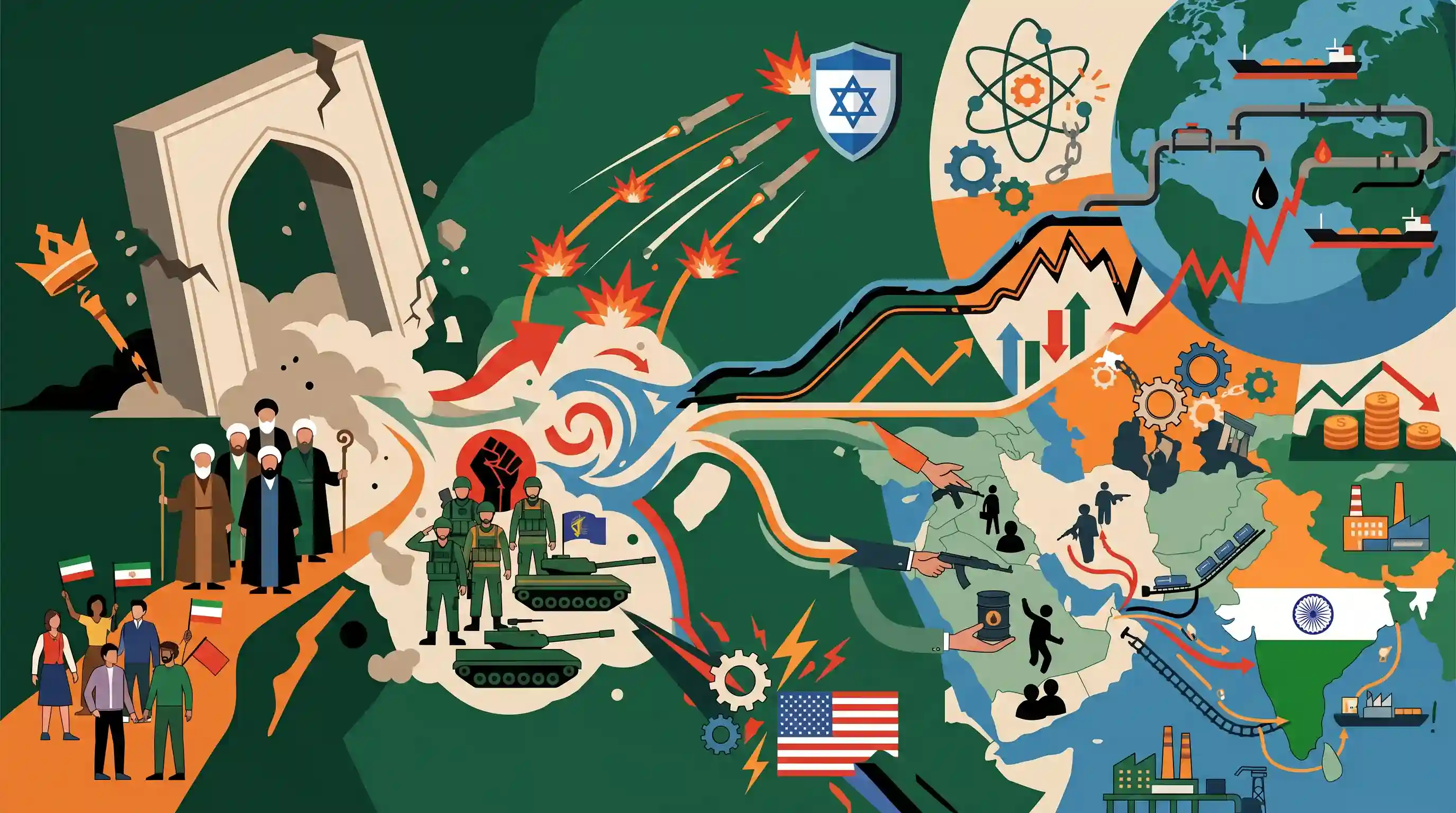
The death of Iran's Supreme Leader Ayatollah Ali Khamenei represents a watershed moment that threatens to reshape Middle Eastern geopolitics. The article examines the impending succession battle, assessing the relative influence of the clergy, the Islamic Revolutionary Guard Corps (IRGC), and reformist factions. This internal transition creates significant unpredictability regarding Iran's foreign policy—specifically its hostile posture toward Israel, its complicated relationship with the US, and its funding of regional proxies. Ultimately, the direction taken by Iran's new leadership will have profound implications for global energy security, nuclear non-proliferation, and broader regional stability, directly impacting international markets and strategic alliances.
Key Points
- The passing of Ayatollah Ali Khamenei triggers a critical succession process in Iran, with the Islamic Revolutionary Guard Corps (IRGC) expected to play a decisive role in shaping the country's future leadership.
- A potential power vacuum or internal power struggle could alter Iran's domestic policies, pitting hardline conservative factions against reformist elements and an increasingly disillusioned public.
- The transition injects massive uncertainty into Middle Eastern geopolitics, particularly concerning Iran's ongoing confrontation with Israel and its sustained support for regional proxy militias (the Axis of Resistance).
- For the US and the global community, key concerns revolve around Iran's nuclear program trajectory, potential disruptions to global energy markets, and the broader stability of the Persian Gulf region.
Important Terms
Joint Comprehensive Plan of Action (JCPOA)

A 2015 landmark agreement between Iran and world powers (P5+1) aimed at limiting Iran's nuclear program for peaceful purposes in exchange for lifting international economic sanctions.
UPSC context
GS Paper 2 (International Relations); critical for understanding India-Iran strategic ties and global nuclear non-proliferation architecture.
Islamic Revolutionary Guard Corps (IRGC)
An elite branch of the Iranian military independent of the regular army, tasked with protecting the Islamic system and exerting significant regional influence through proxies and economic control.
UPSC context
GS Paper 2 (International Relations) & Paper 3 (Security); vital for studying West Asian stability and state-sponsored non-state actors.
Axis of Resistance
An informal, Iran-led political and military alliance including state and non-state actors like Hezbollah and the Houthis, aimed at countering Western and Israeli influence in West Asia.
UPSC context
GS Paper 2 (International Relations); essential for analyzing regional conflicts and their impact on India's 'Connect West' policy.
Supreme Leader (Rahbar)
The highest-ranking political and religious authority in Iran, holding final command over the military, judiciary, and foreign policy, and overseeing the country's unique theocratic governance structure.
UPSC context
GS Paper 2 (International Relations); tests understanding of the power dynamics in a key regional partner and its policy-making process.
Energy Security
The uninterrupted availability of energy sources at an affordable price, crucial for maintaining a nation's industrial output, economic stability, and long-term national development.
UPSC context
GS Paper 3 (Economy/Resources); a central pillar of India's strategic autonomy given its heavy dependence on Middle Eastern oil imports.
Prelims Trap
"The Supreme Leader of Iran is directly elected by the citizens through a national vote."
The Supreme Leader is appointed by the Assembly of Experts (a body of Islamic clerics), not directly elected. Aspirants often confuse this with Iran's direct presidential elections.
Static Concepts Connected
What are the key maritime chokepoints for West Asian energy trade?
- Strait of Hormuz: Connects the Persian Gulf to the Gulf of Oman and the Arabian Sea; heavily guarded due to transit of ~20% of global oil.
- Bab el-Mandeb: Links the Red Sea to the Gulf of Aden; highly vulnerable to disruptions by Iran-backed Houthi rebels in Yemen.
How does Iran anchor India's Eurasian connectivity architecture?
- Chabahar Port: Strategic port in southeastern Iran bypassing Pakistan, providing India direct maritime-land access to Afghanistan and resource-rich Central Asia.
- INSTC: A 7,200-km multi-modal freight network (ship, rail, and road) connecting Mumbai to Saint Petersburg via Iranian territory.
Cross-Topic Patterns
Gulf volatility & imported inflation
Disruption in the Strait of Hormuz spikes global crude prices, directly expanding India's Current Account Deficit (CAD) and complicating the RBI's inflation targeting via imported inflation.
Internal shifts & India's "Act West" policy
A hardline IRGC takeover or renewed Western sanctions on a post-Khamenei Iran could jeopardize India's delicate strategic balancing act between Israel, Gulf Arab states, and Tehran.

Expect a multi-statement question on West Asian maritime chokepoints (Hormuz/Bab-el-Mandeb) or INSTC's operational nodes in 2026.
Linked PYQs · 4
Linked PYQs · 4
- 2025MainsGS2
"Energy security constitutes the dominant kingpin of India's foreign policy, and is linked with India's overarching influence in Middle Eastern countries.” How would you integrate energy security with India's foreign policy trajectories in the coming years?
- 2018MainsGS2
In what ways would the ongoing US-Iran Nuclear Pact Controversy affect the national interest of India? How should India respond to this situation?
- 2018MainsGS2
“India’s relations with Israel have, of late, acquired a depth and diversity, which cannot be rolled back.” Discuss.
- 2023PrelimsGS1
Consider the following statements: Statement-I: Israel has established diplomatic relations with some Arab States. Statement-II: The 'Arab Peace Initiative' mediated by Saudi Arabia was signed by Israel and Arab League. Which one of the following is correct in respect of the above statements?
