PESO Guidelines Amendment for Industrial Safety in Explosives Units
Source:Indian Express ↗
Why It Matters
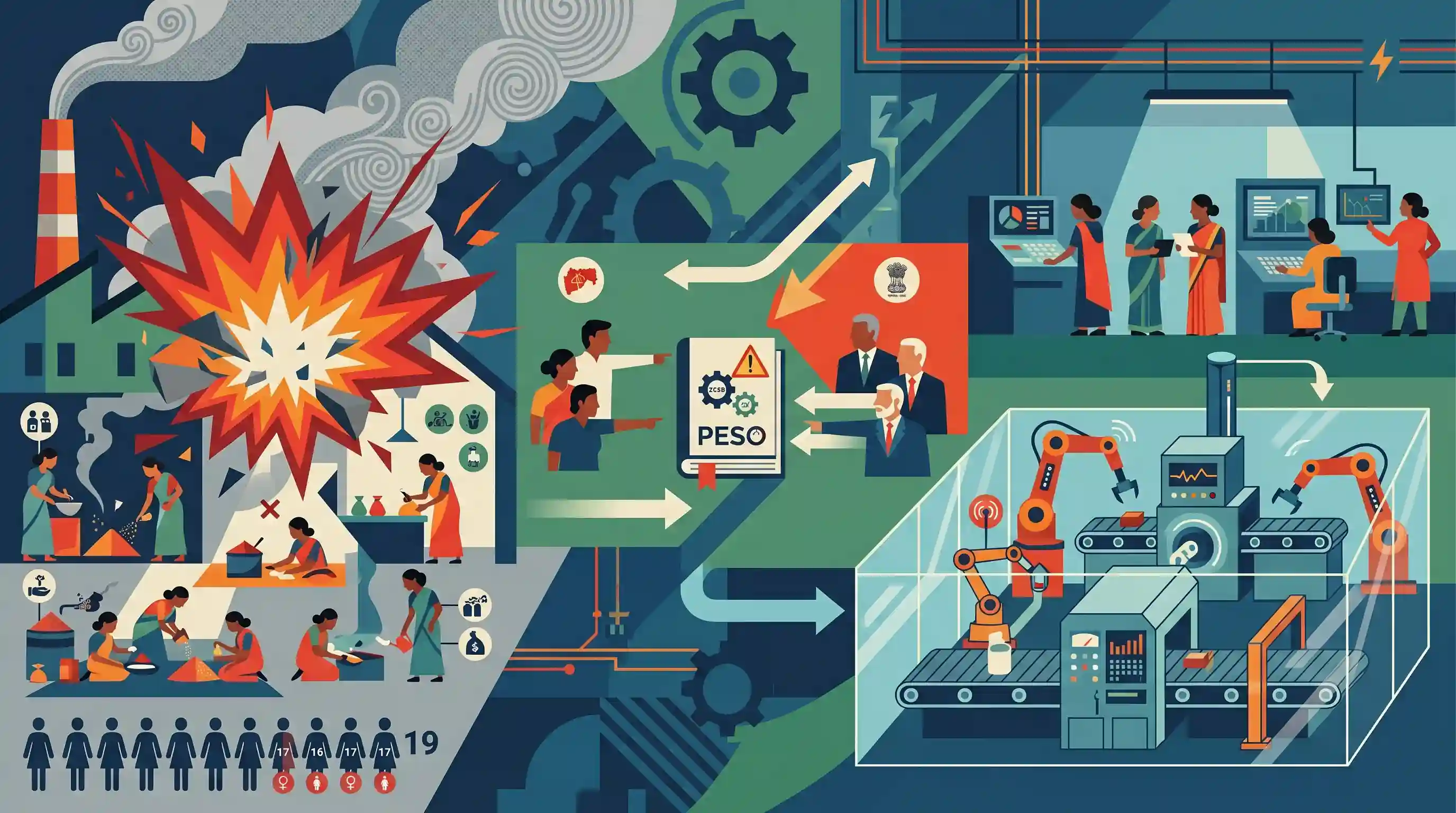
Industrial disasters reveal gaps in regulatory frameworks like the PESO guidelines. The incident is highly relevant for GS3 Disaster Management and GS1/GS2 topics on gender and employment, illustrating how economic distress forces women into hazardous jobs lacking adequate safety regulations.
Summary
Following a tragic explosion at an explosives manufacturing unit in Katol, Nagpur that claimed 19 lives, the Maharashtra government is pushing the Centre to amend the 2008 Petroleum and Explosives Safety Organisation (PESO) guidelines. The state seeks to mandate automation in the final stages of explosive manufacturing to eliminate human error. The incident also brings attention to the socio-economic realities forcing rural women into hazardous labor, as 17 of the deceased were women preferentially hired for their focus and punctuality.
Key Points
- The blast at SBL Energy Limited in Katol, Nagpur resulted in 19 worker fatalities, highlighting critical lapses in industrial safety.
- Maharashtra Chief Minister Devendra Fadnavis announced plans to urge the Centre to amend the 2008 PESO guidelines to mandate automation in hazardous explosive manufacturing processes.
- The tragedy exposes gender-specific occupational hazards, as 17 of the 19 victims were women hired for their perceived "focus" in high-risk jobs, driven by rural economic distress.
- Police have registered an FIR against the factory management for negligence, and state compensation has been announced for victims\' families.
Important Terms
Petroleum and Explosives Safety Organisation (PESO)

India's nodal agency regulating the safety of hazardous substances (explosives, compressed gases, petroleum). It operates under the DPIIT, Ministry of Commerce and Industry, and is headquartered in Nagpur.
UPSC context
GS Paper III: Industrial Safety and Disaster Management; GS Paper II: Statutory and Regulatory Bodies. Tests understanding of hazard-control frameworks.
Explosives Rules, 2008
A comprehensive set of regulations framed under the Explosives Act, 1884, governing the licensing, manufacture, storage, transport, and use of explosives to prevent accidents and ensure public safety.
UPSC context
GS Paper III: Disaster Management. Specifically relevant for discussions on industrial accident prevention and recent policy amendments following tragedies.
Explosives Act, 1884
The parent legislation enacted during the British era (and periodically amended) that provides the legal framework for the regulation of explosives' manufacture, possession, sale, and transport in India.
UPSC context
GS Paper II: Important Acts and Policies. Tests knowledge of the historical and legal basis for industrial safety regulations in India.
DPIIT (Department for Promotion of Industry and Internal Trade)
A department under the Ministry of Commerce and Industry responsible for industrial policy, investment facilitation, and ease of doing business. It is the administrative parent of PESO.
UPSC context
GS Paper III: Indian Economy and industrial growth. Crucial for understanding the administrative structure behind industrial regulation.
Hazardous Processes
Manufacturing operations involving toxic or flammable materials that can cause health risks or environmental damage. These require stringent oversight under the Factories Act and PESO guidelines.
UPSC context
GS Paper III: Disaster Management; GS Paper II: Social Justice (Labour Rights). Important for analyzing industrial safety lapses and worker protections.
Feminization of Vulnerability
A term describing the disproportionate presence of women in low-paid, precarious, or dangerous labor sectors due to socio-economic factors like rural poverty and lack of alternative employment.
UPSC context
GS Paper I: Social Issues; GS Paper II: Issues related to Women. Tests critical analysis of why women predominate in hazardous rural industries.
SBL Energy Limited
The industrial explosives manufacturer in Katol, Nagpur, where a 2024 explosion highlighted significant gaps in safety automation and the socio-economic conditions of rural labor.
UPSC context
Case Study for GS Paper III (Disaster Management) and GS Paper IV (Ethics in Industrial Safety and Corporate Responsibility).
Prelims Trap
PESO operates under the Ministry of Home Affairs or the Ministry of Labour to regulate industrial explosives.
PESO actually operates under the Department for Promotion of Industry and Internal Trade (DPIIT) within the Ministry of Commerce and Industry, not MHA or Labour.
Static Concepts Connected
What is the administrative control and statutory mandate of PESO?
- Nodal Ministry: It operates under the Department for Promotion of Industry and Internal Trade (DPIIT), Ministry of Commerce and Industry.
- Governing Acts: It is the nodal agency for enforcing the Explosives Act of 1884 and the Petroleum Act of 1934.
- Key Mandate: It regulates the manufacture, import, export, transport, and storage of explosives, petroleum, and other hazardous substances.
How does the OSH Code, 2020 regulate hazardous industries?
- Universal Application: The Code applies to any establishment dealing with hazardous processes or life-threatening activities, regardless of the total number of workers employed.
- Safety Committees: It mandates the constitution of bipartite safety committees in hazardous units to involve workers in occupational safety protocols.
- Employer Responsibility: It shifts absolute responsibility for drafting on-site emergency plans and ensuring safety strictly to the employer/occupier.
Cross-Topic Patterns
Feminization of hazardous informal labor
Agrarian distress and lack of rural employment drive women into high-risk industrial sectors. This links economic geography directly to occupational hazards, highlighting the 'feminization of poverty'.
NDMA guidelines & industrial disaster frameworks
The evolution from the Bhopal Gas Tragedy to the OSH Code 2020 highlights a persistent Mains theme: the gap between statutory safety frameworks and ground-level enforcement in hazardous units.

Expect a Prelims question matching regulatory bodies like PESO, NDMA, and CPCB with their nodal ministries and governing statutory Acts.
Linked PYQs · 3
Linked PYQs · 3
- 2020MainsGS3
Discuss the recent measures initiated in disaster management by the Government of India departing from the earlier reactive approach.
- 2021MainsGS1
Examine the role of 'Gig Economy' in the process of empowerment of women in India.
- 2019MainsGS3
Disaster preparedness is the first step in any disaster management process. Explain how hazard zonation mapping will help disaster mitigation in the case of landslides.
