ISRO Resumes Launch Operations with GISAT 1A Satellite Mission
Source:Indian Express ↗
આ શા માટે મહત્વનું છે
The resumption of ISRO's space missions via GISAT-1A following an operational hiatus highlights the resilience, technological iterations, and strategic importance of indigenous space programmes for resource management and socio-economic development.
સારાંશ
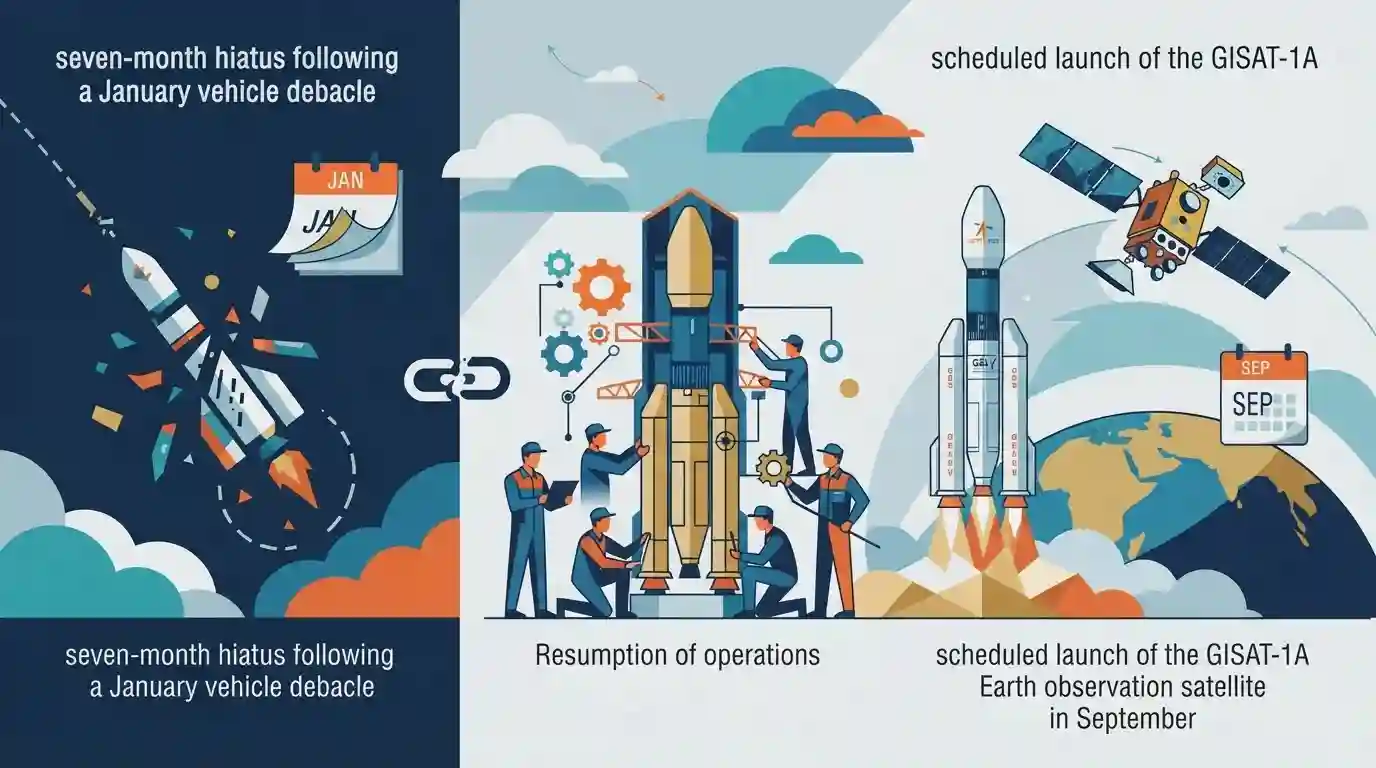
ISRO is set to resume its launch operations after a seven-month hiatus following a January vehicle debacle, with the scheduled launch of the GISAT-1A Earth observation satellite in September.
મુખ્ય મુદ્દા
- ISRO is preparing to end a seven-month operational hiatus with the launch of the GISAT-1A Earth observation satellite in September.
- The upcoming launch follows a launch vehicle debacle/failure encountered in January, highlighting the technical challenges and risks inherent in space missions.
- GISAT-1A highlights India's continuous advancements and reliance on indigenous Earth observation satellites for resource monitoring, weather forecasting, and strategic applications.
મહત્વપૂર્ણ શબ્દો
GISAT-1A

An Earth observation satellite placed in a geosynchronous orbit to provide continuous real-time imaging of the Indian subcontinent for disaster monitoring, agriculture, and strategic applications.
UPSC context
UPSC GS Paper III (Science and Technology - Space): Tests awareness of satellite types, orbits, and domestic remote-sensing applications.
ISRO
India's national space agency responsible for planning, developing, and executing space exploration, satellite deployment, and launch vehicle programs.
UPSC context
UPSC GS Paper III (Science and Technology - Space): Evaluates institutional frameworks, achievements, and challenges in India's space program.
પ્રિલિમ્સ ટ્રેપ
GISAT-1A is a Low Earth Orbit satellite providing global coverage every 30 minutes.
Aspirants often confuse GISAT's Geostationary Orbit (GSO) with Low Earth Orbit (LEO) or Sun-Synchronous Orbit (SSO) used by standard IRS missions.
સંલગ્ન સ્થિર ખ્યાલો
What are the primary differences between Low Earth Orbit (LEO) and Geosynchronous Orbit (GSO) satellites used in Earth observation?
- Orbit Altitude: Altitude range, operating below 2,000 km for LEO and precisely at 35,786 km for GSO/GEO.
- Coverage Style: Coverage type, where LEO provides global swaths with revisit times of days, while GSO provides continuous real-time staring over a fixed regional sector.
- Vehicle Demand: Launch complexity, requiring heavier launch vehicles like GSLV for GSO payloads compared to lighter PSLV or SSLV for LEO missions.
આંતર-વિષય પેટર્ન
Space Tech + Precision Agriculture Linkages
Earth observation payloads use multispectral and hyperspectral imaging to monitor soil health and moisture, linking space tech directly to sustainable agriculture and precision farming initiatives.
Earth Observation + National Security Grid
High-resolution geostationary Earth observation satellites provide real-time boundary and terrain monitoring, enhancing national security infrastructure alongside traditional border surveillance grids.

GISAT's geostationary orbit advantages over LEO constellations will likely feature in a statement-based prelims question.
સંલગ્ન PYQ · 2
સંલગ્ન PYQ · 2
- 2018PrelimsGS1
With reference to India's satellite launch vehicles, consider the following statements: 1. PSLVs launch the satellites useful for Earth resources monitoring whereas GSLVs are designed mainly to launch communication satellites. 2. Satellites launched by PSLV appear to remain permanently fixed in the same position in the sky, as viewed from a particular location on Earth. 3. GSLV Mk III is a four-staged launch vehicle with the first and third stages using solid rocket motors; and the second and fourth stages using liquid rocket engines. Which of the statements given above is/are correct?
- 2016MainsGS3
Discuss India's achievements in the field of Space Science and Technology. How the application of this technology has helped India in its socio-economic development?
