ISRO resumes operations with GISAT 1A satellite launch
Source:Indian Express ↗
આ શા માટે મહત્વનું છે
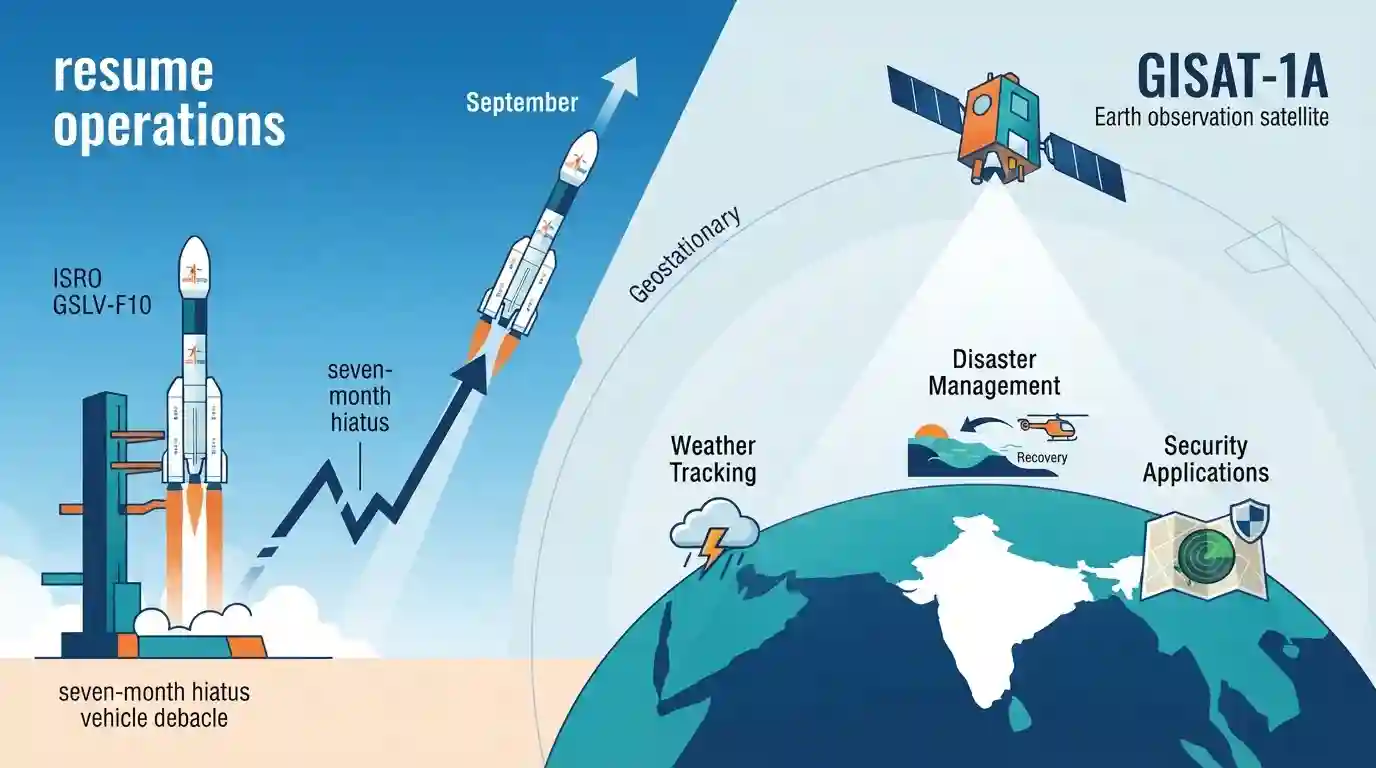
The article addresses ISRO's operational continuity, recovery from launch vehicle setbacks, and the deployment of advanced Earth observation payloads like GISAT-1A, which are critical for national security, disaster warning, and socio-economic planning.
સારાંશ
ISRO is set to resume its launch operations after a seven-month hiatus following a January vehicle debacle, with the launch of the GISAT-1A Earth observation satellite scheduled for September. GISAT-1A will provide continuous, real-time monitoring capabilities from geostationary orbit, aiding weather tracking, disaster management, and security applications.
મુખ્ય મુદ્દા
- ISRO's operational hiatus of seven months following a January launch vehicle debacle is set to end with the scheduled September launch of the GISAT-1A Earth observation satellite.
- GISAT-1A (Geostationary Imaging Satellite) is designed for continuous real-time imaging of the Indian subcontinent and surrounding oceans from a geostationary orbit.
- The mission marks a crucial resumption of India's space launch cadence and highlights resilient corrective engineering following launch vehicle challenges.
- Earth observation satellites in geostationary orbits play a vital role in disaster management, weather forecasting, and strategic surveillance.
મહત્વપૂર્ણ શબ્દો
GISAT-1A

India's advanced Earth observation satellite operating from geostationary orbit to provide continuous real-time monitoring for weather tracking, disaster management, and security applications.
UPSC context
UPSC Paper III (Science and Technology - Space Tech): Tests knowledge of satellite applications, remote sensing, and geostationary orbit missions.
ISRO
India's national space agency under the Department of Space, responsible for developing space technology, satellite launch vehicles, and conducting space exploration and applications.
UPSC context
UPSC Paper III (Science and Technology): Tests achievements of Indians in science and technology and indigenization of space technology.
પ્રિલિમ્સ ટ્રેપ
All Earth observation satellites operate in Low Earth Orbit (LEO) to capture high-resolution imagery of disaster zones.
Aspirants often assume all Earth Observation Satellites (EOS) are in Low Earth Orbit (LEO) for high-resolution snapshots. GISAT-1A is unique because it is stationed in Geostationary Orbit (36,000 km) for continuous, real-time monitoring.
સંલગ્ન સ્થિર ખ્યાલો
What are the key orbital differences between Low Earth Orbit (LEO) and Geostationary Orbit (GEO) used in satellite missions?
- LEO Altitude: LEO operates at altitudes between 160 km and 2,000 km, providing periodic coverage and high-resolution imaging due to proximity.
- GEO Advantage: GEO operates at approx. 36,000 km, matching Earth's rotational speed to provide continuous, real-time unblinking coverage over a fixed geographic region.
- Coverage Scope: LEO requires constellations for global coverage, whereas a single properly placed GEO satellite can monitor nearly a third of the Earth's surface.
આંતર-વિષય પેટર્ન
Space Surveillance + Indo-Pacific Maritime Domain Awareness
ISRO's shift to geostationary Earth observation pairs with maritime domain awareness initiatives, linking space situational awareness directly to Indo-Pacific security architectures.
Launch Failures + Commercial Space Diplomacy (NSIL)
Frequent launch vehicle failures and corrective hiatuses test the resilience of India's commercial space arm (NSIL) in honoring international launch commitments.

GISAT-1A's geostationary orbit capability vs. LEO imaging trade-offs is prime material for a statement-based prelims question.
સંલગ્ન PYQ · 2
સંલગ્ન PYQ · 2
- 2016MainsGS3
Discuss India's achievements in the field of Space Science and Technology. How the application of this technology has helped India in its socio-economic development?
- 2011PrelimsGS1
Satellites used for telecommunication relay are kept in a geostationary orbit. A satellite is said to be in such an orbit when: 1. The orbit is geosynchronous. 2. The orbit is circular. 3. The orbit lies in the plane of the Earth's equator. 4. The orbit is at an altitude of 22,236 km.
