Historical Origins of Sino Indian Border Dispute
Source:The Hindu ↗
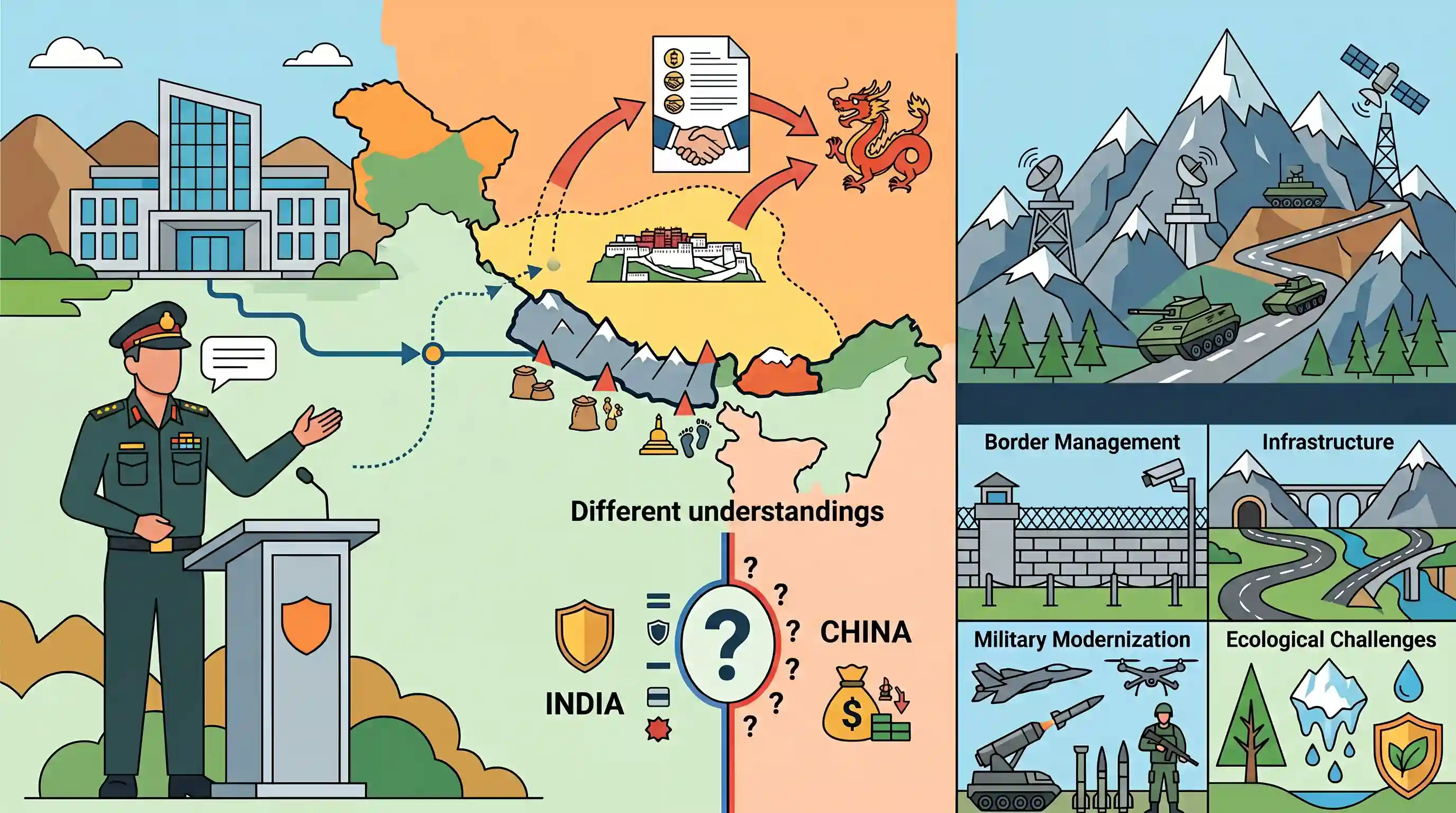
Why It Matters
The CDS\'s remarks provide an authoritative historical context to the Sino-Indian border dispute, highlighting differing interpretations of the Panchsheel Agreement. Understanding the evolution of the \'Himalayan buffer\' is crucial for analyzing ongoing border tensions and evaluating India\'s strategic infrastructure development in the region.
Summary
During the inauguration of the strategic think tank Bharat Himalayan International Strategic Manch (BHISM) in Dehradun, Chief of Defence Staff General Anil Chauhan reflected on the historical origins of the India-China border dispute. He noted that India\'s post-Independence desire for stable ties led to the 1954 Panchsheel Agreement, wherein India recognized Tibet as part of China, effectively erasing the traditional Himalayan buffer. While India assumed the agreement—and its designation of six passes for trade and pilgrimage—settled the northern frontiers, China maintained it was solely a trade pact, leaving the border unresolved. Chauhan emphasized the growing strategic importance of the Himalayan frontiers and the need for comprehensive planning to address border management, infrastructure, military modernization, and ecological challenges.
Key Points
- Chief of Defence Staff General Anil Chauhan stated that India sought stable relations with China post-Independence, leading to the 1954 Panchsheel Agreement and the recognition of Tibet as part of China.
- The absorption of Tibet eliminated the traditional Himalayan buffer zone, turning it into a direct border with China.
- India believed the Panchsheel Agreement, which opened six passes for trade and pilgrimage, inherently settled the northern boundary, but China viewed it strictly as a trade arrangement.
- A new strategic think tank, the Bharat Himalayan International Strategic Manch (BHISM), was inaugurated in Dehradun to provide policy recommendations on Himalayan region issues.
- BHISM will focus on a holistic Himalayan perspective, addressing border management, military modernization, climate change, water security, and disaster preparedness.
Important Terms
Panchsheel Agreement

A 1954 treaty between India and China establishing five principles of peaceful coexistence. It formally recognized Tibet as part of China, which CDS Chauhan suggests removed the traditional Himalayan buffer.
UPSC context
GS-II (International Relations) and GS-I (Post-Independence History); tests understanding of early foreign policy frameworks and their long-term impact on border disputes.
Bharat Himalayan International Strategic Manch (BHISM)
A Dehradun-based strategic think tank inaugurated in 2026 to provide policy recommendations on Himalayan security, infrastructure development, and border management to the Indian government.
UPSC context
GS-III (Internal Security) and GS-II (Governance); tests knowledge of institutional mechanisms for strategic planning in sensitive border regions.
National Security Advisory Board (NSAB)
A non-statutory body providing long-term strategic analysis to the National Security Council (NSC). It comprises experts from defense, diplomacy, and academia to offer independent policy perspectives.
UPSC context
GS-III (Security Architecture); tests understanding of India's three-tier national security management system and the role of advisory inputs in policymaking.
Buffer Zone
A neutral area or state situated between two potentially hostile powers to prevent direct conflict. Historically, Tibet served as a buffer between India and China until the 1954 pact.
UPSC context
GS-II (International Relations/Geopolitics); tests conceptual clarity on strategic geography and its significance in maintaining regional stability.
Middle Sector
The central portion of the India-China boundary, primarily along the borders of Himachal Pradesh and Uttarakhand. It is characterized by six passes identified in the 1954 pact.
UPSC context
GS-III (Border Management); tests geographical awareness and specific sector-wise understanding of the Line of Actual Control (LAC) disputes.
Prelims Trap
The 1954 Panchsheel Agreement formally demarcated the northern boundary between India and China.
While India implicitly believed the pact settled the frontier by designating six passes, China maintained it was strictly a trade arrangement, leaving borders legally undefined.
Static Concepts Connected
What are the 5 principles of the Panchsheel Agreement (1954)?
- Mutual respect: For each other's territorial integrity and sovereignty.
- Non-aggression: Strict adherence to mutual non-aggression and avoiding use of force.
- Non-interference: Mutual non-interference in each other's internal affairs.
- Peaceful coexistence: Commitment to equality, mutual benefit, and peaceful coexistence.
What is the geographical significance of the trade passes in the 1954 pact?
- Shipki La: Located in Kinnaur district (Himachal Pradesh); the Sutlej river enters India from Tibet through this pass.
- Lipulekh: Situated at the tri-junction of India, Nepal, and China (Uttarakhand); vital for the Kailash Mansarovar Yatra.
- Mana & Niti: High-altitude passes in Uttarakhand connecting the Garhwal region directly to the Tibetan plateau.
Cross-Topic Patterns
Upper Riparian Hydro-hegemony
The loss of the Tibetan buffer extends beyond military frontiers to water security, making China the upper riparian controller of vital transboundary rivers like the Brahmaputra and Sutlej.
Himalayan Ecology & Border Infrastructure
BHISM’s "Holistic Security" mandate integrates military modernization with disaster preparedness, mirroring syllabus themes on the ecological fragility of border infrastructure projects in the Himalayas.

Expect a 2026 Mains question linking the historical loss of the Tibetan buffer to modern 'Holistic Security' and transboundary water risks.
Linked PYQs · 4
Linked PYQs · 4
- 2012MainsGS2
Do you think that China's emergence as one of the largest trading partners of India has adversely affected the settlement of the outstanding border problem?
- 2014MainsGS2
With respect to the South China sea, maritime territorial disputes and rising tension affirm the need for safeguarding maritime security to ensure freedom of navigation and over flight throughout the region. In this context, discuss the bilateral issues between India and China.
- 2024MainsGS3
India has a long and troubled border with China and Pakistan fraught with contentious issues. Examine the conflicting issues and security challenges along the border. Also give out the development being undertaken in these areas under the Border Area Development Programme (BADP) and Border Infrastructure and Management (BIM) Scheme.
- 2020MainsGS3
For effective border area management, discuss the steps required to be taken to deny local support to militants and also suggest ways to manage favourable perception among locals.
