Manipur Political Dissent and State Government Leadership
Source:Indian Express ↗
Why It Matters
The political instability in Manipur serves as a crucial case study for UPSC aspirants on the intersection of internal security, state governance, and constitutional provisions (like Article 356). It highlights how ethnic conflicts can precipitate leadership crises and challenge the stability of state governments.
Summary
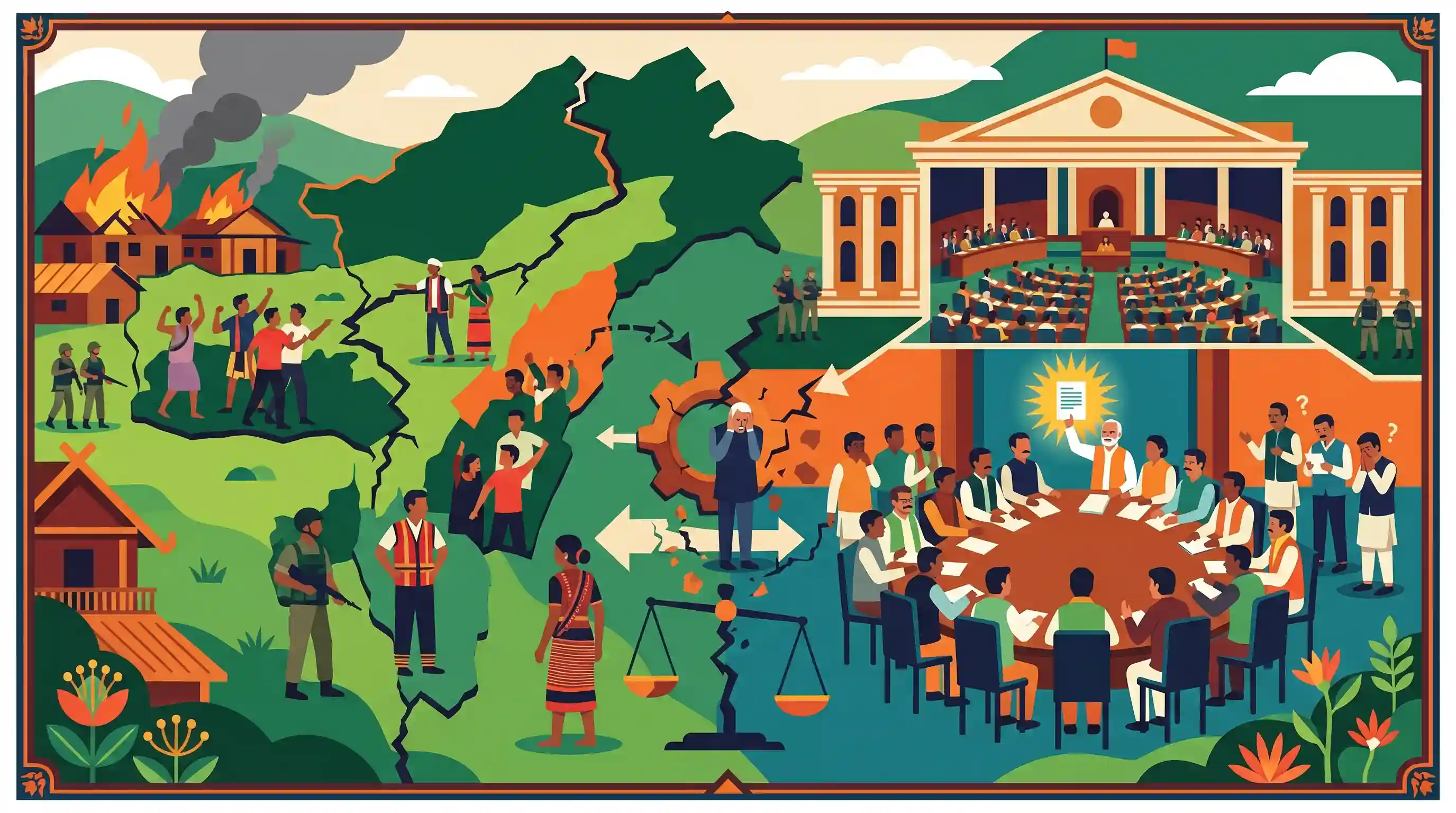
Amid the ongoing ethnic turmoil in Manipur, significant political fissures have emerged within the ruling party. Twenty-three BJP MLAs recently held a meeting and passed a resolution demanding the formation of a "popular government." This move signals deep internal dissatisfaction with the current state leadership's handling of the protracted Meitei-Kuki conflict. The development underscores the intricate relationship between political stability and internal security in border states, raising potential concerns over governance deficits and the functioning of constitutional machinery during severe crises.
Key Points
- In a display of significant internal dissent, 23 BJP MLAs in Manipur convened to resolve for the formation of a 'popular government'.
- The resolution suggests a profound lack of confidence in the current state leadership's handling of the prolonged ethnic conflict.
- This political instability exacerbates the ongoing internal security challenges involving the Meitei and Kuki communities.
- Prolonged governance deficits and internal political fractures in border states often raise questions about the potential breakdown of constitutional machinery.
Important Terms
Article 356

Empowers the President to impose direct rule in a state upon the failure of its 'constitutional machinery,' typically resulting in the suspension or dismissal of the state government.
UPSC context
GS Paper II (Polity): Essential for questions on Centre-State relations, Emergency provisions, and the role of the Governor.
Tenth Schedule
Commonly known as the Anti-Defection Law, it prescribes the disqualification of legislators who voluntarily give up party membership or vote against party whips to ensure political stability.
UPSC context
GS Paper II: Frequently tested regarding the Speaker's powers, legislative stability, and recent judicial interpretations like Kihoto Hollohan.
Popular Government
A term used to describe a representative government formed by elected members (MLAs), as opposed to administration by a Governor or direct central rule during emergencies.
UPSC context
GS Paper II: Relevant to the restoration of democratic processes and governance during a political impasse in border states.
Suspended Animation
The legal status of a State Legislative Assembly during President's Rule where it is not dissolved but its functions are temporarily stayed, allowing for potential government reformation.
UPSC context
GS Paper II: Crucial for understanding the procedural nuances of Article 356 and the subsequent Bommai judgment safeguards.
Article 355
Mandates the Union to protect states against external aggression and internal disturbances and to ensure state governments function in accordance with the Constitution.
UPSC context
GS Paper II/III: Vital for discussions on internal security, federal duties, and the constitutional threshold for central intervention.
Manipur State Legislative Assembly
The unicameral house of representatives for the state of Manipur, consisting of 60 members, currently in suspended animation following the state's political crisis.
UPSC context
GS Paper II: Contextual example of state-level legislative functioning and breakdown in the Northeast region.
Prelims Trap
MLAs demanding a change in their own party's Chief Minister are automatically disqualified under the Anti-Defection Law.
Under the Tenth Schedule, internal dissent does not equal 'voluntarily giving up membership' unless a formal whip is defied on the floor of the House.
Static Concepts Connected
Can the Governor order a floor test based solely on intra-party dissent?
- Subhash Desai Judgment: The SC (2023) ruled that Governors cannot use floor tests to resolve internal party disputes or rivalries.
- Objective Material: The Governor needs substantive, objective material indicating the government has lost its legislative majority, not just intra-party factionalism.
What justifies the imposition of President's Rule under Article 356?
- Article 355 Duty: The Union is constitutionally obligated to protect states from external aggression and internal disturbance.
- Article 356 Imposition: Invoked when a state government cannot be carried on in accordance with constitutional provisions, such as during unmanageable internal rebellion or loss of majority.
Cross-Topic Patterns
Internal security + Constitutional crises
Political instability in border states severely complicates the policing of the porous Indo-Myanmar border and weakens tripartite Suspension of Operations (SoO) pacts with insurgent groups.
10th Schedule + Intra-party democracy
The recurring friction between MLAs demanding leadership changes and the threat of disqualification tests the limits of the Anti-Defection Law, as seen recently in Maharashtra and Manipur.

Governor’s discretionary powers on floor tests (Subhash Desai case) + Tenth Schedule limits will likely form a 2026 Prelims question.
Linked PYQs · 3
Linked PYQs · 3
- 2023MainsGS2
Account for the legal and political factors responsible for the reduced frequency of using Article 356 by the Union Governments since mid 1990s.
- 2025MainsGS3
What are the major challenges to internal security and peace process in the North-Eastern States? Map the various peace accords and agreements initiated by the government in the past decade.
- 2014PrelimsGS1
Which one of the following Schedules of the Constitution of India contains provisions regarding anti-defection?
