India Bangladesh bilateral relations after political transition
Source:decypher-asia ↗
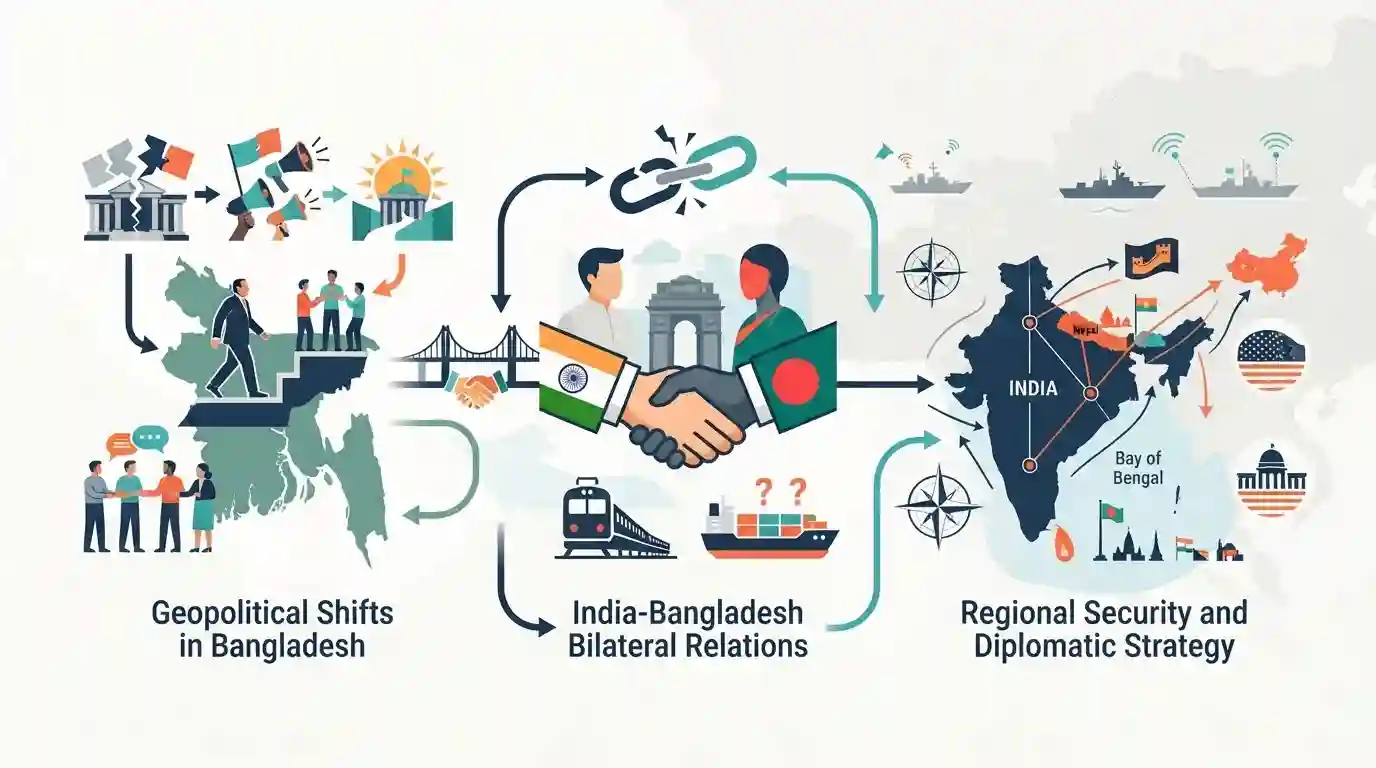
Why It Matters
Crucial for understanding India's strategic security and diplomatic engagement with its eastern neighbor, particularly in light of regime changes.
Summary
The article analyzes the geopolitical shifts in Bangladesh following the fall of Sheikh Hasina's regime, detailing the ramifications for India-Bangladesh bilateral relations, regional security, and diplomatic strategy.
Key Points
- The ouster of Sheikh Hasina in Bangladesh has ushered in a period of intense political uncertainty, impacting bilateral relations with India.
- India-Bangladesh relations face challenges due to changing political regimes, security concerns, cross-border migration issues, and regional stability dynamics.
- Geopolitically, Bangladesh shares a long land and riverine boundary with India, particularly affecting states like West Bengal.
Important Terms
Awami League

A historically dominant center-left political party in Bangladesh founded in 1949 and led by Sheikh Hasina, which has faced severe crackdowns and bans following the 2024 mass uprisings.
UPSC context
Crucial for WBCS Paper II (International Relations & Neighborhood Policy), testing understanding of domestic political shifts in Bangladesh and India's diplomatic stakes.
BNP
A major center-right political party in Bangladesh founded in 1978 by Ziaur Rahman, historically advocating Bangladeshi nationalism, a free-market economy, and conservative social policies.
UPSC context
Important for WBCS Paper II under international affairs, examining how changing political parties in neighboring countries impact bilateral relations with India.
Static Concepts Connected
What are the key geopolitical dimensions of the India-Bangladesh border?
- Border Length: Bangladesh shares its longest international land border with India, spanning approximately 4,096.7 km across five states.
- West Bengal Share: West Bengal shares the largest share of the international boundary with Bangladesh among all Indian states.
- Historical Roots: The Radcliffe Award of 1947 partitioned Bengal, creating the historical foundation for the modern boundary.
Cross-Topic Patterns
Neighborhood Regime Shifts and Border Security
Sudden political regime change in immediate neighbors tests India's border diplomacy, intelligence coordination, and refugee management frameworks across the eastern sector.

Bangladesh post-Hasina shift + India's longest land border (4,096 km) security management likely to feature in WBCS Paper II.
Linked PYQs · 2
Linked PYQs · 2
- 2015WBCS_PRELIMSGS1
West Bengal has international boundaries on
- 2018WBCS_PRELIMSGS1
Geomorphologists opine that change of the course of the Kosi river resulted in
