Prime Minister to Dedicate Pachpadra Refinery to Nation
Source:newindianexpress ↗
Why It Matters
The Pachpadra Refinery (HRRL) is one of the largest industrial developments in Rajasthan and a frequent subject of RPSC RAS examination questions regarding its ownership structure, capacity, and location. Knowing its updated location (Balotra district) and related infrastructure projects like Jaipur Metro Phase II is crucial for state civil services preparation.
Summary
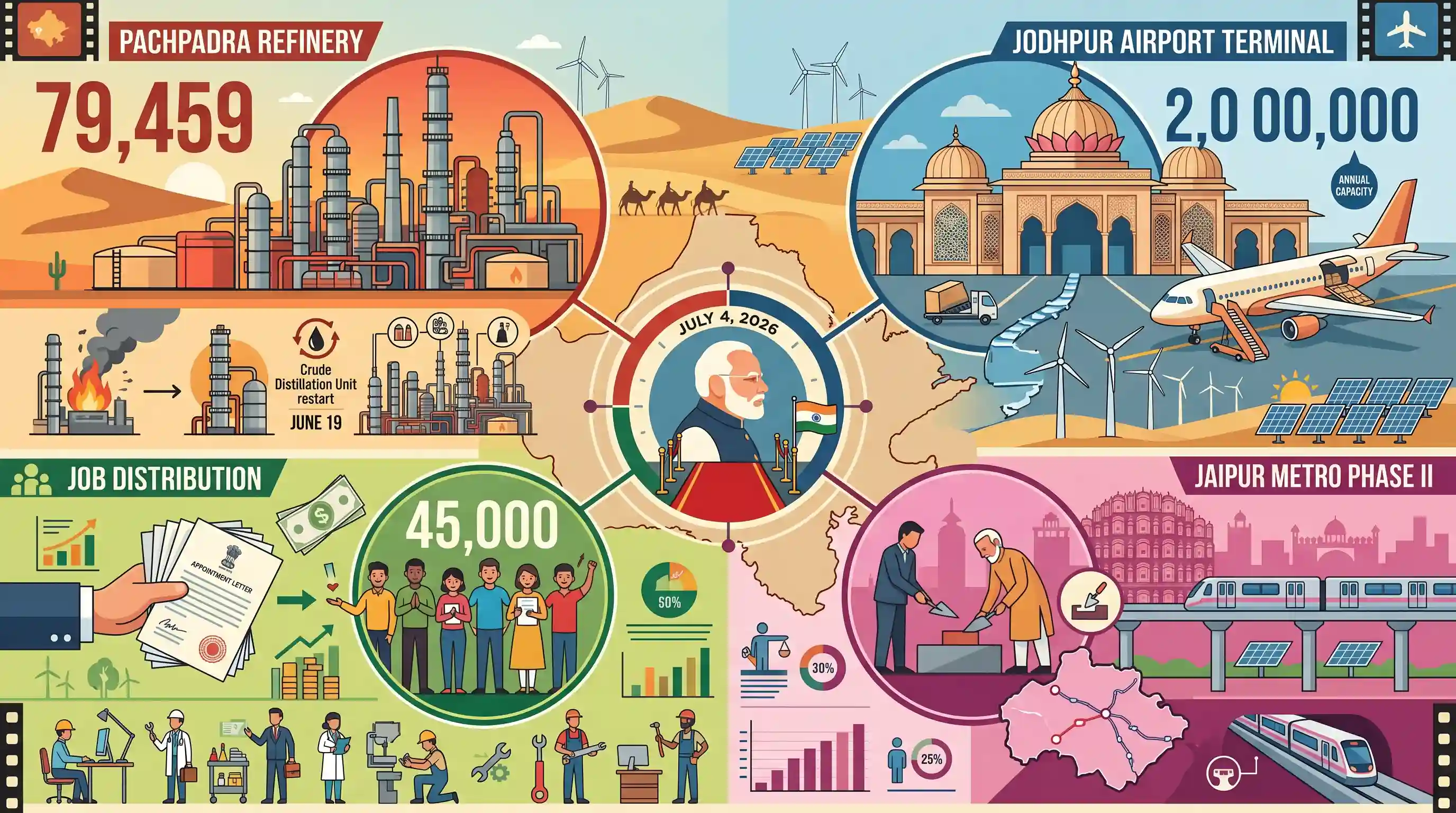
Prime Minister Narendra Modi will visit Rajasthan on July 4, 2026, to inaugurate the Rs 79,459-crore HPCL Rajasthan Oil Refinery at Pachpadra in the newly created Balotra district (formerly part of Barmer). The mega-project's launch was delayed from April 20, 2026, due to a major fire that damaged its Crude Distillation Unit, which resumed operations on June 19. During his visit, the PM will also inaugurate the new terminal building at Jodhpur Airport, lay the foundation stone for Phase II of the Jaipur Metro, and distribute appointment letters to 45,000 state government job recruits.
Key Points
- Prime Minister Narendra Modi will visit Rajasthan on July 4, 2026, to inaugurate the Rs 79,459-crore HPCL Rajasthan Oil Refinery at Pachpadra, Balotra.
- The refinery, spread over 4,500 acres, is developed by HRRL—a joint venture between HPCL (74%) and the Government of Rajasthan (26%). It is India's first integrated refinery-cum-petrochemical complex producing BS-VI grade fuels.
- The launch was postponed from April 20, 2026, to July 4, 2026, due to a major fire on April 19, which damaged the Crude Distillation Unit (CDU). Production resumed on June 19 after repairs.
- Additional development projects slated for launch during the PM's visit include a new terminal building at Jodhpur Airport and laying the foundation stone for Phase II of the Jaipur Metro Rail project.
- The PM will also distribute appointment letters to approximately 45,000 candidates selected for state government jobs.
Important Terms
HPCL Rajasthan Refinery Limited (HRRL)

Joint venture between HPCL (74%) and Rajasthan Government (26%), building India's first integrated greenfield refinery-cum-petrochemical complex (9 MMTPA capacity) at Pachpadra, Balotra district, to boost domestic petrochemical manufacturing and reduce import reliance.
UPSC context
GS Paper III (Infrastructure & Energy). Relates to energy security, industrial development, and joint-venture investment models.
Hindustan Petroleum Corporation Limited (HPCL)
A Maharatna Central Public Sector Enterprise (CPSE) under the Ministry of Petroleum and Natural Gas. Operating as an ONGC subsidiary, it is a key player in India's downstream oil and gas marketing, refining, and distribution network.
UPSC context
GS Paper III (Economic Development & CPSEs). Tests understanding of Maharatna PSUs, corporate governance, and state-led energy sector policies.
Jaipur Metro Rail Project Phase II
A 41-km rapid transit expansion (Orange Line) connecting Prahladpura to Todi Mod. Approved in April 2026, the project features 36 stations, primarily elevated, to decongest Jaipur's heavy business and residential corridors.
UPSC context
GS Paper III (Infrastructure: Transport & Urban Development). Tests understanding of transit-oriented development, sustainable cities, and mass rapid transit systems (MRTS).
Rajasthan Metro Rail Corporation Limited (RMRCL)
A 50:50 joint venture between the Government of India and the Government of Rajasthan. It serves as the nodal implementing agency responsible for the execution, development, and operation of Jaipur Metro's Phase II expansion.
UPSC context
GS Paper II & III (Cooperative Federalism & Infrastructure). Tests knowledge of institutional frameworks and joint-venture models for municipal utility execution.
Prelims Trap
The HRRL project at Pachpadra is a 50:50 joint venture between the Central Government and the Government of Rajasthan.
HRRL is a 74:26 joint venture between HPCL (a Central PSU) and the Government of Rajasthan, not a 50:50 direct sovereign partnership.
Static Concepts Connected
What are the advantages of integrating petrochemical complexes with petroleum refineries?
- Feedstock Optimization: Provides direct, cheap feedstock like naphtha, propylene, and LPG to petrochemical units, reducing transportation and logistics costs.
- Value Addition: Converts low-value refinery streams into high-value petrochemical polymers and specialty chemicals, boosting overall profit margins.
- Energy Efficiency: Integrating utilities like steam, power, and water treatment lowers the carbon footprint and operational costs of both units.
What are the key technical and environmental specifications of BS-VI fuel standards in India?
- Sulphur Reduction: BS-VI fuels contain a maximum of 10 ppm (parts per million) sulphur, a major reduction from the 50 ppm limit in BS-IV.
- NOx Emission Limits: Reduces Nitrogen Oxide (NOx) emissions significantly—by 25% for petrol engines and 68% for diesel engines.
- Particulate Matter Control: Introduces strict limits on Particulate Matter (PM 2.5 and PM 10), requiring Diesel Particulate Filters (DPF) in diesel vehicles.
Cross-Topic Patterns
Water-intensive refining in arid zones
Balancing high-water-consumption industries like petroleum refining with extreme groundwater depletion in western Rajasthan tests sustainable industrial zoning and wastewater recycling policies.
Metro rail SPVs and cooperative federalism
The 50:50 joint venture structure of Jaipur Metro Phase II highlights the evolving financial architecture of urban transit, balancing central fiscal support with state-level execution.

UPSC may contrast the financial models of 50:50 metro SPVs with lopsided PSU-State JV equity structures like HRRL (74:26).
Linked PYQs · 1
Linked PYQs · 1
- 2018RPSC_PRELIMSGS1
The proposed oil refinery in Pachpadra, Barmer, is a joint venture of which?
