Election Commission Disciplinary Jurisdiction over State Officials
Source:Indian Express ↗
Why It Matters
This case provides a real-world example of the practical challenges the ECI faces in exerting its disciplinary authority over state administrative machinery during elections. It is highly relevant for GS Paper 2 questions on the powers of constitutional bodies, electoral reforms, and federal administrative relations.
Summary
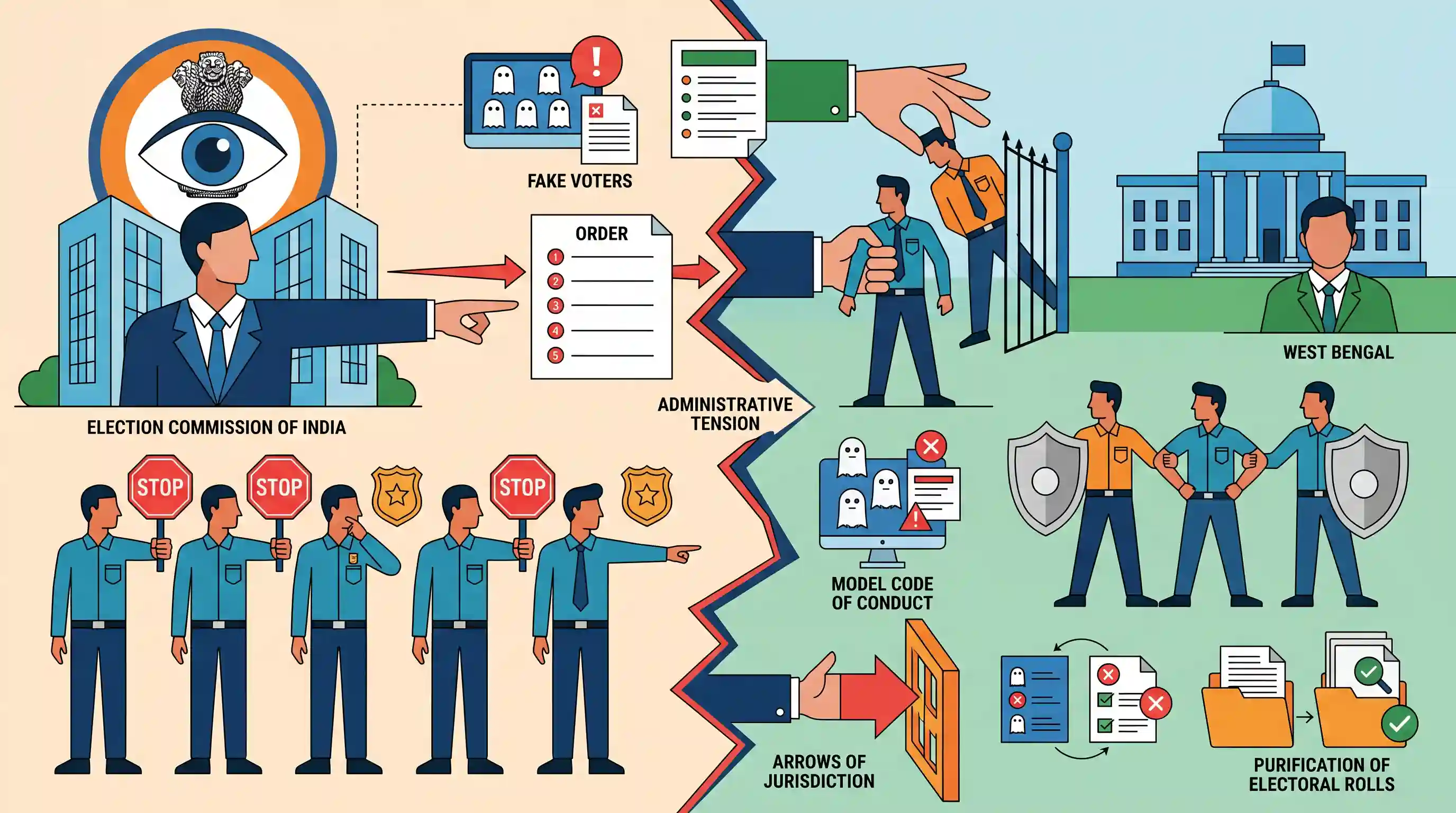
The Election Commission of India (ECI) ordered the suspension of and filing of FIRs against five officials in West Bengal in connection with a "fake" voters issue. However, the West Bengal state government only withdrew two of these officials from poll-related duties. This partial compliance exposes administrative friction between the central electoral watchdog and state government machinery, raising critical concerns over the ECI's disciplinary jurisdiction, enforcement of the Model Code of Conduct, and the effective purification of electoral rolls during elections.
Key Points
- The ECI ordered the suspension and filing of FIRs against five officials in West Bengal over the issue of fake voters.
- The West Bengal government partially complied by removing only two officials from election-related duties, revealing friction between the ECI and state administration.
- Under Article 324, the ECI exercises superintending and disciplinary jurisdiction over state officials deputed for poll duties to ensure free and fair elections.
- The incident highlights challenges in enforcing the Model Code of Conduct and implementing electoral reforms, particularly concerning the purification of electoral rolls.
Important Terms
Article 324

Constitutional provision vesting the Election Commission of India with the 'superintendence, direction and control' of the preparation of electoral rolls and the conduct of all elections.
UPSC context
GS Paper II (Constitution). Fundamental for understanding the ECI's plenary powers and its autonomy from executive interference.
Election Commission of India (ECI)
An autonomous constitutional body responsible for administering Union and State election processes, ensuring they are free, fair, and impartial through oversight of officials and political conduct.
UPSC context
GS Paper II (Constitutional Bodies). Tests knowledge of institutional integrity, mandate, and the challenges of multi-tiered electoral governance.
Representation of the People Act, 1950
A parliamentary act providing the legal framework for the allocation of seats, delimitation of constituencies, and the preparation and revision of electoral rolls.
UPSC context
GS Paper II (RPA). Specifically relates to the 'purification' of voter lists and the legal qualifications for registration.
Model Code of Conduct (MCC)
A set of guidelines issued by the ECI to regulate the conduct of political parties and candidates during elections to maintain a level playing field.
UPSC context
GS Paper II (Electoral Reforms). Tests the application of non-statutory regulations that gain mandatory force via Article 324.
Deputation (Election Duty)
The legal status where state government officials are placed under the administrative control of the ECI for the duration of an election period.
UPSC context
GS Paper II (Centre-State Relations). Highlights administrative friction and the ECI's disciplinary jurisdiction over state-controlled machinery.
Purification of Electoral Rolls
The continuous administrative process of removing 'fake', deceased, or shifted voters from the electoral roll to ensure the list remains accurate and credible.
UPSC context
GS Paper II (Elections). Critical for discussing electoral integrity and the prevention of fraudulent voting practices.
Prelims Trap
The ECI has absolute authority to permanently dismiss state government officials assigned to election duties.
Officials are on "deemed deputation" to ECI. ECI can suspend or transfer them during elections, but final dismissal or major disciplinary action remains exclusively with the parent state government.
Static Concepts Connected
What is the disciplinary jurisdiction of the ECI over state officials?
- Deemed Deputation: Under Section 28A of RPA 1951, state staff on poll duty are legally deemed to be on deputation to the ECI.
- Suspension Power: ECI exercises superintending control and can suspend, transfer, or substitute errant officials during the election period.
- Major Penalties: Ultimate authority for major penalties, such as dismissal from service, remains with the respective state government according to cadre rules.
How are electoral rolls legally prepared and purified in India?
- RPA 1950: The Representation of the People Act, 1950, provides the legal framework for the allocation of seats, delimitation, and preparation of electoral rolls.
- Statutory Officers: The Electoral Registration Officer (ERO), a statutory authority, is responsible for preparing, continuously revising, and purifying the electoral rolls for a constituency.
- Summary Revisions: The ECI holds Special Summary Revisions to add new voters and eliminate fake or deceased entries, upholding the "one person, one vote" constitutional mandate.
Cross-Topic Patterns
Federal friction in administrative control
State refusal to execute ECI suspension orders mirrors broader Centre-State administrative clashes, such as disputes over IAS/IPS deputation rules and withdrawal of general consent to the CBI.
RPA 1950 vs RPA 1951 jurisdictions
UPSC frequently tests the division of powers between the two Acts. Fake voter elimination and roll revision fall under RPA 1950, while staff deputation and conduct of polls fall under RPA 1951.

Expect a 2026 Prelims statement testing if ECI can unilaterally dismiss state officials or if they are merely on 'deemed deputation'.
Linked PYQs · 3
Linked PYQs · 3
- 2022MainsGS2
Discuss the role of the Election Commission of India in the light of the evolution of the Model Code of Conduct.
- 2024MainsGS2
Examine the need for electoral reforms as suggested by various committees with particular reference to "one nation one election" principle.
- 2020MainsGS2
There is a need for simplification of procedure for disqualification of persons found guilty of corrupt practices under the Representation of Peoples Act". Comment.
