US Deportation Drive Targeting Iranian Diaspora
Source:The Hindu ↗
Why It Matters
The drastic escalation in U.S.-Iran tensions—manifesting in both military conflict and stringent immigration policies—significantly impacts global geopolitics, diaspora security, and human rights. This development is crucial for UPSC aspirants studying international relations and the secondary impacts of bilateral conflicts on global security and human rights.
Summary
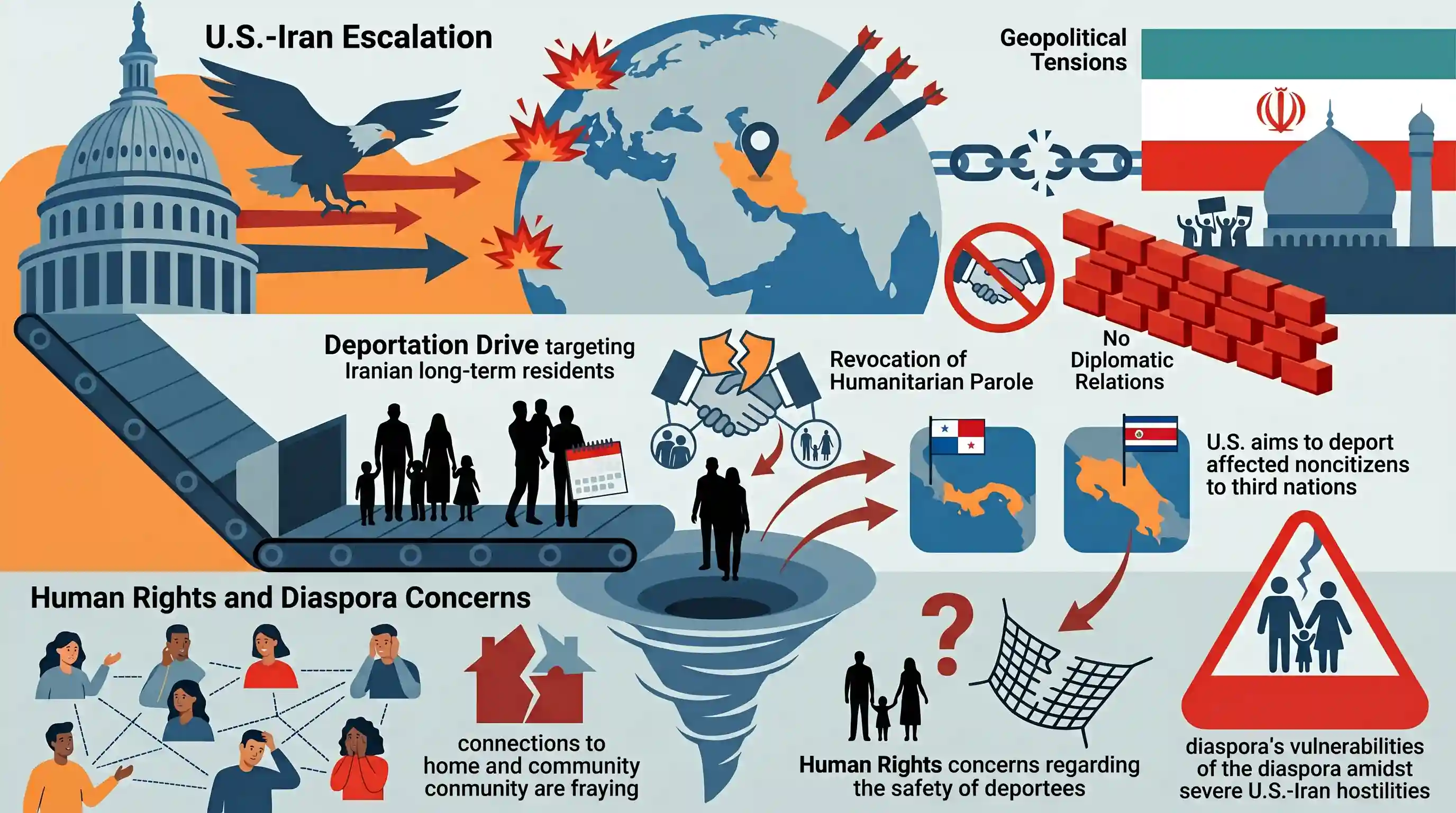
The article discusses the Trump administration's intensified deportation drive targeting Iranians who have lived in the United States for decades, against the backdrop of escalating geopolitical tensions and U.S. military strikes on Iranian nuclear facilities. Lacking direct diplomatic relations and flights, the U.S. aims to deport affected noncitizens to third nations like Panama and Costa Rica. This crackdown—coupled with the revocation of humanitarian parole programs—raises substantial human rights concerns regarding the safety of deportees and highlights the broader vulnerabilities of the diaspora amidst severe U.S.-Iran hostilities.
Key Points
- The Trump administration has escalated its deportation drive, targeting Iranians who have resided in the U.S. for decades, causing widespread anxiety in the diaspora community.
- Due to severed diplomatic ties and a lack of direct flights, the U.S. is utilizing agreements to deport Iranians to third countries such as El Salvador, Costa Rica, and Panama.
- Recent U.S. military strikes on Iranian nuclear facilities have created a de facto state of war, heightening human rights concerns over deporting individuals to a conflict zone.
- The deportation drive coincides with broader immigration crackdowns, including the termination of Biden-era humanitarian parole programs and the reinstatement of travel bans.
Important Terms
Humanitarian Parole Programs

A discretionary mechanism allowing noncitizens temporary stay in the United States for urgent humanitarian reasons or significant public benefit, without granting permanent residency or a pathway to citizenship.
UPSC context
Relevant for GS Paper II (International Relations and Diaspora) concerning global migration policies and the rights of displaced populations.
U.S. Travel Ban
A set of U.S. federal policies (e.g., Executive Order 13769) that restrict or prohibit nationals of specific countries—often including Iran—from entering the U.S. on national security grounds.
UPSC context
Relevant for GS Paper II (International Relations) regarding bilateral ties, executive overreach, and discriminatory immigration frameworks.
U.S. Immigration and Customs Enforcement (ICE)
The primary U.S. federal agency responsible for enforcing immigration laws, managing detention centers, and executing deportations of undocumented noncitizens within the interior of the United States.
UPSC context
Relevant for GS Paper II (Governance) and GS Paper III (Internal Security) regarding state-led enforcement and human rights in detention.
National Iranian American Council (NIAC)
A non-profit advocacy organization representing the Iranian-American community, focused on promoting diplomacy, protecting civil rights, and opposing military conflict between the United States and Iran.
UPSC context
Relevant for GS Paper II (International Relations/Diaspora) as a case study of international pressure groups and diaspora political influence.
Third-country Deportation
The practice of forcibly removing individuals to a nation that is neither their country of origin nor their last residence, often due to lack of diplomatic ties.
UPSC context
Relevant for GS Paper II (Human Rights/International Law) regarding the principle of non-refoulement and global refugee protections.
Diaspora
A population scattered across different geographical locations from its ancestral homeland, maintaining cultural ties and often influencing the foreign policy of their host and home nations.
UPSC context
Crucial for GS Paper II (International Relations) focusing on the "Effect of policies of developed countries on the Indian/global diaspora."
Prelims Trap
India is legally bound to accept refugees as it is a signatory to the 1951 UN Refugee Convention.
India is NOT a signatory to the 1951 Convention or the 1967 Protocol. Aspirants frequently confuse customary international law with formal treaty obligations.
Static Concepts Connected
What constitutes the Principle of Non-refoulement under international law?
- Core Definition: Prohibits states from transferring or returning refugees to territories where their life or freedom would be threatened.
- Legal Origin: Explicitly codified in Article 33 of the 1951 UN Refugee Convention.
- Customary Law Status: Widely recognized as customary international law, meaning it applies even to non-signatory nations, though enforcement is often weak.
How do 'Protecting Powers' function when diplomatic ties are severed?
- Vienna Convention: Governed by the 1961 Vienna Convention on Diplomatic Relations, allowing a third state to protect a nation's interests.
- Neutral Intermediary: Provides consular services and diplomatic communication (e.g., Switzerland representing U.S. interests in Tehran since 1980).
- Mutual Consent: The appointment of a protecting power strictly requires the consent of both the sending state and the receiving state.
Cross-Topic Patterns
Offshoring Asylum & Migration
The U.S. deporting Iranians to Central America mimics the controversial UK-Rwanda and Italy-Albania deals, indicating a clear global pattern of outsourcing asylum and migration responsibilities.
Geopolitics vs. Diaspora Security
Showcases how escalating strategic hostilities (nuclear strikes) instantly strip legal protections (humanitarian parole) from diaspora communities, weaponizing immigration status during bilateral crises.

Expect a 2026 Prelims matched-pair question linking offshore asylum models (UK-Rwanda, US-Panama) with the non-refoulement principle.
Linked PYQs · 2
Linked PYQs · 2
- 2018MainsGS2
In what ways would the ongoing US-Iran Nuclear Pact Controversy affect the national interest of India? How should India respond to this situation?
- 2025MainsGS2
"Energy security constitutes the dominant kingpin of India's foreign policy, and is linked with India's overarching influence in Middle Eastern countries.” How would you integrate energy security with India's foreign policy trajectories in the coming years?
