Western Disturbances and Winter Climate Variability in North India
Source:Indian Express ↗
Why It Matters
The transition of seasons and winter rainfall patterns in North-West India are fundamental concepts in Indian Geography. Understanding the role of Western Disturbances and the IMD's forecasting mechanisms is crucial for answering questions related to climatology and changing weather behaviors in both Prelims and Mains.
Summary
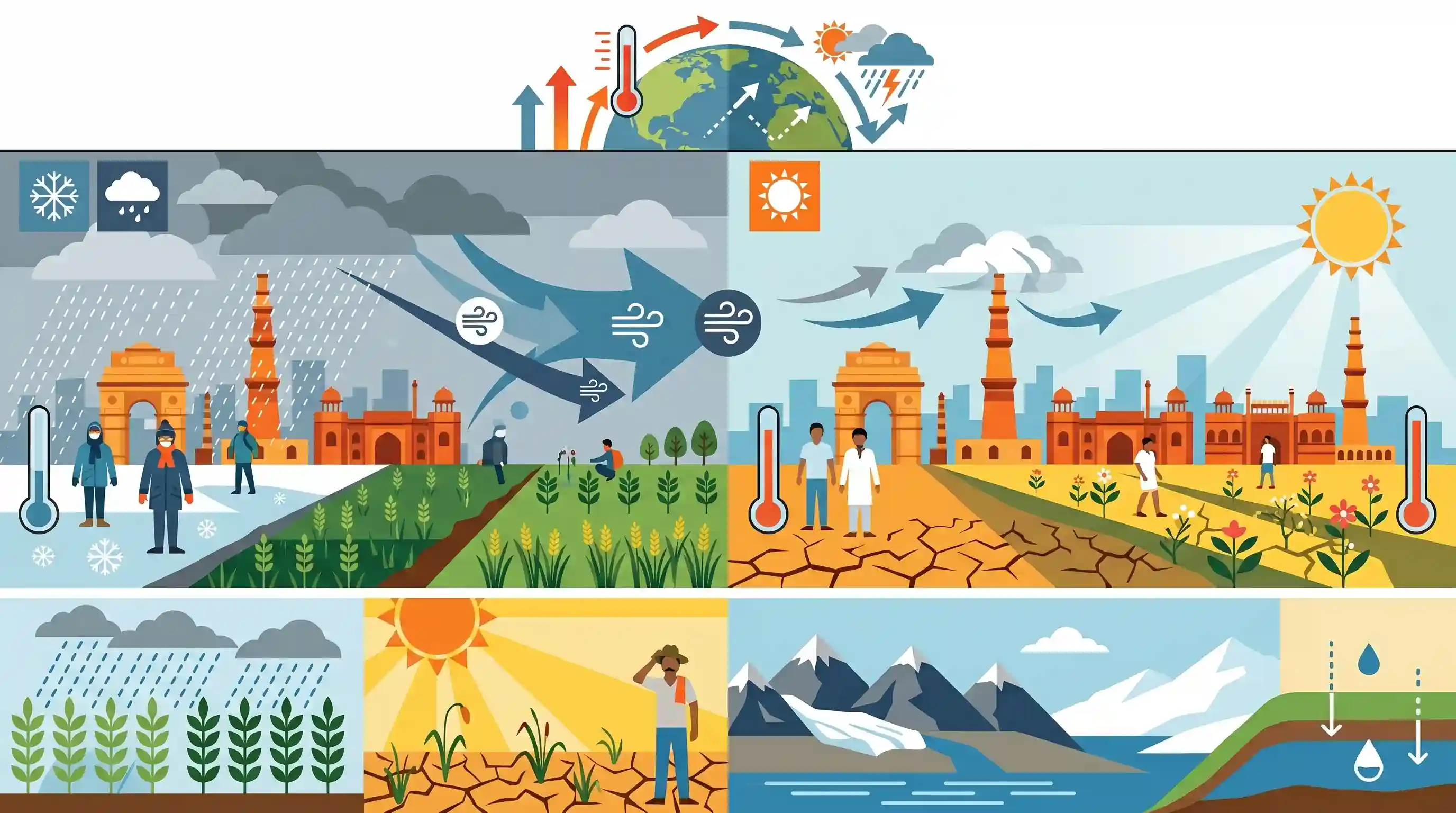
Following a notably cold and wet January, the India Meteorological Department (IMD) has predicted a transition to a warmer and drier February for Delhi. This shift underscores the role of Western Disturbances in dictating winter precipitation in North-West India and highlights the broader issue of fluctuating local weather patterns and climatic variability.
Key Points
- Delhi witnessed an unusually cold and wet January, primarily driven by active Western Disturbances bringing winter rainfall to North-West India.
- The India Meteorological Department (IMD) has forecast a sharp transition to a warmer and drier February for the national capital.
- These rapid seasonal fluctuations highlight changing local weather patterns and the increasing unpredictability of regional climates.
- Accurate meteorological forecasting by the IMD is critical for urban preparedness and agricultural planning in the surrounding regions.
Important Terms
India Meteorological Department (IMD)

The principal government agency under the Ministry of Earth Sciences (established 1875) responsible for meteorological observations, weather forecasting, and seismology, including monitoring monsoons and issuing disaster warnings.
UPSC context
GS Paper I (Geography) and GS III (Disaster Management); tests institutional roles in weather monitoring.
Western Disturbances (WD)
Extra-tropical cyclonic storms originating in the Mediterranean region that bring crucial winter rainfall and snowfall to Northwest India, primarily steered by the subtropical westerly jet stream.
UPSC context
GS Paper I (Geography); tests understanding of non-monsoonal precipitation and its agricultural significance.
Rabi Crops
Agricultural crops sown in winter (October–December) and harvested in spring (April–June), such as wheat and mustard, which rely on winter moisture provided by Western Disturbances.
UPSC context
GS Paper III (Agriculture); tests knowledge of seasonal cropping patterns and food security.
Climate Variability
Natural, short-to-medium term fluctuations in temperature and precipitation patterns caused by atmospheric shifts, distinct from long-term permanent climate change.
UPSC context
GS Paper I (Geography); tests the ability to analyze seasonal anomalies versus permanent climatic shifts.
Subtropical Westerly Jet Stream
A narrow band of fast-moving upper-tropospheric winds that transport Western Disturbances eastward into India; its latitudinal shift significantly dictates North India’s winter weather.
UPSC context
GS Paper I (Geography); tests knowledge of planetary wind systems and regional weather dynamics.
Cold Wave
A condition where the minimum temperature drops significantly below normal thresholds, often occurring in North India after the passage of a Western Disturbance.
UPSC context
GS Paper III (Disaster Management); tests understanding of extreme weather events and public health impacts.
Prelims Trap
"Western Disturbances are tropical cyclones brought to India by the Tropical Easterly Jet Stream."
WDs are extratropical (temperate) cyclones, not tropical. They are steered into India by the Subtropical Westerly Jet Stream, not the Tropical Easterly Jet.
Static Concepts Connected
How do Western Disturbances impact Indian agriculture and hydrology?
- Rabi Crop Lifeline: They provide crucial winter rainfall that acts as a lifeline for Rabi crops like wheat, mustard, and barley in North-West India.
- Glacial Replenishment: They bring snowfall to the Himalayas, which replenishes glaciers and sustains perennial northern rivers during the dry pre-monsoon summer months.
- Hazard Potential: Unseasonal or excessively intense WDs can cause severe hailstorms, crop lodging, and frost damage to standing agricultural yields.
What is the role of the Subtropical Westerly Jet Stream in India's winter?
- Steering Mechanism: Flowing south of the Himalayas in winter, it acts as the steering mechanism drawing extratropical depressions from the Mediterranean into the Indian subcontinent.
- Monsoon Trigger: Its withdrawal northward across the Himalayas in early summer marks the onset phase for the Southwest Monsoon.
Cross-Topic Patterns
ENSO influence on Western Disturbances
El Niño years typically enhance the frequency and moisture of Western Disturbances, leading to wetter winters in NW India, whereas La Niña often brings drier conditions and intense cold waves.
IMD's role in Regional Disaster Diplomacy
IMD's predictive mandate extends beyond India; as a WMO Regional Specialised Meteorological Centre (RSMC), it provides critical cyclone and weather advisories for the entire Northern Indian Ocean neighborhood.

Expect a multi-statement question interlinking El Niño's winter effects, Subtropical Westerly Jet Stream dynamics, and Rabi crop yields.
Linked PYQs · 3
Linked PYQs · 3
- 2015PrelimsGS1
Consider the following statements: 1. The winds which blow between 30° N and 60° S latitudes through-out the year are known as westerlies. 2. The moist air masses that cause winter rains in North-Western region of India are part of westerlies. Which of the statements given above is/are correct?
- 2015MainsGS1
How far do you agree that the behaviour of the Indian monsoon has been changing due to humanizing landscapes? Discuss.
- 2022MainsGS1
Discuss the meaning of colour-coded weather warnings for cyclone prone areas given by India Meteorological Department.
