Western Disturbances and North Indian Winter Weather Patterns
Source:Indian Express ↗
Why It Matters
Understanding the mechanics of North Indian winter weather, specifically the role of Western Disturbances, is a core component of the UPSC Geography syllabus. It also provides a real-world context for studying climate variability and extreme weather events.
Summary
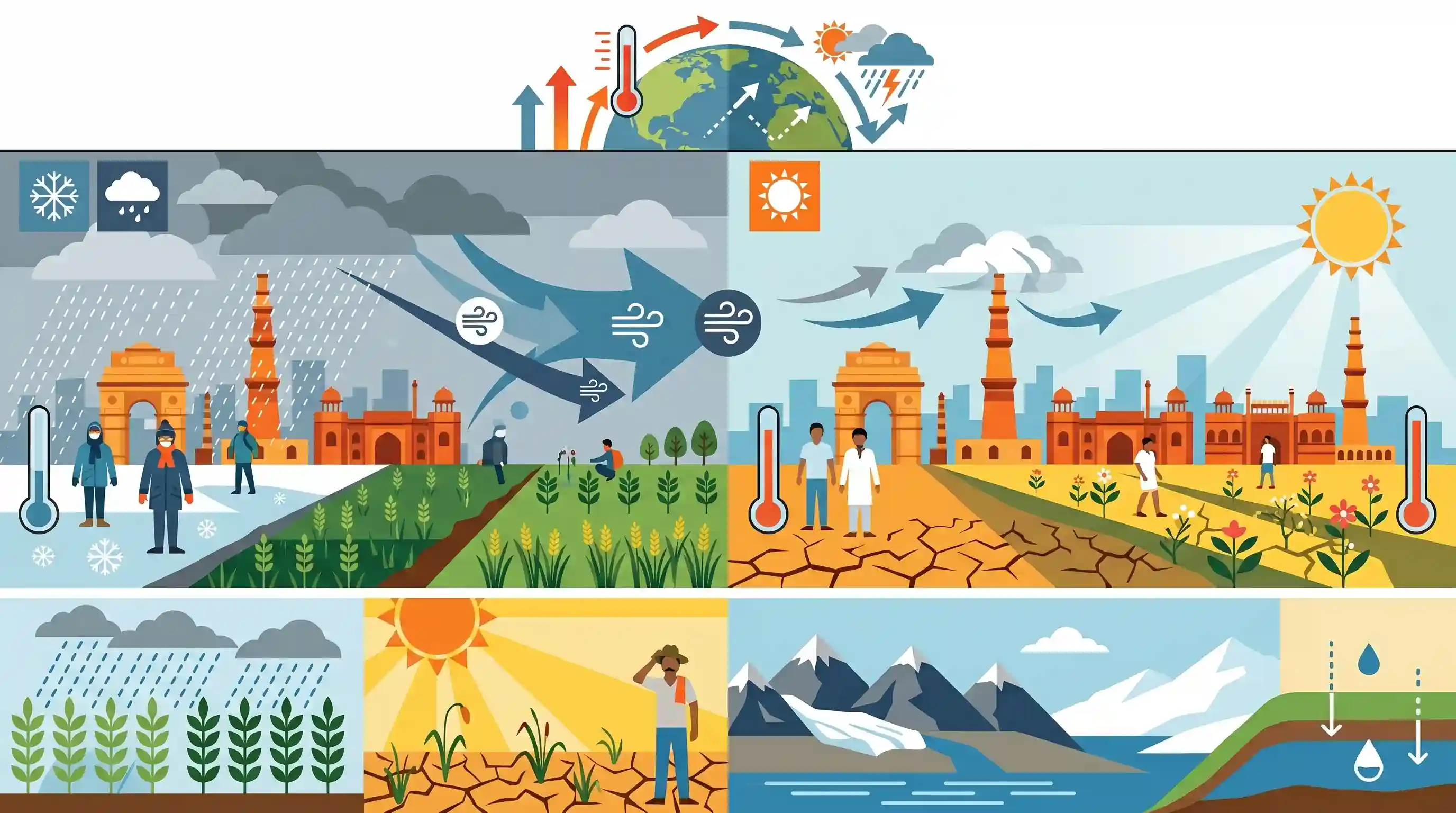
After a cold and wet January, Delhi is predicted to experience a warmer and drier February. This shift in weather patterns is closely tied to the behaviour of Western Disturbances, which bring winter moisture to North India. The sudden transition highlights increasing temperature variability and the broader impacts of climate change on regional weather systems, which can significantly affect local agriculture and hydrology.
Key Points
- Delhi is forecasted to experience a warmer and drier February following an unusually cold and wet January.
- The variability in winter rainfall and temperature in North India is primarily driven by the frequency and intensity of Western Disturbances.
- Such abrupt temperature fluctuations highlight broader climate change trends, increasing the unpredictability of seasonal transitions.
- These weather shifts have direct implications for Rabi crop cycles in the surrounding agricultural belts of Northwest India.
Important Terms
Western Disturbances

Extratropical storms originating in the Mediterranean region that bring winter rainfall to North India, driven by the Subtropical Westerly Jet Stream.
UPSC context
GS Paper I (Geography); critical for understanding Indian winter weather, Himalayan snowfall, and impact on Rabi agriculture.
India Meteorological Department (IMD)
The premier government agency under the Ministry of Earth Sciences responsible for meteorological observations, weather forecasting, and seismology in India.
UPSC context
GS Paper I/III; essential for disaster management, monsoon prediction, and climate change monitoring.
Rabi Crops
Agricultural crops sown in winter (October to December) and harvested in spring (April to June), such as wheat, mustard, and gram.
UPSC context
GS Paper III (Agriculture); linked to food security and the economic impact of winter precipitation from Western Disturbances.
Hydrology
The scientific study of the movement, distribution, and quality of water on Earth, including the hydrological cycle and water resource management.
UPSC context
GS Paper I (Geography); fundamental for studying water cycles, river systems, and sustainable water management in India.
Temperature Variability
The fluctuation of atmospheric temperatures over time, increasingly marked by extremes and unpredictability due to the impacts of regional climate change.
UPSC context
GS Paper III (Environment); focuses on climate adaptation, regional warming trends, and their effects on biodiversity and agriculture.
Prelims Trap
"Western Disturbances are tropical cyclones originating over the Arabian Sea that bring winter rain."
Western Disturbances are extra-tropical (temperate) cyclones originating over the Mediterranean Sea, not tropical cyclones. They are steered by upper-air westerly winds.
Static Concepts Connected
How do Western Disturbances impact Indian weather and agriculture?
- Origin & Nature: They are extra-tropical (temperate) cyclones originating over the Mediterranean Sea, carrying moisture towards the subcontinent.
- Steering Mechanism: They are steered into North India by the Subtropical Westerly Jet Stream (STWJ) during the winter months.
- Agricultural Impact: Winter rainfall provides essential soil moisture for Rabi crops (like wheat) in Northwest India, boosting yields.
What is 'Terminal Heat Stress' in Indian agriculture?
- Definition: Unseasonable, sudden temperature spikes during the crucial grain-filling stage of winter crops (typically February/March).
- Consequences: It forces premature ripening, shrivels the grains, and can drastically reduce the overall yield of crops like wheat.
Cross-Topic Patterns
Erratic WDs and Rabi food security
Warmer Februarys induce 'terminal heat stress' in wheat. This directly impacts food inflation and India's wheat export dynamics, linking physical geography (climatology) to macroeconomic stability.
Jet Streams and Monsoon onset timing
The Subtropical Westerly Jet Stream steers winter WDs. Its timely northward shift in summer is the primary trigger for the South-West monsoon, linking winter anomalies to summer monsoon delays.

Expect a multi-statement question linking Western Disturbances, Subtropical Jet Streams, and terminal heat stress on Rabi crops in 2026.
Linked PYQs · 2
Linked PYQs · 2
- 2015PrelimsGS1
Consider the following statements: 1. The winds which blow between 30° N and 60° S latitudes through-out the year are known as westerlies. 2. The moist air masses that cause winter rains in North-Western region of India are part of westerlies. Which of the statements given above is/are correct?
- 2017MainsGS3
'Climate change' is a global problem. How India will be affected by climate change? How Himalayan and coastal states of India will be affected by climate change?
