Rajya Sabha Numerical Composition and Federal Legislative Process
Source:Indian Express ↗
Why It Matters
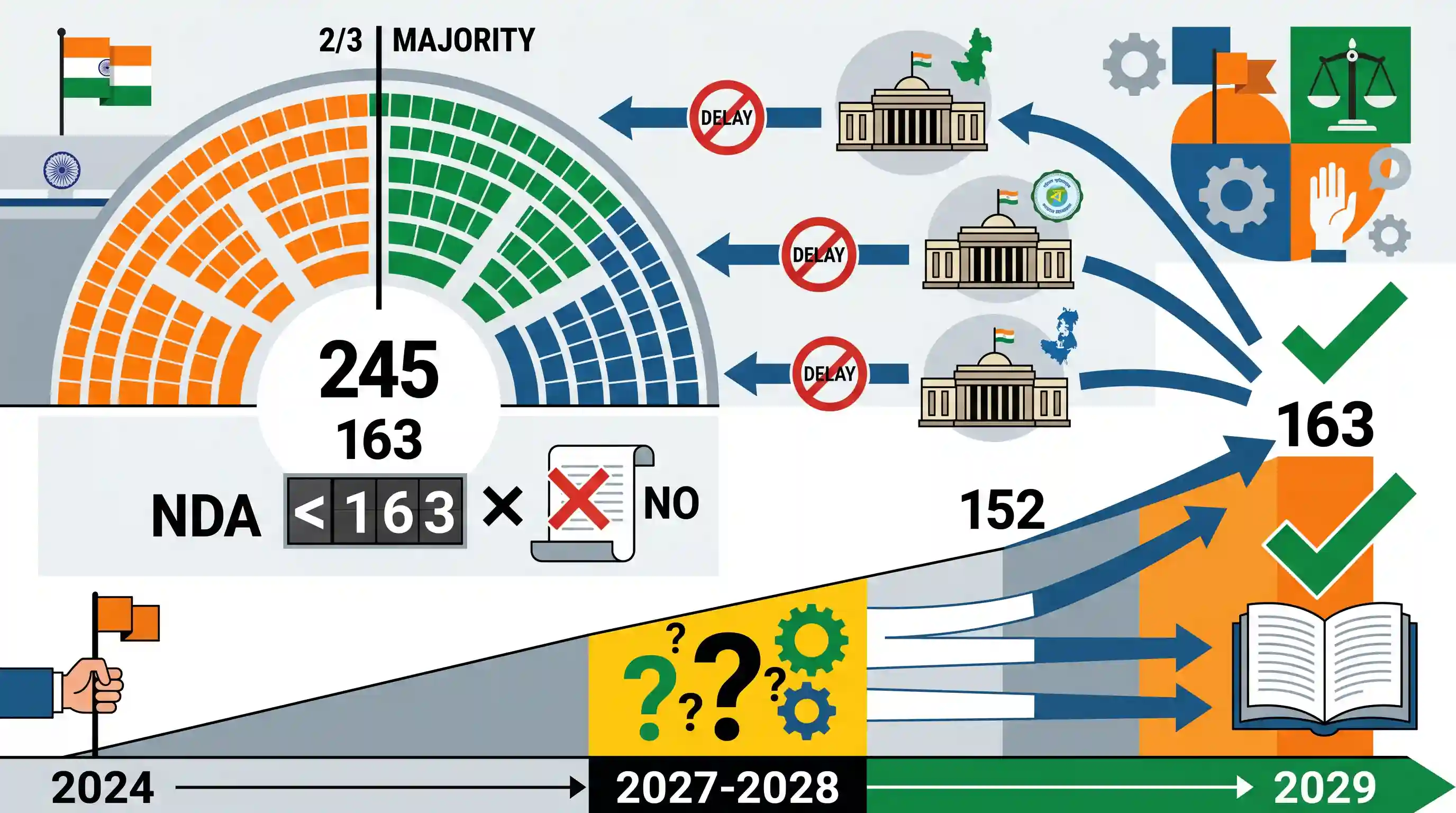
The article practically demonstrates the federal design of the Indian Parliament, illustrating how state assembly election outcomes translate into Rajya Sabha representation and impact the Union government's ability to pass constitutional amendments.
Summary
The article analyzes the numerical composition of the Rajya Sabha, highlighting that the BJP-led NDA currently lacks the two-thirds majority required to pass constitutional amendments. Despite recent electoral successes in states like West Bengal, the structural lag in the Rajya Sabha election cycle prevents immediate gains. The NDA's tally is projected to reach 152 seats by the end of 2028, making the outcomes of the 2027-2028 state assembly elections pivotal for achieving the 163-seat supermajority by 2029.
Key Points
- Following the merger of seven AAP MPs with the BJP, the NDA's tally in the Rajya Sabha is 148, falling 15 seats short of the 163 needed for a two-thirds majority to pass constitutional amendments.
- Despite a sweeping victory in the West Bengal Assembly elections, the BJP will not secure immediate Rajya Sabha gains, as vacancies there will only emerge after the 2029 Lok Sabha polls.
- Based on current state assembly compositions, the NDA is projected to increase its Rajya Sabha tally to 152 seats by the end of 2028 through 83 expected vacancies across 22 states.
- Achieving a two-thirds majority will heavily rely on the outcomes of crucial 2027-2028 state Assembly elections in Uttar Pradesh, Punjab, Karnataka, and Himachal Pradesh.
Important Terms
Constitutional amendments

The process of modifying the nation's fundamental law under Article 368. Most amendments require a special majority (2/3rd present and voting) in both Houses of Parliament independently.
UPSC context
GS Paper II (Polity). Tests understanding of Article 368, special majorities, and the lack of joint sittings for constitutional changes.
Rajya Sabha
The 'Council of States' or Upper House of Parliament. It is a permanent body where members are indirectly elected by state MLAs using proportional representation.
UPSC context
GS Paper II (Polity). Focuses on its federal role, election process (proportional representation), and its permanent nature compared to Lok Sabha.
Lok Sabha
The 'House of the People' or Lower House of Parliament. Its members are directly elected by citizens. It holds primary authority over money bills and executive accountability.
UPSC context
GS Paper II (Polity). Tests knowledge of direct elections, five-year tenure, and exclusive powers over financial legislation and government stability.
Anti-Defection Law
Contained in the Tenth Schedule (52nd Amendment), it disqualifies legislators for voluntarily leaving their party or defying party whips. It aims to ensure government stability.
UPSC context
GS Paper II (Polity/Elections). Crucial for questions on parliamentary discipline, the Speaker’s powers, and impacts on legislative independence.
Proportional Representation
An electoral system used for Rajya Sabha elections where seats are allocated based on the percentage of votes received, typically via the Single Transferable Vote (STV).
UPSC context
GS Paper II (Elections). Evaluates the difference between First-Past-The-Post (Lok Sabha) and indirect representation methods used in federal bodies.
National Democratic Alliance (NDA)
A centre-right political alliance in India led by the Bharatiya Janata Party (BJP). It currently forms the Union government and seeks dominance in both Houses.
UPSC context
GS Paper II (Governance/Elections). Relevant for understanding coalition politics, parliamentary majority requirements, and the functioning of the multi-party system.
Prelims Trap
"Mergers are exempt from anti-defection if two-thirds of the political party agree."
The 10th Schedule requires two-thirds of the *legislature party* (the elected MPs/MLAs), not the broader outside *political party*, to agree to the merger to avoid disqualification.
Static Concepts Connected
How are Rajya Sabha members elected under Article 80?
- Electoral College: Members are elected indirectly by the elected members of State Legislative Assemblies (nominated MLAs do not vote).
- Voting System: Elections use proportional representation by means of the single transferable vote.
- Structural Lag: It is a permanent house; one-third of members retire every second year, creating a delay before state assembly mandates reflect at the Centre.
What are the conditions for a valid merger under the Tenth Schedule?
- Threshold: At least two-thirds of the members of the legislature party must agree to merge with another party.
- 91st Amendment: The 91st Amendment Act (2003) deleted the provision for 'splits' (one-third) and tightened the exemption to only recognize two-thirds 'mergers'.
- Protection: Both the members who merge and those who disagree and function as a separate group are exempt from disqualification.
Cross-Topic Patterns
Federalism + Constitutional Amendments
While the NDA seeks 163 RS seats, amending federal features under Article 368 also requires ratification by 50% of State Legislatures, directly linking state assembly victories to the passage of sweeping national reforms.
Simultaneous Elections + Upper House Lag
The Rajya Sabha's 'structural lag' is a core talking point in the 'One Nation, One Election' debate, as staggered state polls continuously shift the balance of power in the Upper House.

Expect a 2026 Prelims statement contrasting 'special majority' types (Art 368 vs Art 61) alongside Tenth Schedule merger thresholds.
Linked PYQs · 5
Linked PYQs · 5
- 2024PrelimsGS1
As per Article 368 of the Constitution of India, the Parliament may amend any provision of the Constitution by way of : 1. Addition 2. Variation 3. Repeal Select the correct answer using the code given below:
- 2022PrelimsGS1
Consider the following statements: 1. A bill amending the Constitution requires a prior recommendation of the President of India. 2. When a Constitution Amendment Bill is presented to the President of India, it is obligatory for the President of India to give his/her assent. 3. A Constitution Amendment Bill must be passed by both the Lok Sabha and the Rajya Sabha by a special majority and there is no provision for joint sitting. Which of the statements given above are correct?
- 2025PrelimsGS1
Consider the following subjects under the Constitution of India : I. List I-Union List, in the Seventh Schedule II. Extent of the executive power of a State III. Conditions of the Governor's office For a constitutional amendment with respect to which of the above, ratification by the Legislatures of not less than one-half of the States is required before presenting the bill to the President of India for assent?
- 2022PrelimsGS1
With reference to anti-defection law in India, consider the following statements: 1. The law specifies that a nominated legislator cannot join any political party within six months of being appointed to the House. 2. The law does not provide any time-frame within which the presiding officer has to decide a defection case. Which of the statements given above is/are correct?
- 2014PrelimsGS1
Which one of the following Schedules of the Constitution of India contains provisions regarding anti-defection?
