India strategic shift toward indigenous sovereign AI capabilities
Source:Indian Express ↗
Why It Matters
Highlights the strategic imperative for India to develop its own foundational AI capabilities and compute infrastructure. It contrasts India's success in DPI with its lag in core AI research, making it highly relevant for GS3 Science and Technology questions regarding indigenization and emerging tech.
Summary
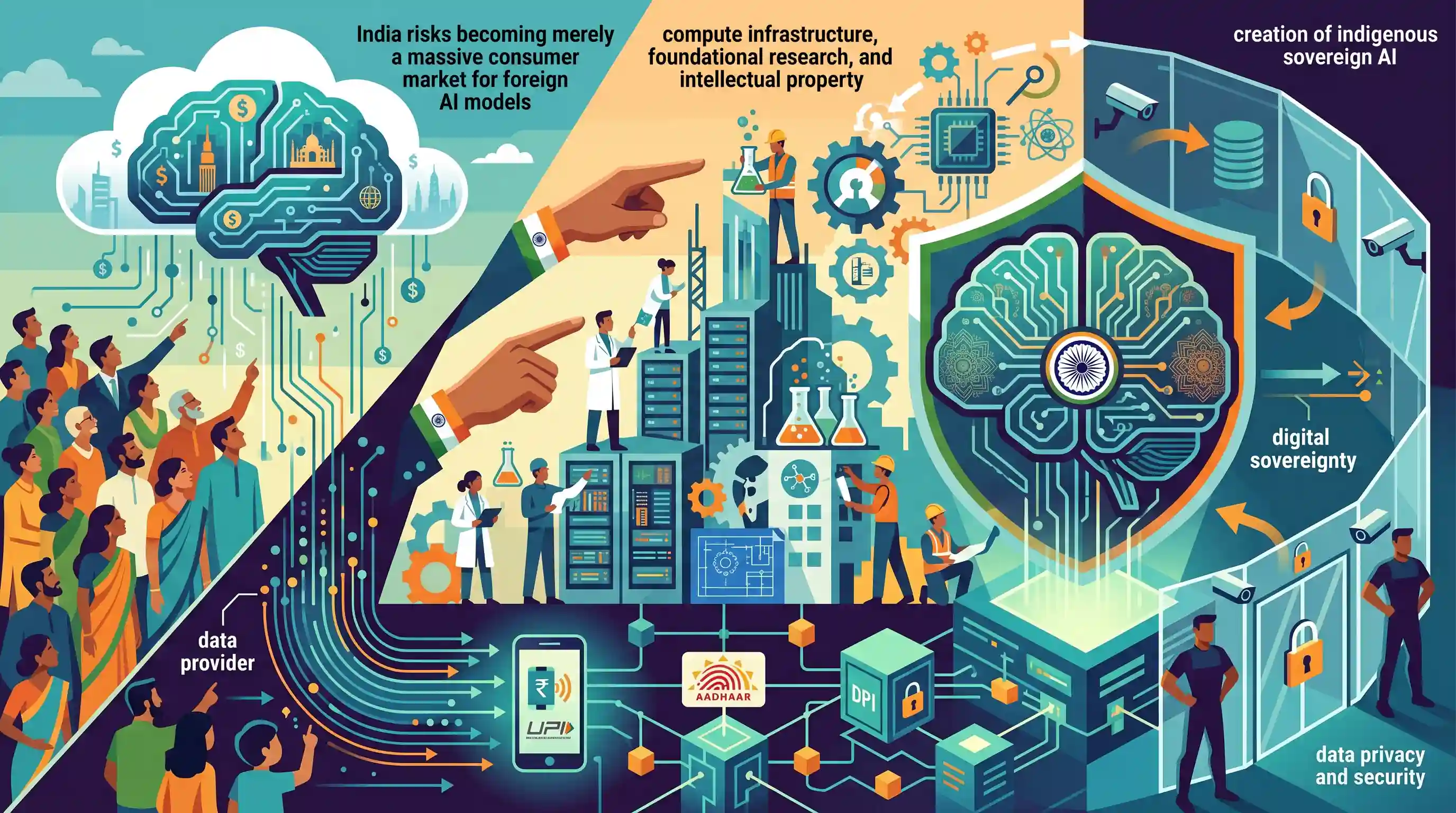
The article reflects on India's position in the rapidly evolving Artificial Intelligence landscape, particularly following recent global AI summits. It warns that while India successfully built robust Digital Public Infrastructure (DPI) like UPI, it currently risks becoming merely a massive consumer market for foreign-developed foundational AI models. To ensure digital sovereignty and future economic competitiveness, the author argues that India must transition from being a data provider to a creator of indigenous 'sovereign AI' by investing aggressively in compute infrastructure, foundational research, and intellectual property.
Key Points
- Following global AI summits, concerns are rising that India might default to being a consumer of AI applications rather than a developer of core foundational AI models.
- While India's Digital Public Infrastructure (DPI) is a massive homegrown success story, the AI race requires distinct hardware investments, specifically in advanced compute capabilities like GPUs.
- Heavy reliance on foreign-developed AI models risks a form of digital colonization, where India's vast data sets fuel external tech monopolies without generating domestic intellectual property.
- To secure digital sovereignty, India must invest heavily in indigenous 'sovereign AI' models tailored to its linguistic diversity and unique socio-economic needs.
- The shift from a traditional IT services-driven model to a product, IP, and innovation-driven AI ecosystem is critical for India's long-term strategic autonomy and economic growth.
Important Terms
Digital Public Infrastructure (DPI)

A set of shared, interoperable digital systems (like Aadhaar, UPI, and DigiLocker) built on open standards to deliver essential services at a societal scale.
UPSC context
GS Paper II (Governance) and III (Economy/S&T); tests concepts of digital inclusion, public service delivery, and 'India Stack' frameworks.
Sovereign AI
A nation's strategic capacity to develop, deploy, and govern AI systems using its own data, compute infrastructure, and workforce to ensure autonomy and security.
UPSC context
GS Paper III (S&T/Security); examines indigenization of technology, data sovereignty, and the transition from a tech consumer to a creator.
Global Partnership on Artificial Intelligence (GPAI)
An international, multi-stakeholder initiative (29 members) focused on bridging the gap between AI theory and practice through responsible, human-centric development.
UPSC context
GS Paper II (International Relations); relevant for global governance of emerging technologies and India's role as Lead Chair (2024).
Unified Payments Interface (UPI)
A real-time, instant payment system developed by the NPCI that enables mobile-based, inter-bank transactions via a Virtual Payment Address (VPA).
UPSC context
GS Paper III (Economy); tests knowledge of financial inclusion, digital economy formalization, and India's global leadership in fintech.
Foundational AI Models
Large-scale AI systems trained on vast, diverse datasets that can be adapted for multiple downstream tasks; they form the core of modern generative AI.
UPSC context
GS Paper III (Science & Tech); relates to the global 'compute divide' and the requirement for high-end hardware like GPUs.
Prelims Trap
Sovereign AI primarily involves hosting foreign AI foundational models on servers physically located within India.
Sovereign AI goes beyond mere data localization; it necessitates building indigenous foundational models, local compute capabilities (GPUs), and domestic intellectual property.
Static Concepts Connected
What distinguishes Digital Public Infrastructure (DPI) from Foundational AI development?
- DPI focus: Relies largely on software, open APIs, and interoperability protocols (e.g., UPI, Aadhaar) to create accessible public digital goods.
- AI focus: Requires massive capital investment, proprietary algorithms, and centralized, hardware-intensive computing infrastructure (tens of thousands of GPUs).
What is 'Data Colonialism' in the context of Artificial Intelligence?
- Resource extraction: Foreign tech monopolies harvest massive volumes of raw local datasets (like user behavior, health records, and linguistic data) from developing nations without fair economic return.
- IP monopoly: Extracted data is processed abroad to train proprietary AI models, leaving the host nation as a mere consumer dependent on renting foreign intellectual property.
Cross-Topic Patterns
Sovereign AI + India Semiconductor Mission
The push for indigenous foundational AI directly relies on the success of the India Semiconductor Mission and PLI schemes to secure domestic GPU and high-performance computing supply chains.
Data Governance + Non-Personal Data
Protecting Indian datasets from 'digital colonization' connects to the Gopalakrishnan Committee's framework on regulating community non-personal data to build domestic public goods.

A 2026 GS3 question will likely contrast India's software-driven DPI success with the hardware-intensive hurdles of 'Sovereign AI'.
Linked PYQs · 3
Linked PYQs · 3
- 2023MainsGS3
Introduce the concept of Artificial Intelligence (AI). How does Al help clinical diagnosis? Do you perceive any threat to privacy of the individual in the use of Al in healthcare?
- 2020PrelimsGS1
With the present state of development, Artificial Intelligence can effectively do which of the following? 1. Bring down electricity consumption in industrial units 2. Create meaningful short stories and songs 3. Disease diagnosis 4. Text-to-Speech Conversion 5. Wireless transmission of electrical energy Select the correct answer using the code given below:
- 2024PrelimsGS1
Consider the following statements: I. It is expected that Majorana 1 chip will enable quantum computing. II. Majorana 1 chip has been introduced by Amazon Web Services (AWS). III. Deep learning is a subset of machine learning. Which of the statements given above are correct?
