Eco-Development and Human-Wildlife Conflict Mitigation
Source:The Hindu ↗
Why It Matters
This presents a successful case study for Mains GS3 on resolving the 'development vs. conservation' dilemma. It demonstrates how participatory eco-development and smart crop selection (cultivating crops unpalatable to wildlife) can simultaneously secure tribal livelihoods and reduce human-wildlife conflicts in critical tiger habitats.
Summary
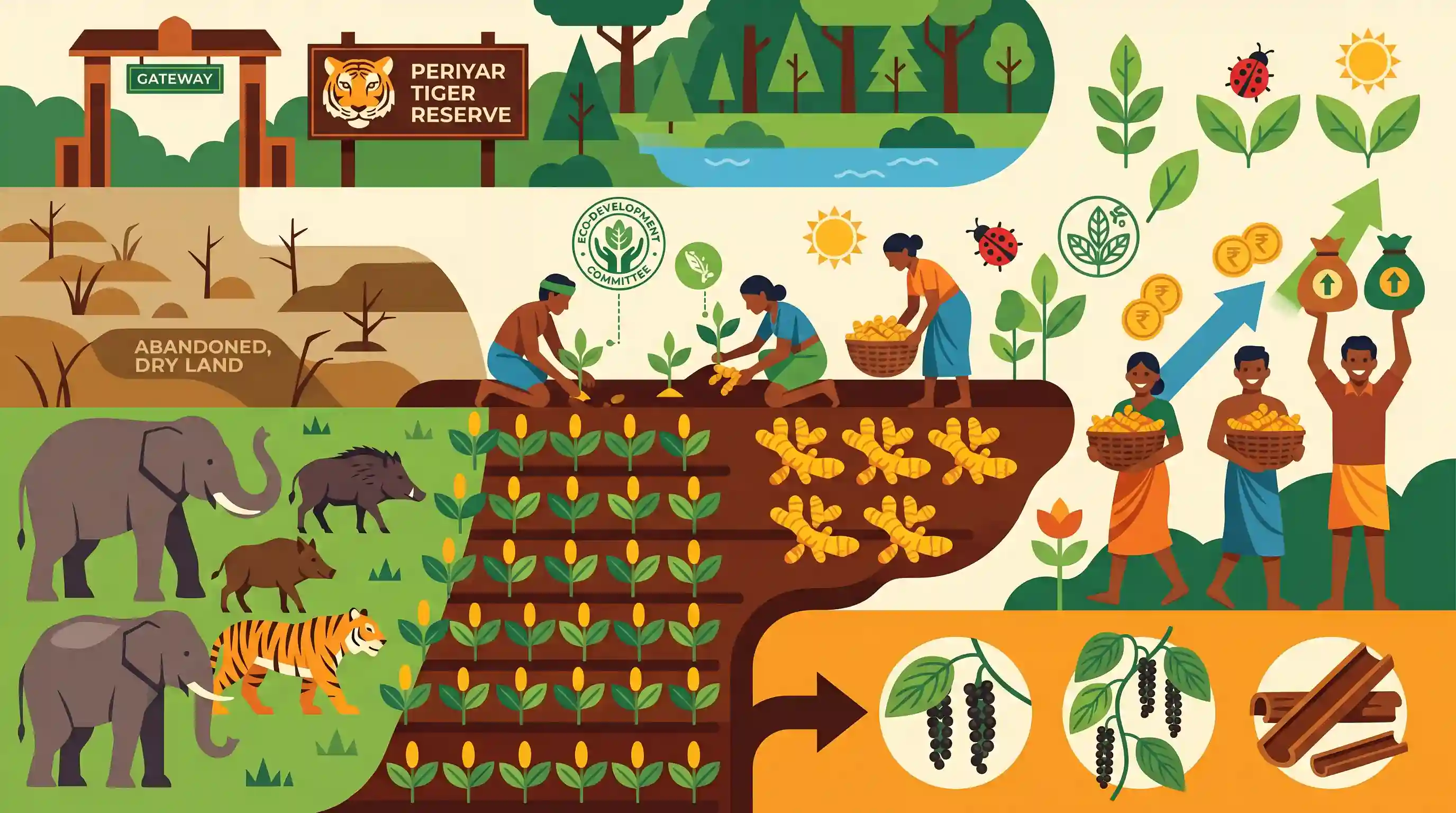
The Kerala Forest Department and local Eco-Development Committees are resuming agricultural activities on abandoned tribal lands within the Periyar Tiger Reserve after 15 years. By cultivating turmeric—a crop naturally avoided by wildlife—the initiative strategically mitigates human-wildlife conflict while providing sustainable, organic livelihood options for indigenous forest-dwelling communities. The project plans to expand into other spices like black pepper and cinnamon using eco-friendly farming methods.
Key Points
- Agriculture is being revived on abandoned tribal settlement lands within the Periyar Tiger Reserve (PTR) after a 15-year hiatus, spearheaded by Eco-Development Committees (EDCs).
- Alleppey Finger Turmeric has been chosen as the primary crop because wild animals typically avoid consuming it, serving as an effective strategy to mitigate human-wildlife conflicts.
- The initiative is designed to provide sustainable livelihoods and financial stability for local tribal communities residing in protected areas.
- Farming practices will remain strictly organic to align with the ecological sensitivities of the tiger reserve, with future plans to cultivate other spices such as black pepper, cinnamon, cloves, nutmeg, and ginger.
Important Terms
Scheduled Tribes and Other Traditional Forest Dwellers (Recognition of Forest Rights) Act, 2006 (FRA)

A 2006 Act recognizing individual and community forest rights for Scheduled Tribes and traditional dwellers, correcting historical injustices regarding land and resource access.
UPSC context
GS II (Social Justice) & GS III (Environment). Tests tribal rights and conservation-development balance.
Periyar Tiger Reserve (PTR)
A major protected area in Kerala’s Western Ghats, renowned for its artificial lake, diverse biodiversity (tigers, elephants), and pioneering community-based conservation models.
UPSC context
GS I (Geography) & GS III (Environment). Key for biodiversity hotspots and protected area management.
Eco-Development Committees (EDCs)
Grassroots institutions of local forest-dependent communities that collaborate with the Forest Department for participatory conservation, ecotourism, and sustainable livelihood generation.
UPSC context
GS II/III. Tests participatory governance and community-led environmental protection models.
Human-Wildlife Conflict (HWC)
Negative interactions between humans and wild animals resulting in crop damage, livestock loss, or fatalities, often driven by habitat fragmentation and resource competition.
UPSC context
GS III (Environment). Tests mitigation strategies and coexistence in shared landscapes.
State-Specific Disaster
A legal classification (pioneered by Kerala for HWC) enabling faster fund mobilization and inter-departmental coordination for relief under the Disaster Management Act, 2005.
UPSC context
GS III (Disaster Management). Tests innovative policy frameworks for handling localized ecological crises.
Crop Diversification (HWC Mitigation)
The strategic cultivation of wildlife-resistant crops (like turmeric or chilli) near forest fringes to prevent animal raids and reduce conflict encounters.
UPSC context
GS III (Agriculture/Environment). Tests biological/non-physical strategies for conflict mitigation.
Prelims Trap
"Agriculture and crop cultivation are strictly prohibited under all circumstances within the boundaries of a Tiger Reserve."
The Forest Rights Act (FRA) 2006 recognizes the traditional rights of forest-dwelling communities to inhabit and cultivate lands they have historically occupied, even inside Tiger Reserves.
Static Concepts Connected
How do Eco-Development Committees (EDCs) differ from Joint Forest Management Committees (JFMCs)?
- Location focus: EDCs are formed exclusively for villages situated in and around Protected Areas (National Parks and Sanctuaries).
- Objective difference: JFMCs operate in territorial forest areas to regenerate degraded forests and share timber/NTFP. EDCs focus on reducing local dependency on Protected Areas and mitigating human-wildlife conflict.
What are the criteria for modifying tribal rights in a Critical Tiger Habitat (CTH)?
- Statutory backing: CTHs are notified under the Wildlife Protection Act, 1972, based on scientific objective criteria requiring inviolate spaces for tiger conservation.
- Relocation conditions: Under the FRA 2006, rights can only be modified or resettled if state agencies conclude that human presence causes irreversible damage to tigers, and co-existence is not possible.
- Gram Sabha consent: Gram Sabhas must give free, prior, and informed consent in writing to the proposed resettlement and ecological mitigation package.
Cross-Topic Patterns
Bio-deterrents in HWC mitigation
Cultivating non-palatable crops like turmeric acts as a natural bio-fence. UPSC frequently links ecological conservation with innovative, low-cost agricultural deterrents, akin to using bee boxes (Project RE-HAB) against elephants.
GI tags and tribal economic empowerment
Alleppey Finger Turmeric's GI tag enables premium market access. The synergy between traditional crops, GI tags, and the Forest Rights Act (FRA) is a high-value Mains theme for inclusive tribal growth.

Expect a Prelims multi-statement question testing the legality of agriculture in PAs under FRA 2006 alongside natural bio-fencing crops.
Linked PYQs · 4
Linked PYQs · 4
- 2025PrelimsGS1
Consider the following statements about turmeric during the year 2022-23: I. India is the largest producer and exporter of turmeric in the world. II. More than 30 varieties of turmeric are grown in India. III. Maharashtra, Telangana, Karnataka and Tamil Nadu are major turmeric producing States in India. Which of the statements given above are correct?
- 2019PrelimsGS1
Consider the following statements: 1. As per recent amendment to the Indian Forest Act, 1927, forest dwellers have the right to fell the bamboos grown on forest areas. 2. As per the Scheduled Tribes and Other Traditional Forest Dwellers (Recognition of Forest Rights) Act, 2006, bamboo is a minor forest produce. 3. The Scheduled Tribes and Other Traditional Forest Dwellers (Recognition of Forest Rights) Act, 2006 allows ownership of minor forest produce to forest dwellers. Which of the statements given above is/are correct?
- 2020PrelimsGS1
In the context of India, which of the following is/are considered to be practice(s) of eco-friendly agriculture ? 1. Crop diversification 2. Legume intensification 3. Tensiometer use 4. Vertical farming Select the correct answer using the code given below:
- 2013PrelimsGS1
Under the Scheduled Tribes and Other Traditional Forest Dwellers (Recognition of Forest Rights) Act, 2006, who shall be the authority to initiate the process for determining the nature and extent of individual or community forest rights or both?
