India Resumes Tourist Visas for Chinese Nationals After Five Year Gap
Source:The Hindu ↗
Why It Matters
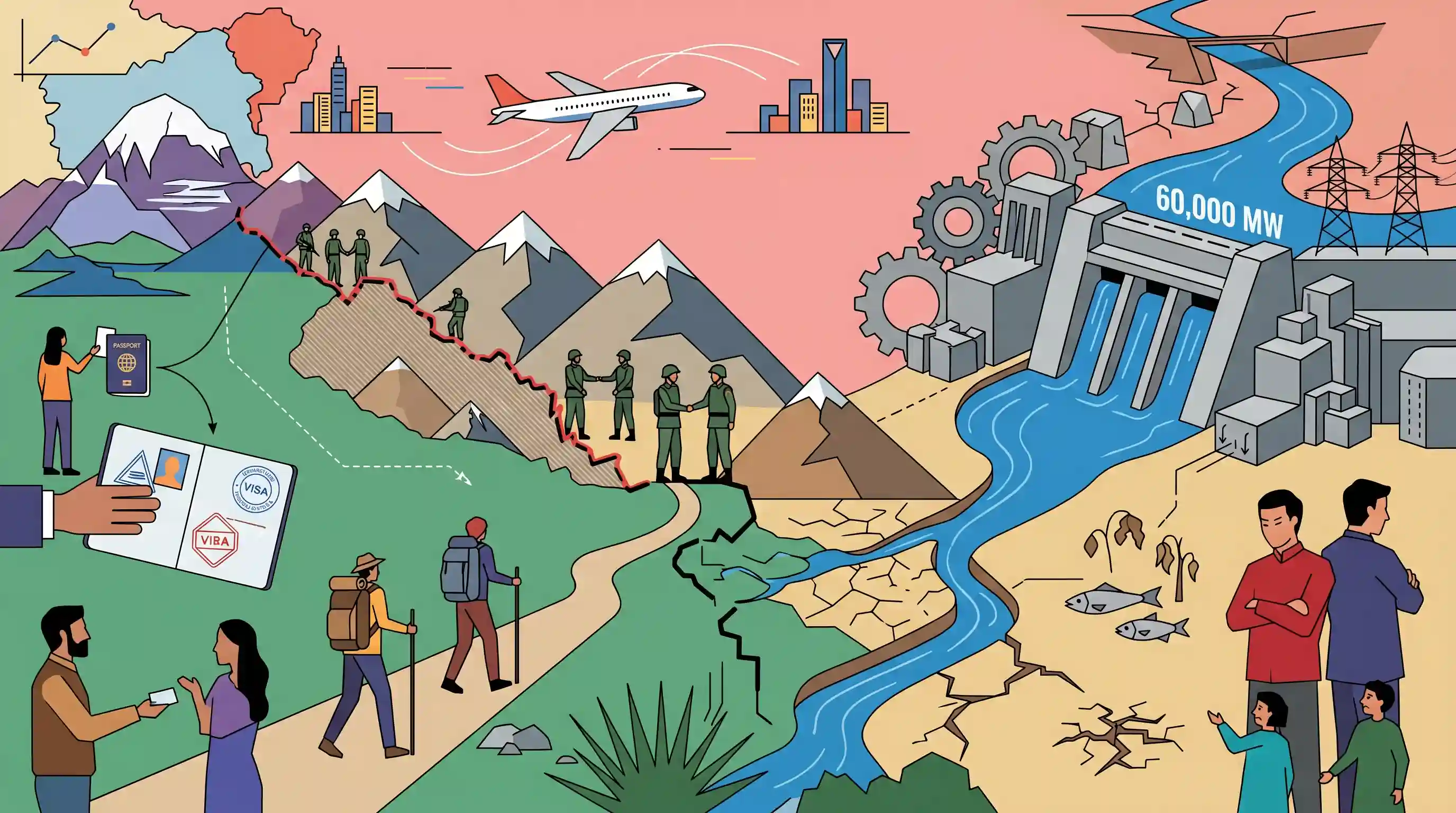
Highlights the dual-track nature of India-China relations: while diplomatic and civilian engagements (visas, border patrolling) are slowly normalizing, structural strategic issues—such as trans-boundary water sharing and infrastructure building in sensitive ecological zones—remain unresolved.
Summary
After a five-year hiatus prompted by the Covid-19 pandemic and exacerbated by the 2020 Galwan Valley clashes, India will resume issuing tourist visas to Chinese nationals. This step reflects a broader effort to normalize India-China relations, following recent agreements on border patrolling along the Line of Actual Control. Resumption of direct passenger flights and the historic Kailash Manasarovar Yatra are also under active discussion. However, amidst this diplomatic thaw, China is moving forward with the massive 60,000 MW Medog hydropower project on the Yarlung Zangbo (Brahmaputra) river near the Indian border. The Chinese government dismissed ecological, seismological, and downstream flow concerns raised by India and Bangladesh, maintaining that the development falls within its legitimate rights.
Key Points
- India is resuming tourist visas for Chinese nationals after a five-year gap initiated by the Covid-19 pandemic and the 2020 Galwan border clashes.
- The move marks a significant step towards normalizing bilateral ties, accompanied by talks to restore direct flights and the Kailash Manasarovar Yatra.
- Despite diplomatic thawing, China is proceeding with the massive 60,000 MW Medog hydropower project on the Yarlung Zangbo (Brahmaputra) river in Tibet.
- China dismissed ecological and disaster management concerns raised by lower riparian states (India and Bangladesh), asserting its sovereign right to develop its water resources.
Important Terms
Line of Actual Control (LAC)

A 3,488 km notional demarcation line separating Indian-controlled territory from Chinese-controlled territory, divided into Western, Middle, and Eastern sectors. Unlike a formal border, it remains undemarcated and subject to differing perceptions.
UPSC context
GS Paper II: India and its Neighborhood. Tests border management dynamics and sovereignty issues.
Galwan Valley Clashes
A site in Eastern Ladakh and location of a deadly 2020 military clash that significantly deteriorated India-China relations, leading to a focus on disengagement and restored patrolling rights.
UPSC context
GS Paper II: International Relations. Relevant for understanding bilateral trust deficits and strategic recalibration.
Medog Hydropower Project
A proposed 60,000 MW mega-dam in Tibet near the Indian border. It raises strategic concerns regarding China's 'hydro-hegemony,' downstream water security, and potential ecological impact on the Brahmaputra basin.
UPSC context
GS Paper II: Trans-boundary water governance. Tests hydro-diplomacy and upstream-riparian state challenges.
Kailash Manasarovar Yatra
A sacred multi-faith pilgrimage to Tibet's Mount Kailash and Lake Mansarovar. It serves as a key soft-power instrument and a barometer for the normalization of India-China ties.
UPSC context
GS Paper II: Soft Power. Tests knowledge of cultural diplomacy and people-to-people engagement.
Yarlung Zangbo
The Tibetan name for the Brahmaputra River. It is the primary trans-boundary river involved in hydro-political disputes between China (upstream) and India/Bangladesh (downstream).
UPSC context
GS Paper I: Geography; GS Paper II: IR. Crucial for river systems and regional water security.
Ministry of External Affairs (MEA)
India's nodal government agency responsible for conducting foreign relations, issuing visas, and representing India's strategic interests in bilateral and multilateral dialogues.
UPSC context
GS Paper II: Institutional framework. Essential for the execution of India's foreign policy.
Prelims Trap
India and China manage the Yarlung Zangbo through a bilateral water-sharing treaty.
India and China do not have a formal water-sharing treaty. They only possess Memorandums of Understanding (MoUs) for sharing monsoon hydrological data.
Static Concepts Connected
What is the geographical course of the Brahmaputra river before entering India?
- Origin: Originates at the Chemayungdung glacier in the Kailash range (Tibet), where it is known as the Yarlung Zangbo.
- Great Bend: Flows eastward parallel to the Himalayas before taking a sharp U-turn at Namcha Barwa peak.
- Entry into India: Enters Arunachal Pradesh as the Siang/Dihang river, later joining the Dibang and Lohit to form the Brahmaputra proper in Assam.
What are the traditional routes for the Kailash Manasarovar Yatra?
- Lipulekh Pass: Located in Uttarakhand, this traditional route passes through the strategic tri-junction of India, China (Tibet), and Nepal.
- Nathu La Pass: Located in Sikkim, this pass was reopened for the Yatra in 2015 to provide a safer, alternative motorable route for pilgrims.
Cross-Topic Patterns
Hydro-diplomacy: IWT vs. Brahmaputra vacuum
Contrasts India's legal treaty framework with Pakistan (Indus Water Treaty) against the lack of a formal architecture with China, highlighting India's vulnerability to upper-riparian "hydro-hegemony" and man-made ecological disasters.
Soft power diplomacy amidst strategic friction
Demonstrates the dual-track nature of India-China relations, where civilian normalization (tourism, Yatra, flights) is pursued concurrently with unresolved strategic threats (massive border dams, LAC militarization).

Expect a 2026 prelims mapping question linking Himalayan passes (Lipulekh/Nathu La) with the Brahmaputra's course and riparian rights.
Linked PYQs · 5
Linked PYQs · 5
- 2012MainsGS2
Do you think that China's emergence as one of the largest trading partners of India has adversely affected the settlement of the outstanding border problem?
- 2014MainsGS2
With respect to the South China sea, maritime territorial disputes and rising tension affirm the need for safeguarding maritime security to ensure freedom of navigation and over flight throughout the region. In this context, discuss the bilateral issues between India and China.
- 2024MainsGS3
India has a long and troubled border with China and Pakistan fraught with contentious issues. Examine the conflicting issues and security challenges along the border. Also give out the development being undertaken in these areas under the Border Area Development Programme (BADP) and Border Infrastructure and Management (BIM) Scheme.
- 2016PrelimsGS1
Which of the following is/are tributary/tributaries of Brahmaputra? 1. Dibang 2. Kameng 3. Lohit Select the correct answer using the code given below.
- 2011PrelimsGS1
The Brahmaputra, Irrawady and Mekong rivers originate in Tibet and flow through narrow and parallel mountain ranges in their upper reaches. Of these rivers, Brahmaputra makes a “U” turn in its course to flow into India. This “U” turn is due to
