Maharashtra Prison Infrastructure Expansion And Overcrowding
Source:freepressjournal ↗
Why It Matters
Prison administration falls under the State List in India. The severe overcrowding highlights systemic issues within the criminal justice system, undertrial management, and human rights. Awareness of remedial mechanisms like NALSA guidelines and central schemes is crucial for public administration.
Summary
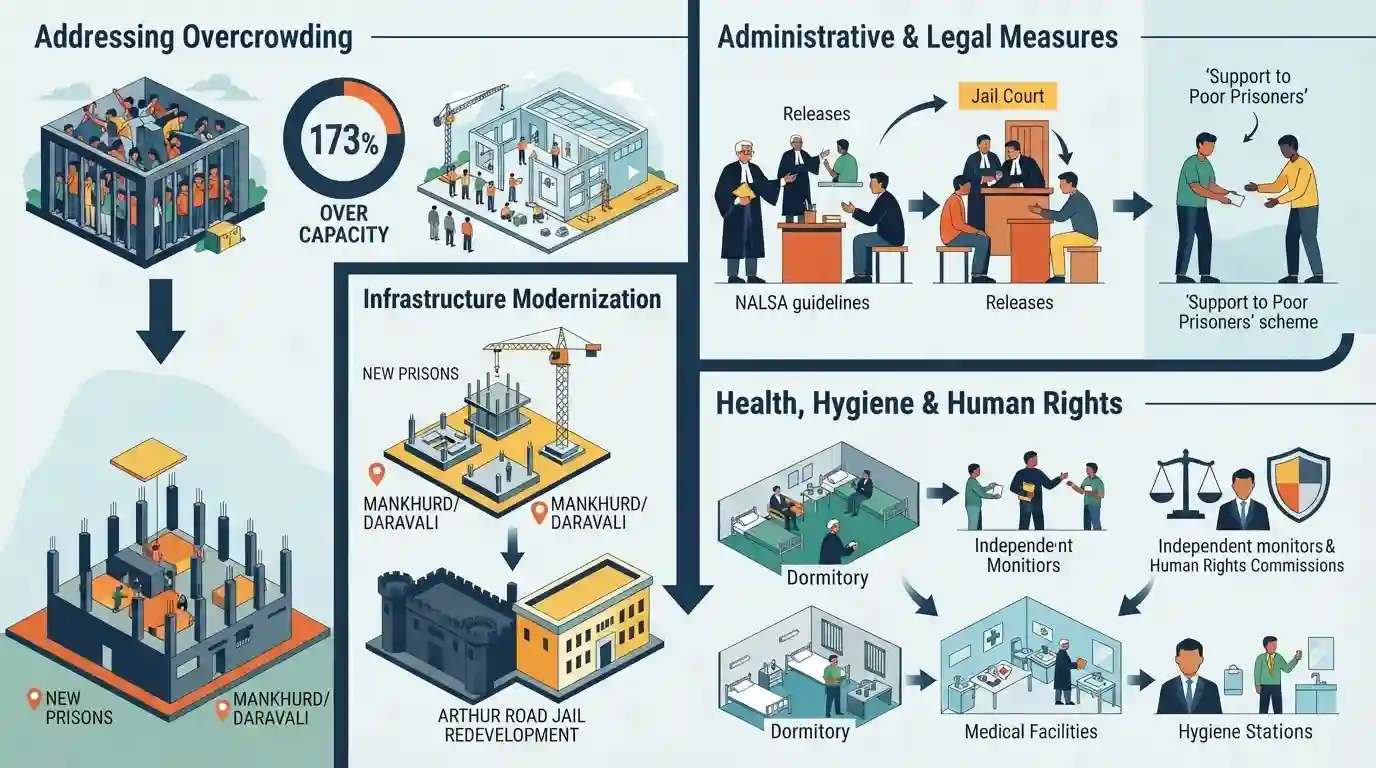
To address the critical issue of overcrowding, with state prisons operating at 173% capacity, the Maharashtra Government is undertaking a major expansion and modernization of its prison infrastructure. Key initiatives include constructing new prisons in Mankhurd and Daravali, and redeveloping the Arthur Road Jail. Concurrently, the state is implementing administrative and legal measures, such as utilizing the 'Support to Poor Prisoners' scheme, adhering to NALSA guidelines, and holding jail courts to release eligible inmates, while ensuring health and hygiene standards monitored by Human Rights Commissions.
Key Points
- Maharashtra's prisons are operating at 173% of their sanctioned capacity, with Arthur Road Jail holding 3,410 inmates against a capacity of 999.
- The Maharashtra Government is acquiring land in Mankhurd (11 acres) and Daravali in Borivali (53 acres) to build new, modern prison facilities.
- Mumbai Central Prison (Arthur Road) is slated for comprehensive redevelopment into a multi-storey facility.
- Administrative measures to reduce overcrowding include releasing eligible prisoners on remission, facilitating bail through the 'Support to Poor Prisoners' scheme, and conducting jail courts for minor offenses.
- Prison conditions and hygiene are being monitored under the guidance of the judiciary and Human Rights Commissions.
Important Terms
Support to Poor Prisoners scheme

A centrally sponsored scheme launched in 2023 by the Ministry of Home Affairs to provide financial aid to indigent inmates unable to afford bail bonds or court-imposed fines.
UPSC context
MPSC GS Paper II (Polity & Governance). Tests understanding of social welfare schemes, Article 21, and criminal justice reforms.
National Legal Services Authority (NALSA)
A statutory body established in 1995 under the Legal Services Authorities Act, 1987, to provide free legal aid to weaker sections and organize Lok Adalats to fulfill Article 39A.
UPSC context
MPSC GS Paper II (Polity). Essential for questions on free legal aid, judicial structures, and marginalized group welfare.
National Human Rights Commission (NHRC)
A statutory public body established in 1993 under the Protection of Human Rights Act, responsible for the protection, promotion, and monitoring of human rights across India.
UPSC context
MPSC GS Paper II (Polity & HR). Tests knowledge of statutory bodies, their functions, and custodial/human rights protections.
State Human Rights Commission (SHRC)
A statutory state-level body established under the Protection of Human Rights Act, 1993, to investigate human rights violations related to subjects under the State and Concurrent lists.
UPSC context
MPSC GS Paper II (Polity & HR). Tests state-level statutory bodies and oversight of administrative, custodial, and prison conditions.
Maharashtra Home Department
A state executive department responsible for maintaining law and order, police administration, crime prevention, and the management and reform of prison systems within Maharashtra.
UPSC context
MPSC GS Paper II (State Administration). Evaluates knowledge of state executive bodies, internal security, and prison legislation reform.
Prelims Trap
Prisons and reformatories are governed under the Concurrent List, allowing both Centre and States to legislate on daily administration.
Under Entry 4 of the State List (List II), 'Prisons' fall exclusively under State jurisdiction. The Centre only provides model guidelines and financial assistance.
Static Concepts Connected
Which constitutional and statutory provisions govern prison administration in India?
- State List Entry: Entry 4 of List II (Seventh Schedule) places prisons and detained persons under exclusive state jurisdiction.
- Statutory Acts: Governed primarily by the archaic Prisons Act of 1894, which individual states adapt and implement.
- Article 39A: Mandates free legal aid, which is vital for the 77% of inmates who are impoverished undertrials.
What are the key recommendations of the Justice Amitava Roy Committee (2018) on prisons?
- Fast-track Courts: Recommended special fast-track courts to deal exclusively with petty offences and reduce undertrial populations.
- Staff Vacancies: Advised urgent filling of administrative vacancies, particularly prison guards and medical officers, to improve custody management.
- Legal Aid Ratio: Suggested providing one lawyer for every 30 prisoners to ensure robust and continuous legal representation.
Cross-Topic Patterns
Prison overcrowding + Article 21
Severe overcrowding directly impacts the fundamental right to health and dignity, bridging mechanical prison infrastructure expansion with robust constitutional jurisprudence under Article 21.
Digital governance + Legal aid
Integrating e-Prisons database with NALSA's legal aid portals streamlines the identification of bail-eligible undertrials, linking technology with socio-economic welfare.

Expect questions linking Article 39A, NALSA's statutory origin, and Entry 4 of the State List to prison reform initiatives.
Linked PYQs · 2
Linked PYQs · 2
- 2006MPSC_PRELIMSGS1
Which one of the following is not a Human right ?
- 2025MPSC_PRELIMSGS1
Match the correct pairs of punishment and forms of punishment in the Mughal Judicial System. Column 'A' (Punishment) a. Hadd b. Tazir c. Qisas d. Tashir Column 'B' (Forms of Punishment) i. Tit for Tat ii. Defamation, to expose to disgrace iii. Warning, admonish or banishment iv. Death penalty, amputation Code: a b c d
