Yamuna Riverfront Development Project at Paonta Sahib
Source:Indian Express ↗
Why It Matters
Riverfront development projects are increasingly common across Indian cities (e.g., Sabarmati, Gomti) and represent a crucial intersection between urban infrastructure expansion and environmental conservation. They raise important debates regarding floodplain ecology, river rejuvenation, and sustainable tourism, making them highly relevant for GS-3 Environment and GS-1 Geography sections.
Summary
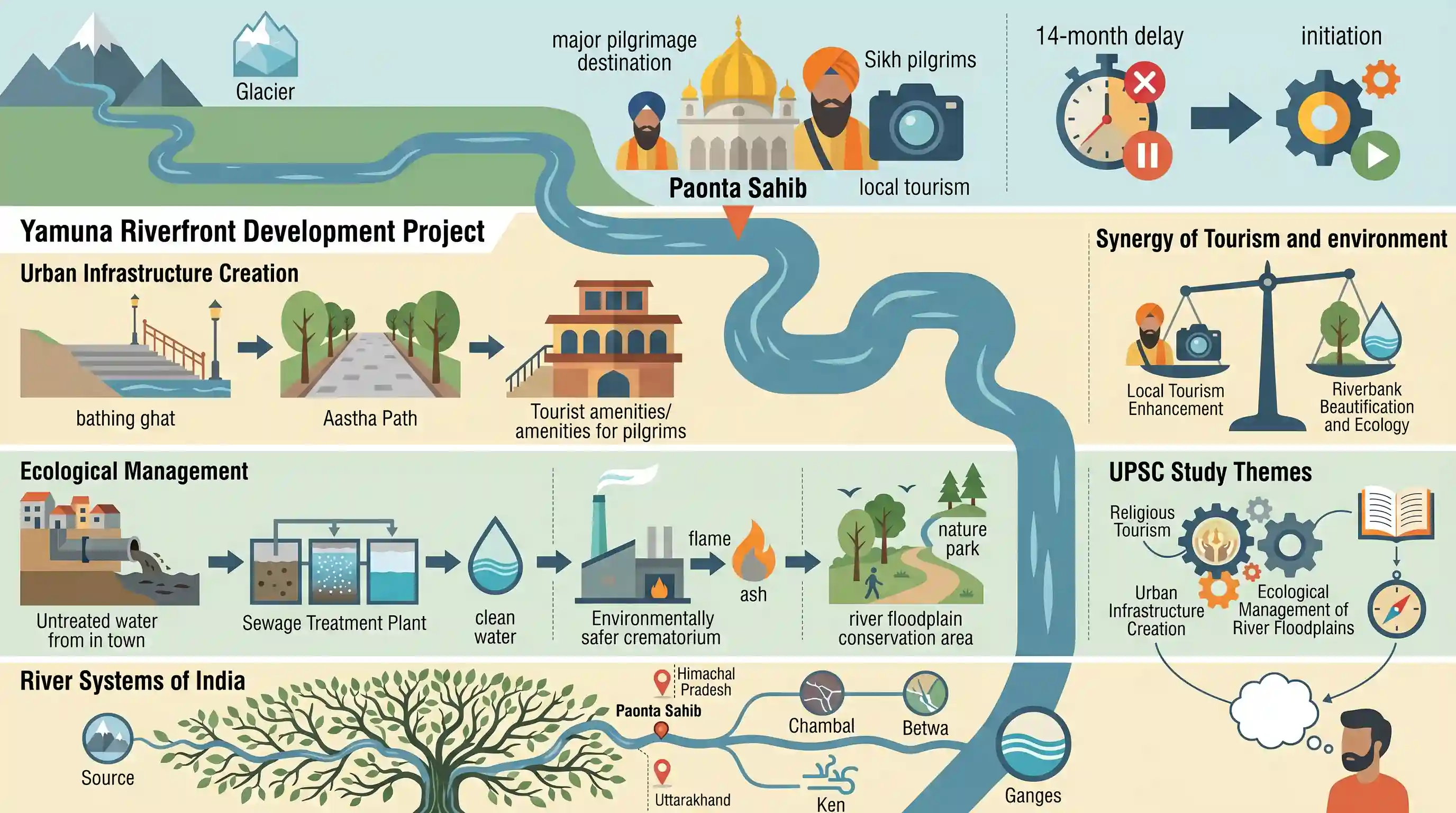
The Yamuna riverfront development project in the historical town of Paonta Sahib, Himachal Pradesh, has been initiated after facing a 14-month delay. Situated on the banks of the Yamuna River, Paonta Sahib is a major Sikh pilgrimage destination. The project seeks to enhance local tourism infrastructure, improve amenities for pilgrims, and beautify the riverbanks. For UPSC aspirants, this development highlights the broader themes of religious tourism, urban infrastructure creation, and the ecological management of river floodplains, which are essential aspects of environmental conservation and geographical studies.
Key Points
- The Yamuna riverfront development project at Paonta Sahib, Himachal Pradesh, has commenced following a 14-month administrative delay.
- Paonta Sahib is a prominent Sikh pilgrimage town located on the banks of the Yamuna River, making it an important hub for religious tourism.
- The project aims to upgrade civic amenities, beautify the riverbanks, and significantly boost local tourism infrastructure for pilgrims and residents.
- Such riverfront projects often necessitate balancing urbanization and tourism goals with the ecological conservation of river floodplains and water quality.
Important Terms
Riverfront Development Project

Urban planning strategy involving the beautification and ecological restoration of riverbanks to improve infrastructure, tourism, and public accessibility while managing floodplains.
UPSC context
Relevant for GS Paper I (Urbanization) and GS Paper III (Environment and Infrastructure).
Yamuna River System
The longest tributary of the Ganga, originating from Yamunotri Glacier, flowing through five states/UTs; vital for northern India's irrigation, ecology, and religious tourism.
UPSC context
Crucial for GS Paper I (Geography - Indian Drainage Systems) and GS Paper III (Pollution).
Urban Local Bodies (ULBs)
Local government entities (e.g., Municipalities) empowered by the 74th Constitutional Amendment to manage urban planning, sanitation, and public amenities like riverfronts.
UPSC context
Important for GS Paper II (Governance and Devolution of Powers).
Ecological Restoration
The process of assisting the recovery of an ecosystem that has been degraded or destroyed, often involving native plantations and waste management.
UPSC context
Key concept for GS Paper III (Environment and Biodiversity Conservation).
River Channelisation
Engineering technique to control water flow and prevent flooding by straightening or deepening riverbeds, often debated for its ecological impact on floodplains.
UPSC context
Significant for GS Paper III (Disaster Management and Environment).
Ministry of Jal Shakti
The nodal central ministry responsible for the development, maintenance, and rejuvenation of rivers, including projects like Namami Gange and riverfront works.
UPSC context
Relevant for GS Paper II (Government Policies and Interventions).
Prelims Trap
Paonta Sahib is a prominent Sikh pilgrimage town situated on the banks of the Sutlej River.
Because it is a prominent Sikh pilgrimage site, aspirants often incorrectly guess a Punjab river like the Sutlej or Beas, ignoring its true location in Himachal Pradesh.
Static Concepts Connected
What are the key Himalayan tributaries of the Yamuna River?
- Tons River: The largest affluent by water volume in the upper course, joining the Yamuna in the lower Himalayas below Kalsi.
- Giri River: Originates in the Shimla hills and joins the Yamuna near Paonta Sahib in the Sirmaur district of Himachal Pradesh.
- Pabbar River: A major tributary of the Tons river, which eventually contributes to the Yamuna basin's upper catchment area.
What are the 3 zones under Draft River Regulation Zone (RRZ) guidelines?
- Prohibited Zone: Covers the active floodplain up to the highest flood level; permanent structures and hard-engineering encroachments are strictly banned.
- Restricted Zone: Lies adjacent to the prohibited area; permits limited, non-disruptive activities like organic agriculture.
- Regulated Zone: The outermost floodplain limit where regulated urban infrastructure and tourism development are permissible if they meet ecological norms.
Cross-Topic Patterns
Sikh History + River Geography
UPSC frequently tests the river banks of historical sites. Paonta Sahib's location on the Yamuna blends Art & Culture with Himalayan drainage systems, echoing past questions on Pandharpur and Chandrabhaga.
Urban infrastructure vs. Floodplain ecology
River beautification projects often conflict with riparian ecology, linking directly to GS3 topics on wetland conservation, Draft RRZ guidelines, and urban flooding caused by concrete embankments.

Expect a pair-matching question in 2026 linking major Sikh historical sites (Paonta Sahib, Anandpur) to their specific adjacent rivers.
Linked PYQs · 4
Linked PYQs · 4
- 2019PrelimsGS1
Consider the following pairs: Glacier River 1. Bandarpunch : Yamuna 2. Bara Shigri : Chenab 3. Milam : Mandakini 4. Siachen : Nubra 5. Zemu : Manas Which of the pairs given above are correctly matched?
- 2024PrelimsGS1
With reference to the Himalayan rivers joining the Ganga downstream of Prayagraj from West to East, which one of the following sequences is correct? (a) Ghaghara – Gomati - Gandak – Kosi (b) Gomati - Ghaghara - Gandak – Kosi (c) Ghaghara - Gomati - Kosi - Gandak (d) Gomati – Ghaghara - Kosi – Gandak
- 2017MainsGS3
Not many years ago, river linking was a concept but it is becoming a reality in the country. Discuss the advantages of river linking and its possible impact on the environment.
- 2024MainsGS3
Industrial pollution of river water is a significant environmental issue in India. Discuss the various mitigation measures to deal with this problem and also the government's initiatives in this regard.
