African union summit addresses demographic disconnect and crises
Source:The Hindu ↗
Why It Matters
Africa's demographic dividend, political stability, and regional integration are pivotal for Global South dynamics and India-Africa bilateral ties. Understanding the institutional challenges of the African Union is crucial for evaluating its role in emerging global governance architectures.
Summary
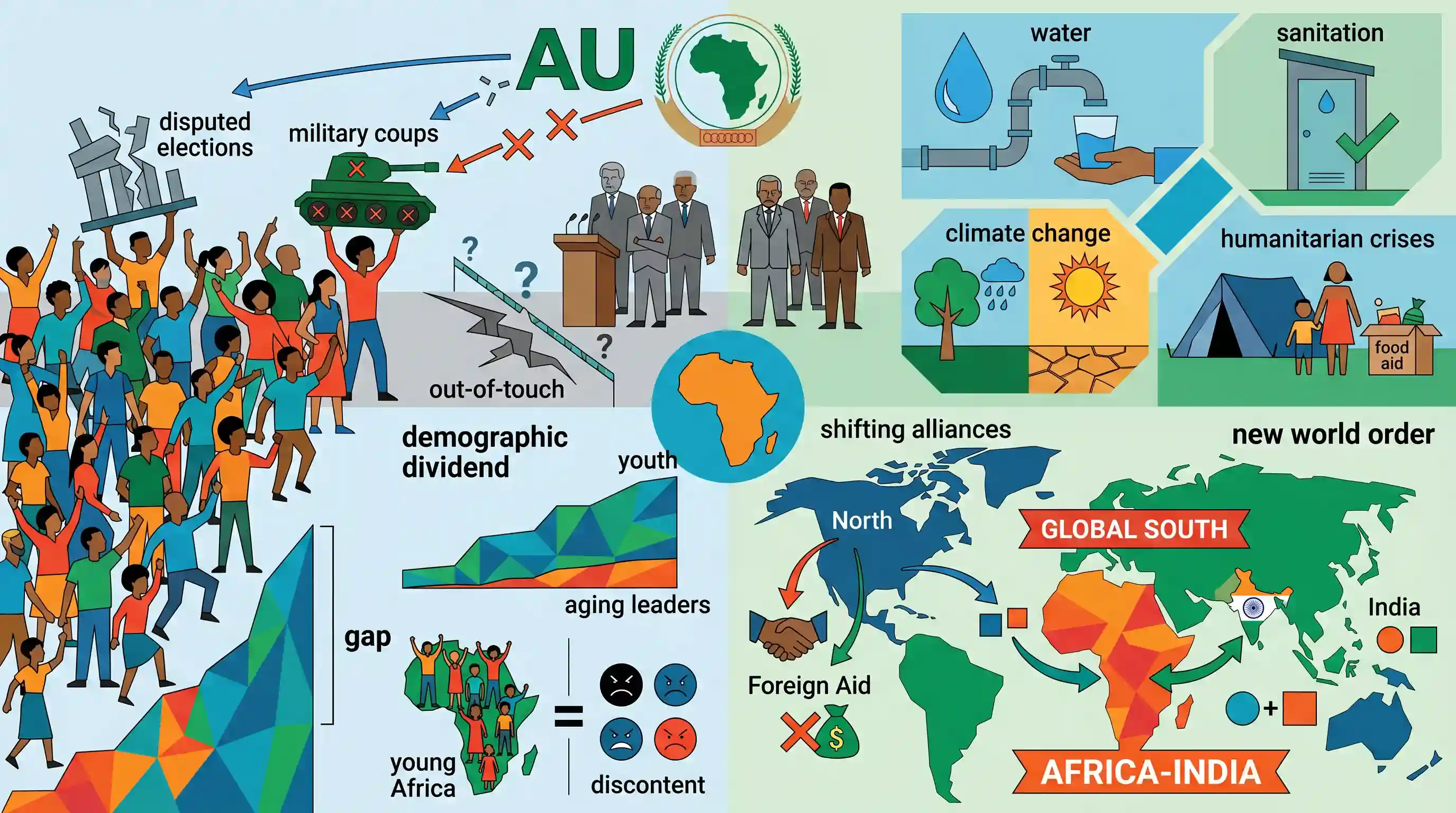
The 39th African Union Summit in Addis Ababa has opened amid growing discontent among Africa's youth, who view the bloc as an out-of-touch group of aging leaders. Despite Africa having the world's youngest population, democratic backsliding, military coups, and disputed elections continue to plague the continent, often drawing weak or delayed responses from the AU. The summit aims to address water and sanitation, climate change, and mounting humanitarian crises, all set against a backdrop of foreign aid cuts and shifting global alliances under a new world order.
Key Points
- The 39th African Union (AU) Summit in Addis Ababa is focusing on water and sanitation, climate change, and humanitarian crises.
- Africa has the world's youngest population (over 400 million aged 15-35), but growing disconnects with aging leadership have fueled protests and military coups.
- The AU is facing a legitimacy crisis, often criticized for failing to condemn flawed elections and democratic backsliding effectively.
- Humanitarian challenges on the continent are being exacerbated by climate change and foreign aid cuts from Western nations, notably the United States.
- Structural weaknesses, including poor enforcement of resolutions and unpaid member dues, continue to undermine the AU's influence in global governance.
Important Terms
African Union (AU)

A continental body consisting of 55 member states of the African continent, launched in 2002 to promote regional integration, peace, and socio-economic development under 'Agenda 2063'.
UPSC context
GS Paper II (International Relations); critical for India-Africa relations and study of regional blocs in global governance.
African Union Commission (AUC)
The executive and administrative arm of the AU, based in Addis Ababa; it initiates proposals, implements decisions, and manages the Union's day-to-day operations and budget.
UPSC context
GS Paper II (International Relations); tests understanding of the institutional framework and functional secretariats of major international organizations.
Global South
A broad term for developing nations in Africa, Asia, and Latin America, characterized by shared colonial histories, economic challenges, and a push for inclusive global governance.
UPSC context
GS Paper II (International Relations); central to India's foreign policy as a self-styled leader and 'voice' of developing nations.
Democratic Backsliding
The gradual decline in the quality of democratic institutions, processes, and norms (like free elections or rule of law), often shifting a state toward hybrid or autocratic rule.
UPSC context
GS Paper II (Governance/Polity); relevant for analyzing global trends in constitutionalism and threats to democratic stability.
International Crisis Group (ICG)
An independent, non-profit NGO founded in 1995 that provides field-based analysis and high-level advocacy to prevent and resolve deadly global conflicts.
UPSC context
GS Paper II (International Relations); highlights the role of non-state actors and think tanks in conflict resolution and peace-building.
Prelims Trap
"The African Union is the only regional bloc to hold full membership status in the G20."
Aspirants often forget that the European Union (EU) has been a full G20 member since inception, making the AU the *second* regional bloc included.
Static Concepts Connected
What is the core institutional architecture of the African Union?
- The Assembly: The supreme policy-making organ comprising Heads of State and Government from all member countries.
- Peace & Security Council: The standing decision-making organ responsible for conflict prevention, management, and resolution across the continent.
- Agenda 2063: The AU's strategic master plan for transforming Africa into the global powerhouse of the future.
What are the structural requirements to harness a demographic dividend?
- Human Capital: Targeted investments in qualitative healthcare, primary education, and future-ready skill development.
- Job Creation: Economic policies fostering industrial and service-sector growth to absorb the surging youth labor force.
- Political Stability: Inclusive governance and institutional trust to prevent youth alienation, democratic backsliding, and civil unrest.
Cross-Topic Patterns
Global South + G20 Integration
Western aid cuts emphasize the need for alternative Global South frameworks. India's recent push for the AU's G20 entry aims to institutionalize Africa's voice in global multilateral financing and governance.
Sahel Instability + Geography Mapping
The democratic backsliding and military coups fueling the AU's crisis are concentrated in the Sahel (Mali, Niger, Burkina Faso), making this a recurring Prelims mapping and resource-security hotspot.

Expect a 2026 multi-statement Prelims question combining the AU’s Agenda 2063, its recent G20 admission, and mapping of Sahel region coups.
Linked PYQs · 3
Linked PYQs · 3
- 2021MainsGS2
If the last few decades were of Asia's growth story, the next few are expected to be of Africa's.” In the light of this statement, examine India's influence in Africa in recent years.
- 2016MainsGS2
Demographic Dividend in India will remain only theoretical unless our manpower becomes more educated, aware, skilled and creative." What measures have been taken by the government to enhance the capacity of our population to be more productive and employable?
- 2024MainsGS3
The world is facing an acute shortage of clean and safe freshwater. What are the alternative technologies which can solve this crisis? Briefly discuss any three such technologies citing their key merits and demerits.
