India Africa Ties: Central Place in Modern Foreign Policy
Source:The Hindu ↗
Why It Matters
India's evolving partnership with Africa is a persistent theme in UPSC Mains GS-2, particularly regarding South-South cooperation, global governance reform, and strategic competition. The formal inclusion of the African Union in the G20 and the upcoming IAFS-IV are high-probability areas for questions on India's leadership in the Global South and its diplomatic footprint in Africa.
Summary
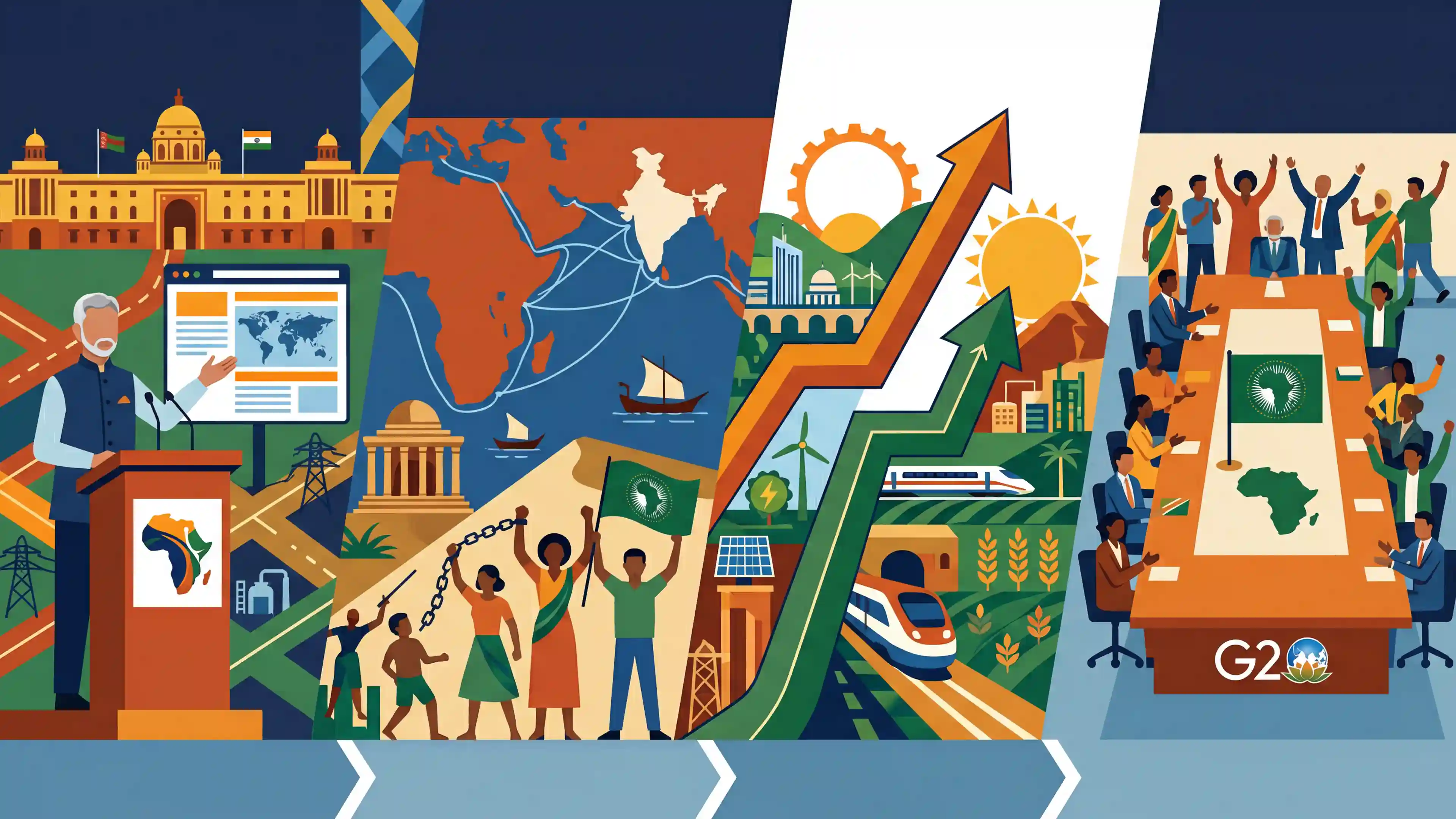
External Affairs Minister S. Jaishankar recently launched the official logo, theme, and website for the fourth India-Africa Forum Summit (IAFS-IV), underscoring that Africa occupies a central place in India's contemporary foreign policy. He emphasized that the partnership is a natural alliance built upon civilizational ties, a shared history of combating colonialism, and mutual developmental aspirations. Specifically, India's long-term vision 'Viksit Bharat 2047' and Africa's 'Agenda 2063' are deeply complementary. Furthermore, Jaishankar highlighted India's continuous support for a more equitable global governance structure that includes Africa, noting the successful inclusion of the African Union into the G20 under India's presidency as a key achievement for amplifying the voice of the Global South.
Key Points
- External Affairs Minister S. Jaishankar launched the logo, theme, and website for the upcoming India-Africa Forum Summit IV (IAFS-IV), emphasizing Africa's central role in India's foreign policy.
- The partnership between India and Africa is described as a 'natural one', rooted in civilizational linkages and shared historical struggles against colonialism.
- The development visions of both regions—India's 'Viksit Bharat 2047' and Africa's 'Agenda 2063'—are complementary and reflect shared developmental goals.
- India advocates for Africa's rightful place in global governance, highlighting the historic inclusion of the African Union (AU) in the G20 during India's presidency as a significant milestone for Global South representation.
Important Terms
Agenda 2063

The African Union’s 50-year strategic blueprint (2013–2063) for transforming Africa into a peaceful, integrated, and prosperous global powerhouse through sustainable development and economic integration.
UPSC context
GS Paper-II (International Relations); relevant for India-Africa synergy and Global South leadership.
Viksit Bharat 2047
The Government of India’s roadmap to transform the nation into a developed country by 2047, focusing on economic growth, social progress, and environmental sustainability.
UPSC context
GS Paper-III (Economy/Development); represents India’s long-term developmental goals and global aspirations.
African Union (AU)
A continental organization of 55 member states established in 2002 to promote unity, economic integration, and peace across Africa, succeeding the Organization of African Unity.
UPSC context
GS Paper-II (International Relations); key partner for India and newly admitted G20 permanent member.
India-Africa Forum Summit (IAFS)
The apex institutional mechanism for official African-Indian relations, facilitating multi-level dialogue on trade, security, and capacity building since its inception in 2008.
UPSC context
GS Paper-II (Bilateral Groupings); tests knowledge of South-South cooperation and India's diplomatic outreach.
G20
An international forum of 19 countries, the EU, and the AU, representing the world's major economies to coordinate policy on global financial and developmental issues.
UPSC context
GS Paper-II (Multilateral Institutions); focuses on India's presidency achievements and global governance reforms.
Prelims Trap
Agenda 2063 is a UN-led climate resilience and sustainable development framework for the Global South.
Agenda 2063 is the African Union's indigenous 50-year strategic framework for economic and political transformation, not a UN-led climate or development initiative.
Static Concepts Connected
What is the structural composition and mandate of the African Union?
- Formation: Established in 2002 to replace the Organisation of African Unity (OAU), aiming to accelerate the political and economic integration of the continent.
- Membership: Comprises 55 member states, representing all countries on the African continent, with its secretariat based in Addis Ababa, Ethiopia.
- AfCFTA Integration: Spearheaded the African Continental Free Trade Area (AfCFTA), creating the world's largest free trade area by the number of participating countries.
How does the India-Africa Forum Summit (IAFS) operate institutionally?
- Apex Platform: It is the official, highest-level platform for India-Africa relations, traditionally held every three years alternating between India and Africa.
- Representation Shift: IAFS-I and II used the 'Banjul Formula' (inviting only 15 African nations), but since IAFS-III (2015), India invites all 54/55 African countries.
Cross-Topic Patterns
Agenda 2063 + Critical Mineral Security
India's KABIL relies on African resource diplomacy to secure critical minerals, directly tying Agenda 2063's value-addition goals to India's clean energy transition.
G20 Expansion & Ezulwini Consensus
The AU's G20 entry strengthens the 'Ezulwini Consensus'—Africa's demand for permanent UNSC seats—which perfectly mirrors and reinforces India's push for global governance reform.

Expect a multi-statement Prelims question in 2026 linking AU's G20 entry, Agenda 2063, and the shift from the Banjul Formula in IAFS.
Linked PYQs · 4
Linked PYQs · 4
- 2021MainsGS2
If the last few decades were of Asia's growth story, the next few are expected to be of Africa's.” In the light of this statement, examine India's influence in Africa in recent years.
- 2015MainsGS2
Increasing interest of India in Africa has its pros and cons. Critically examine.
- 2025MainsGS2
India-Africa digital partnership is achieving mutual respect, co-development and long-term institutional partnerships. Elaborate.
- 2016PrelimsGS1
Consider the following statements: The India-Africa Summit 1. held in 2015 was the third such Summit 2. was actually initiated by Jawaharlal Nehru in 1951 Which of the statements given above is/are correct?
