Pakistan state sponsored terrorism blowback and Afghan border war
Source:Indian Express ↗
Why It Matters
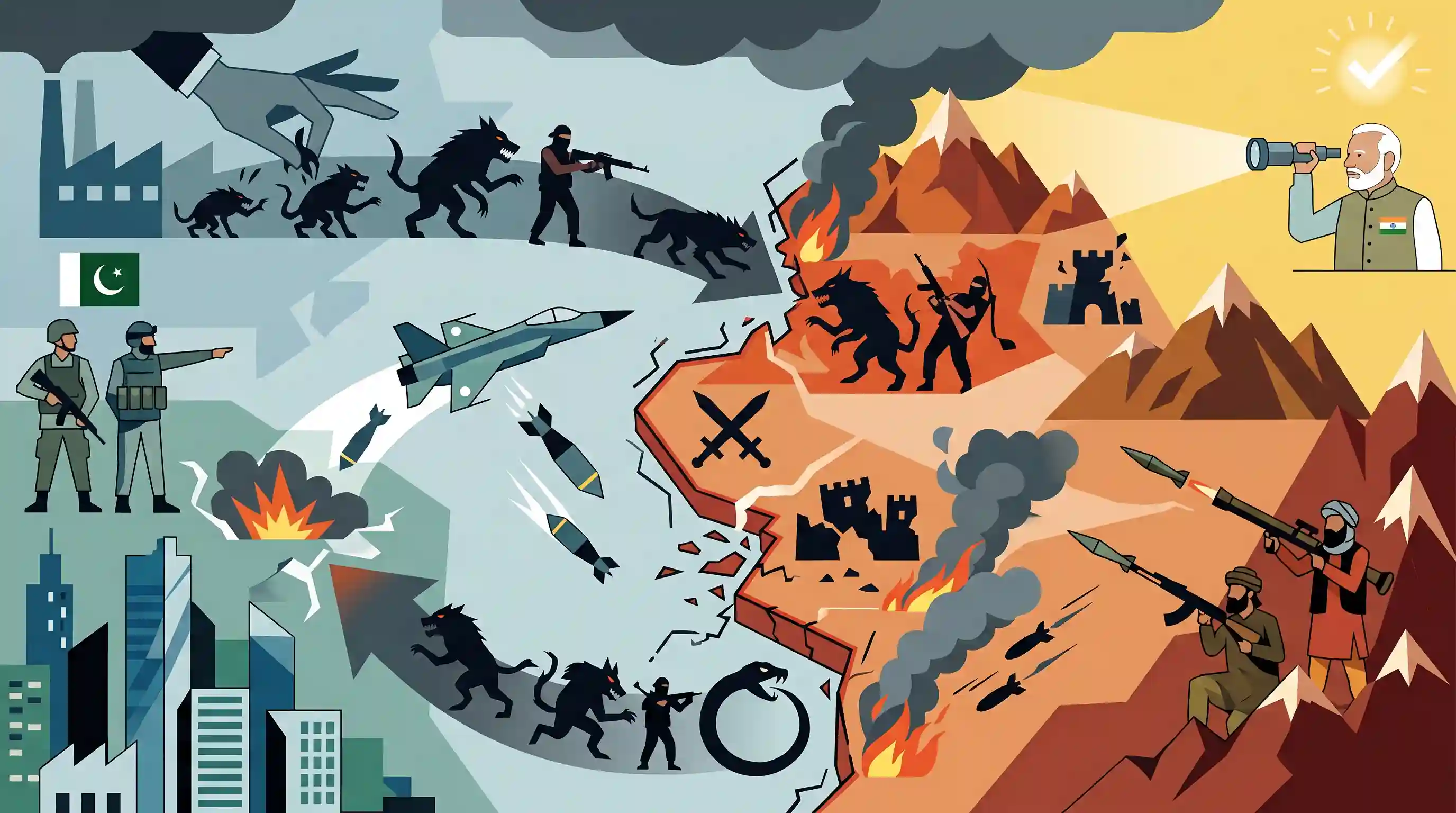
It provides a real-world case study on the inevitable blowback of state-sponsored terrorism and the deployment of non-state actors as proxies. Understanding this dynamic is crucial for aspirants answering questions on regional geopolitics, border security, and India's strategic neighbourhood policy.
Summary
The article analyzes the escalating border conflict and 'open war' dynamics between Pakistan and Taliban-ruled Afghanistan. Pakistan’s historical strategy of nurturing terrorist groups for strategic depth has resulted in massive blowback, as the Tehrik-i-Taliban Pakistan (TTP) utilizes Afghan soil to mount attacks within Pakistan. In response, the Pakistani military establishment (Rawalpindi) has resorted to cross-border airstrikes, triggering direct armed retaliation from the Afghan Taliban. This cycle of violence highlights the failure of Pakistan’s proxy warfare and state-sponsored terrorism. The deteriorating Af-Pak relationship presents substantial regional security concerns, indirectly impacting India by validating its warnings on cross-border terrorism while keeping the geopolitical neighbourhood highly volatile.
Key Points
- Pakistan's long-standing policy of cultivating the Afghan Taliban to secure 'strategic depth' has backfired severely, creating an unmanageable border crisis.
- The Tehrik-i-Taliban Pakistan (TTP) has capitalized on safe havens in Taliban-ruled Afghanistan to launch intensifying cross-border terror attacks against the Pakistani state.
- Retaliatory airstrikes by the Pakistani military inside Afghan territory have led to direct armed clashes and an 'open war' scenario along the disputed Durand Line.
- The escalating situation exposes the inherent blowback of state-sponsored terrorism and the use of non-state actors as proxies—a concern India has repeatedly raised globally.
- This regional volatility distracts the Pakistani military establishment but also risks broader instability in India's immediate neighbourhood.
Important Terms
Tehrik-i-Taliban Pakistan (TTP)

An umbrella organization of various militant groups founded in 2007, aiming to overthrow the Pakistani state and enforce Sharia law. It operates primarily along the porous Afghanistan-Pakistan border.
UPSC context
GS Paper 3: Internal Security. Tests understanding of non-state actors and cross-border security challenges affecting regional stability.
Afghan Taliban
A Sunni Deobandi nationalistic movement that ruled Afghanistan (1996–2001) and returned to power in August 2021. It maintains complex ideological ties with the TTP despite pressure from Pakistan.
UPSC context
GS Paper 2: India and its neighborhood-relations. Tests knowledge of external state actors and their impact on India's interests.
Rawalpindi (Pakistan Military)
A metonym for the Pakistan military establishment, headquartered in Rawalpindi. It historically dictates Pakistan's foreign and security policies, particularly concerning Afghanistan and India.
UPSC context
GS Paper 2: International Relations. Analyzes the role of military establishments in shaping neighborhood diplomacy and regional volatility.
Strategic Depth
A Pakistani military doctrine seeking a friendly or subservient Afghan government to provide a 'buffer' or fallback zone in the event of a conventional war with India.
UPSC context
GS Paper 2: International Relations. Crucial for understanding Pakistan's geopolitical motives and the failure of proxy warfare strategies.
Durand Line
The 2,640 km boundary between Afghanistan and Pakistan, established in 1893. Afghanistan has historically refused to recognize it as an international border, leading to frequent skirmishes.
UPSC context
GS Paper 2: India and its neighborhood. A key historical flashpoint for border management and sovereignty disputes in South Asia.
Proxy Warfare
The use of third-party militants (proxies) by a state to achieve strategic goals without engaging in direct conventional warfare. Pakistan's use of the Taliban is a primary example.
UPSC context
GS Paper 3: Internal Security. Tests ability to analyze non-traditional security threats and the blowback of state-sponsored militancy.
Prelims Trap
The Durand Line is an internationally recognized boundary that is mutually accepted by Afghanistan and Pakistan.
Afghanistan (including the Taliban) has historically rejected the 1893 Durand Line as an arbitrary colonial imposition dividing ethnic Pashtuns, fueling ongoing border clashes.
Static Concepts Connected
What is Pakistan's 'Strategic Depth' doctrine regarding Afghanistan?
- Military Fallback: Formulated by the military to counter India's conventional superiority by securing a territorial retreat space in Afghanistan.
- Pliant Regime: Aimed to install a pliant, pro-Pakistan proxy government in Kabul to secure its western flank and prevent Indian encirclement.
- Proxy Reliance: Relied heavily on cultivating non-state actors like the Afghan Taliban to maintain geopolitical leverage over Afghan territory.
How does the 'Blowback Effect' operate in proxy warfare?
- Asymmetric Warfare: Sovereign states sponsor and harbor militant proxies to wage deniable, low-cost asymmetric warfare against regional adversaries.
- Unintended Consequences: Non-state proxies eventually develop independent political or radical agendas, turning their weapons against their original state sponsors.
- TTP Example: The Tehrik-i-Taliban Pakistan (TTP) utilizing Afghan safe havens to systematically attack the Pakistani state perfectly exemplifies this phenomenon.
Cross-Topic Patterns
Colonial Cartography & Ethnic Conflict
The Durand Line dispute mirrors the Radcliffe and McMahon lines, illustrating how arbitrary British borders divided ethnic communities (like the Pashtuns), embedding chronic geopolitical volatility in South Asia.
Global Counter-Terrorism Frameworks
Pakistan's proxy crisis bolsters India's long-standing diplomatic push at the UN for the Comprehensive Convention on International Terrorism (CCIT) and justifies stringent FATF monitoring.

Mains 2026 could feature a 15-marker on how the failure of Pakistan’s 'Strategic Depth' doctrine impacts India’s internal security matrix.
Linked PYQs · 3
Linked PYQs · 3
- 2021MainsGS3
Analyse the multidimensional challenges posed by external state and non-state actors, to the internal security of India. Also discuss measures required to be taken to combat these threats.
- 2016MainsGS2
Increasing cross-border terrorist attacks in India and growing interference in the internal affairs of several member-states by Pakistan are not conducive for the future of SAARC (South Asian Association for Regional Cooperation)." Explain with suitable examples.
- 2022PrelimsGS1
Consider the following countries: 1. Azerbaijan 2. Kyrgyzstan 3. Tajikistan 4. Turkmenistan 5. Uzbekistan Which of the above have borders with Afghanistan ?
