Border Clashes Escalate Tensions Between Afghanistan and Pakistan
Source:Indian Express ↗
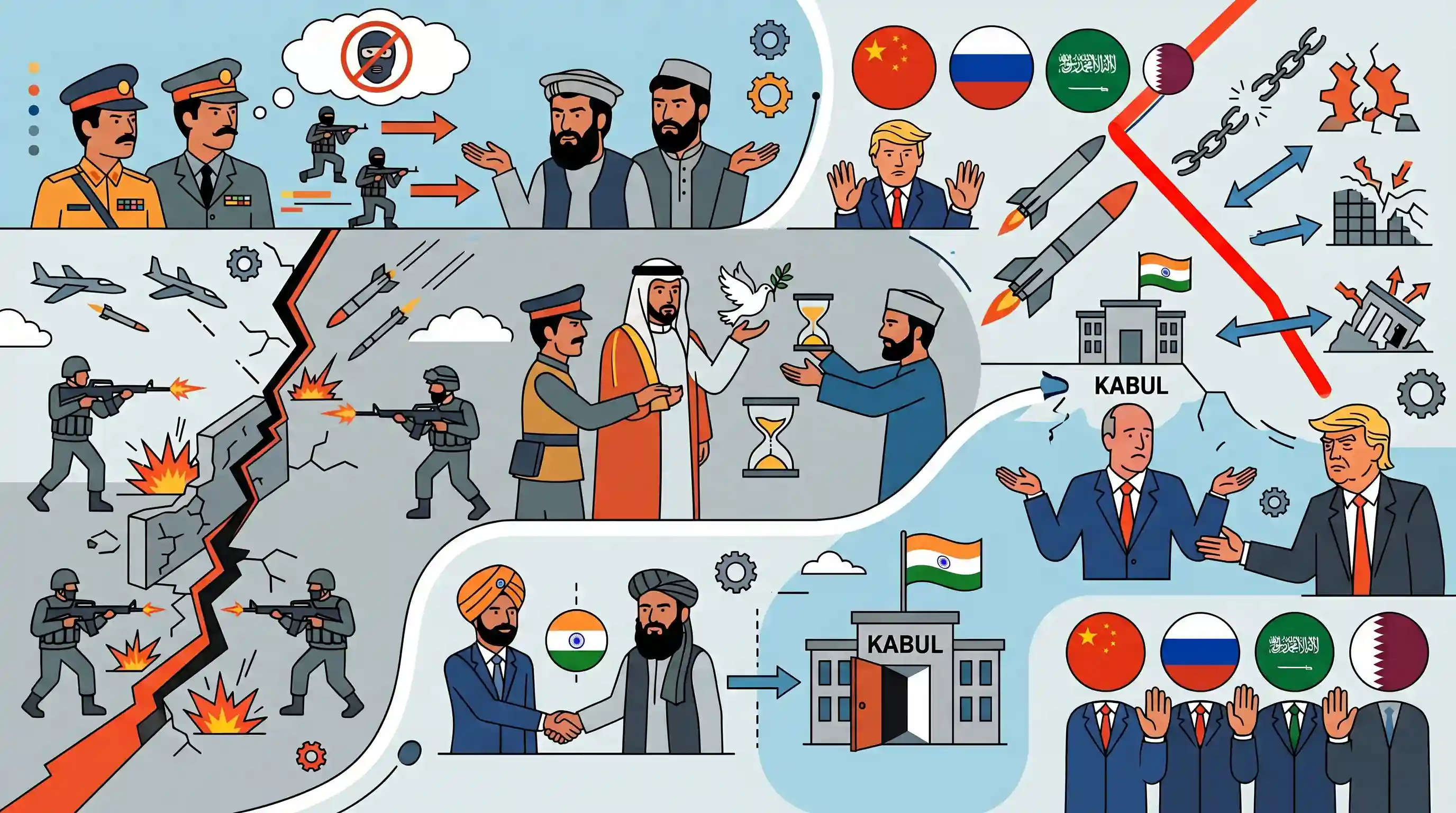
Why It Matters
The escalation of violence between Pakistan and Afghanistan threatens regional stability in South Asia. Concurrently, India's parallel diplomatic engagement with the Taliban—highlighted by the reopening of the Kabul embassy—indicates a significant strategic shift in Indian foreign policy to secure its regional interests amidst shifting alliances.
Summary
Deadly border clashes and airstrikes have sharply escalated tensions between Afghanistan and Pakistan. Pakistan claims Afghanistan is harboring the Pakistani Taliban (TTP) and serving as a base for terrorism, which the Taliban firmly denies. Retaliatory strikes occurred near border areas before Qatar and Saudi Arabia mediated a temporary ceasefire. Concurrently, Taliban Foreign Minister Amir Khan Muttaqi visited India, leading to the strategic announcement that India will reopen its embassy in Kabul. The geopolitical fallout has prompted calls for restraint from China, Russia, Saudi Arabia, and Qatar, with Donald Trump also offering to mediate the conflict. Analysts warn that strikes within Kabul could cross a "red line" with long-term regional consequences.
Key Points
- Afghanistan and Pakistan engaged in deadly border clashes, featuring alleged Pakistani airstrikes in Kabul and Paktika, and Taliban retaliatory strikes in border regions.
- Pakistan accuses the Taliban of providing a safe haven for the Pakistani Taliban (TTP) to launch cross-border terrorist attacks, a claim the Taliban denies.
- Qatar and Saudi Arabia successfully mediated a temporary halt to the hostilities, preventing further immediate escalation.
- Amid the regional turmoil, Taliban Foreign Minister Amir Khan Muttaqi visited India, coinciding with India's announcement to reopen its embassy in Kabul.
- Global powers, including China, Russia, and the US (with Donald Trump offering to mediate), have urged restraint to preserve stability in South Asia.
Important Terms
Taliban

A Sunni Islamist movement and the de facto governing authority of Afghanistan since 2021. It enforces a strict interpretation of Sharia law and faces limited international diplomatic recognition.
UPSC context
GS Paper II: India’s ‘pragmatic engagement’ policy, neighborhood relations, and the security implications of the ‘Kabul-Delhi’ diplomatic reopening.
Pakistani Taliban (TTP)
An umbrella militant group based along the Afghan-Pakistani border seeking to overthrow the Pakistani state. While ideologically aligned with the Afghan Taliban, it remains a distinct organizational entity.
UPSC context
GS Paper III: Internal security, cross-border terrorism, and the impact of non-state actors on regional stability.
Durand Line
The 2,640-km international boundary between Afghanistan and Pakistan, established in 1893. Afghanistan historically disputes its legitimacy, while Pakistan recognizes it as the official border.
UPSC context
GS Paper I/II: Historical boundaries, colonial legacy, and primary source of bilateral friction in South Asian geopolitics.
ACLED
The Armed Conflict Location & Event Data Project is a global non-profit that provides disaggregated, real-time data on political violence and protest events worldwide.
UPSC context
GS Paper III: Security data analysis, evidence-based reporting on global conflict trends, and tracking internal disturbances.
International Institute for Strategic Studies (IISS)
A UK-based global think tank specializing in defense and security. It is renowned for the 'Military Balance' report and the Shangri-La Dialogue security summit.
UPSC context
GS Paper II: Role of global institutions and think tanks in shaping international defense policy and security dialogues.
Cross-border Terrorism
The use of territory in one country to plan and launch terrorist attacks in another, often involving state-sponsored or sheltered non-state actors.
UPSC context
GS Paper III: Core internal security challenge and a recurring theme in India’s diplomatic outreach and counter-terrorism doctrine.
Prelims Trap
"India's reopening of its Kabul embassy signifies its formal diplomatic recognition of the Taliban regime."
India reopening its embassy is a pragmatic step for functional engagement and humanitarian aid, but it does NOT constitute formal or 'de jure' diplomatic recognition of the Taliban government.
Static Concepts Connected
What is the historical context of the Durand Line dispute?
- Colonial Origin: The 2,640-km boundary established in 1893 between British India (Mortimer Durand) and Afghan Amir Abdur Rahman Khan.
- Afghan Rejection: Afghanistan has historically refused to recognize the line, claiming it artificially divides the ethnic Pashtun and Baloch populations.
- Modern Flashpoint: Pakistan's recent efforts to fence the porous border have led to repeated military clashes and exacerbated the presence of cross-border sanctuaries.
What is Pakistan's "Strategic Depth" doctrine?
- Core Objective: A military doctrine seeking a friendly or subservient regime in Kabul to provide a geographic and strategic fallback against an Indian military offensive.
- Proxy Support: Pakistan historically backed militant proxies, including the Taliban, to ensure a pro-Islamabad government and deny India influence in Afghanistan.
- Doctrine Collapse: The current Af-Pak border clashes and TTP attacks from Afghan soil highlight the blowback and functional collapse of this decades-old policy.
Cross-Topic Patterns
Colonial border disputes: Durand vs McMahon
The Durand Line dispute parallels India's own colonial-era border issues (Radcliffe, McMahon, Johnson lines). UPSC often tests these disputed frontiers comparatively in Geography and IR.
Qatar's rise as a global mediator
Qatar's success in brokering the Af-Pak ceasefire mirrors its role in the US-Taliban agreement and Israel-Hamas talks, cementing its status as a critical 'middle power' mediator in Asian geopolitics.
India's shift to Pragmatic Realism
India shifting from mere 'soft power' in a democratic Afghanistan to engaging the Taliban to protect investments highlights a pivot toward pragmatic strategic autonomy to counter Sino-Pak influence.

Durand line geography + India's de facto engagement vs de jure recognition of the Taliban will likely form mixed 2026 Prelims statements.
Linked PYQs · 3
Linked PYQs · 3
- 2016MainsGS2
Increasing cross-border terrorist attacks in India and growing interference in the internal affairs of several member-states by Pakistan are not conducive for the future of SAARC (South Asian Association for Regional Cooperation)." Explain with suitable examples.
- 2024MainsGS2
‘Terrorism has become a significant threat to global peace and security.’ Evaluate the effectiveness of the United Nations Security Council's Counter Terrorism Committee (CTC) and its associated bodies in addressing and mitigating this threat at the international level.
- 2015MainsGS2
Terrorist activities and mutual distrust have clouded India-Pakistan relations. To what extent the use of soft power like sports and cultural exchanges could help generate goodwill between the two countries? Discuss with suitable examples.
